2010 Nobel Prize in Physics Announcement
Transcript
Read and summarize the transcript of this video on Glasp Reader (beta).
Install to Summarize YouTube Videos and Get Transcripts
Explore YouTube Video Summarizer or Get YouTube Transcript Extractor
Summary
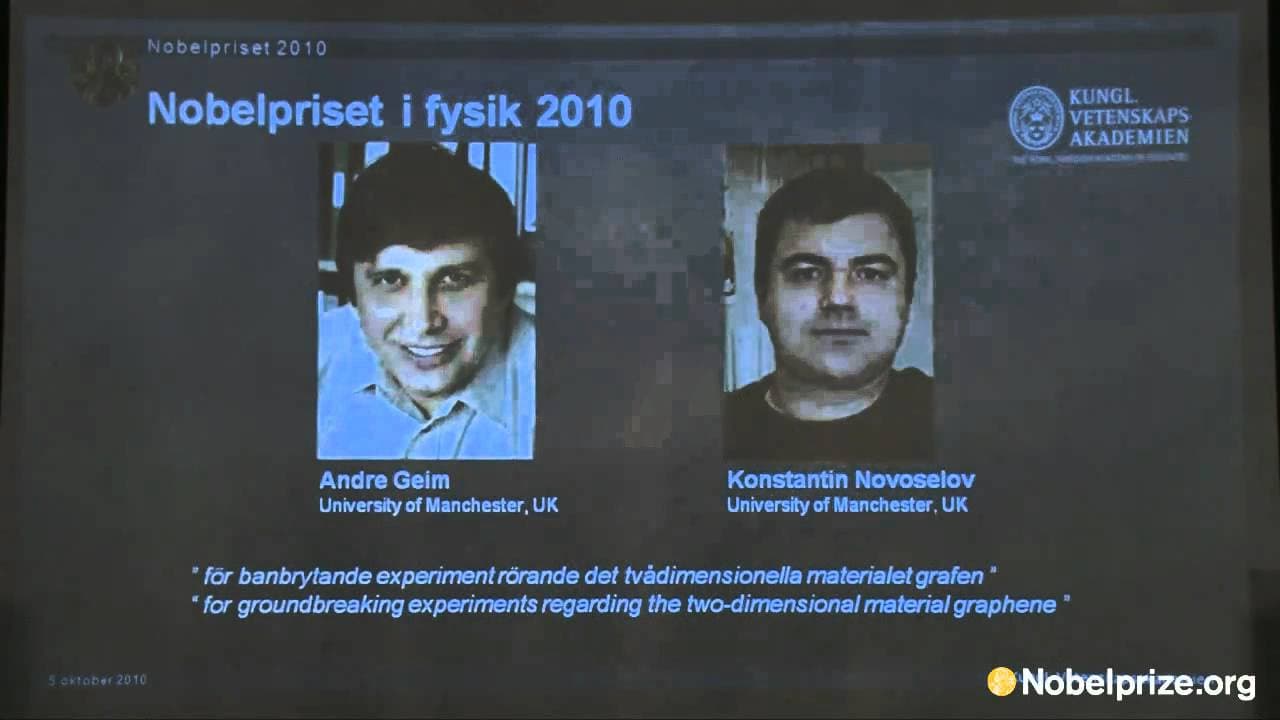
This press conference announces the winners of the 2010 Nobel Prize in Physics, Professor Andre Geim and Professor Konstantin Novoselov, for their groundbreaking experiments on the two-dimensional material graphene.
Questions & Answers
Q: What is the significance of winning the Nobel Prize in Physics?
Winning the Nobel Prize in Physics is a prestigious recognition of an individual's outstanding and impactful contributions to the field. It signifies that the recipient's work has made significant advancements, pushing the boundaries of scientific knowledge.
Q: What are the amazing properties of graphene?
Graphene, a two-dimensional material, possesses a range of remarkable properties that have captivated researchers and scientists. Its exceptional strength, unparalleled electrical conductivity, and thermal stability make it a highly sought-after substance for various applications, such as electronics, energy storage, and material science.
Q: Can you explain Professor Andre Geim's contribution to the field of graphene research?
Professor Andre Geim, alongside Professor Konstantin Novoselov, played a pivotal role in the discovery and exploration of graphene. Geim's contributions include the successful isolation of graphene using a method called micromechanical cleavage. This breakthrough allowed for the study of graphene's unique properties, opening up a new avenue of research in material science.
Q: What are the groundbreaking experiments conducted by Professor Konstantin Novoselov?
Professor Konstantin Novoselov's experiments involved the systematic investigation of graphene's properties and its potential applications. He conducted various experiments to elucidate the electrical, thermal, and mechanical properties of graphene, leading to a comprehensive understanding of its behavior at the atomic level.
Q: How has the discovery of graphene impacted the field of material science?
The discovery of graphene has revolutionized the field of material science. Its exceptional properties have paved the way for numerous technological advancements. Graphene-based materials are being explored for applications in electronics, optoelectronics, energy storage, and biomedicine. It has the potential to revolutionize various industries and lead to the development of advanced and efficient devices.
Q: Could you provide specific examples of graphene's practical applications?
Graphene has shown promise in various practical applications. For instance, in electronics, graphene's exceptional electrical conductivity could lead to the development of high-speed transistors and flexible electronic devices. Its impermeability to gases makes it suitable for applications in filtration and membrane technology. Additionally, graphene-based composites have shown improved strength and flexibility, making them ideal for lightweight and durable materials in aerospace and automotive industries.
Q: How has the discovery of graphene impacted the scientific community?
The discovery of graphene has created a paradigm shift in the scientific community. It has stimulated a surge of research in two-dimensional materials, leading to the exploration and discovery of other fascinating substances with unique properties. It has fostered collaborations among researchers, pushing the boundaries of our understanding of materials and inspiring new avenues for scientific exploration.
Q: What are the future prospects for graphene research?
The future prospects for graphene research are promising. Scientists are continually investigating new methods for large-scale production of graphene and exploring ways to optimize its properties for practical applications. Further research and development efforts aim to overcome challenges associated with integration into existing technologies, paving the way for the commercialization of graphene-based products.
Q: How do these Nobel laureates' accomplishments inspire the next generation of scientists?
These Nobel laureates' accomplishments serve as an inspiration for the next generation of scientists. Their groundbreaking work showcases the power of curiosity and dedication to push the boundaries of scientific knowledge. Their success stories remind aspiring researchers that a single discovery or breakthrough can have profound and lasting impacts on society, and that perseverance and passion are key in making significant contributions to their respective fields.
Q: In what ways has the Nobel Prize in Physics boosted the recognition and understanding of graphene?
The Nobel Prize in Physics has played a significant role in boosting the recognition and understanding of graphene. The global recognition of this prestigious award has brought graphene to the forefront of scientific discussions and public awareness. It has increased funding and support for graphene research, allowing scientists to delve deeper into its potential and accelerate technological advancements in this field.
Takeaways
The Nobel Prize in Physics awarded to Professor Andre Geim and Professor Konstantin Novoselov for their groundbreaking experiments on graphene highlights the exceptional properties and potential applications of this two-dimensional material. Their work has not only advanced our understanding of graphene but also inspired a new wave of research in material science. Graphene's unique properties and versatility hold great promise for revolutionizing various industries, ranging from electronics to aerospace. The recognition and support garnered from the Nobel Prize further fuel the exploration and development of graphene-based technologies, making it an exciting area of research for the future.
Read in Other Languages (beta)
Share This Summary 📚
Summarize YouTube Videos and Get Video Transcripts with 1-Click
Try YouTube Summary with ChatGPT & Claude or YouTube Transcript Generator
Explore More Summaries from Nobel Prize 📚






Summarize YouTube Videos and Get Video Transcripts with 1-Click
Try YouTube Summary with ChatGPT & Claude or YouTube Transcript Generator