Frances H. Arnold: Nobel Lecture in Chemistry 2018
TL;DR
Enzymes are evolved through a process of mutation and selection to acquire new functions and tolerate new environments. The approach combines exploring a vast protein space with careful, iterative mutations and occasional recombination to optimize performance, producing biocatalysts for sustainable chemistry and industrial use.
Transcript
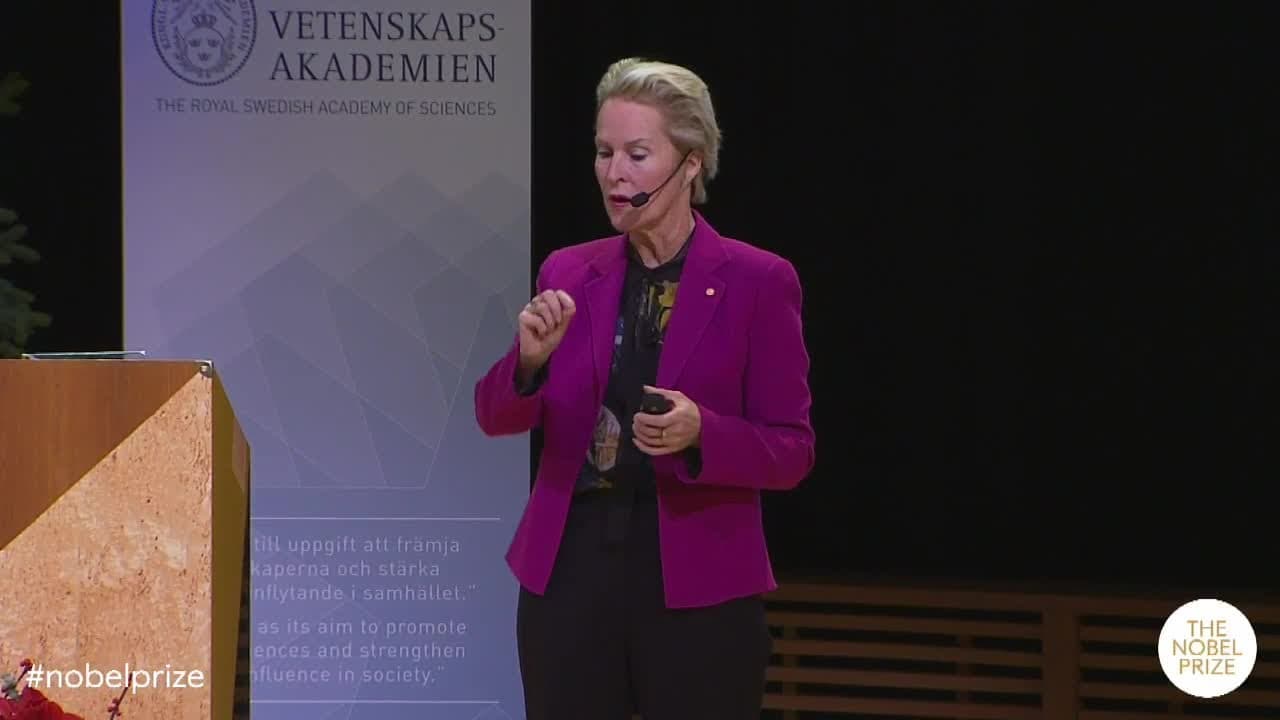
Francis Arnold was born in 1956 in Pittsburgh United States she got her PhD in 1985 at the University of California at Berkeley she is now active as a professor at California Institute of Technology in Pasadena also in California Francis Arnold pioneered directed evolution of enzymes she used her engineering skills to make this method a most versat... Read More
Key Insights
- Enzymes are molecular machines that catalyze most reactions in living systems and can be engineered for new tasks.
- Directed evolution uses mutation and selection to optimize enzyme performance for new environments and functions.
- The search space of possible proteins is enormous, requiring smart strategies to find functional variants.
- Functional proteins are distributed in sequence space such that neighbors differ by one mutation, enabling evolutionary walking.
- A fitness landscape models enzyme performance and guides optimization over generations.
- Early work showed enzymes could function in non natural environments with few mutations.
- Recombination (DNA shuffling) expands diversity beyond single mutations, accelerating improvement.
- A simple, iterative framework lets engineers develop biocatalysts that address sustainability and manufacturing needs.
- More videos from this channel:
- More from this channel: Nobel Prize
Install to Summarize YouTube Videos and Get Transcripts
Explore YouTube Video Summarizer or Get YouTube Transcript Extractor
Questions & Answers
Q: What is directed evolution and how does it relate to enzyme engineering?
Directed evolution is an experimental process that mimics natural evolution to improve enzymes for new jobs or environments. It involves introducing mutations, screening or selecting variants for better performance, and iterating over generations. This approach leverages two key ideas: a fitness landscape to guide optimization and the network of functional proteins that allows evolution to move through sequence space.
Q: Why is the space of possible proteins described as vast and difficult to search?
The space of possible proteins is enormous because a single mutation can create thousands of possibilities and combinations grow exponentially with multiple mutations. Most random sequences are non functional gibberish, so researchers must refine their search strategies and start from a rational starting point to find functional variants efficiently.
Q: How does John Maynard Smith’s concept influence protein evolution experiments?
Maynard Smith argued that functional proteins must be distributed in sequence space so that each functional protein has neighboring functional variants connected by single mutations. This arrangement enables evolution to walk from one functional protein to others, providing a path for adaptation and optimization across generations.
Q: What role does the fitness landscape play in enzyme optimization?
The fitness landscape assigns a performance value to each enzyme variant. If the landscape is navigable, simple optimization by accumulating beneficial mutations can reoptimize an enzyme for a new job. This concept guides experimental design, helping researchers decide how many mutations to test and when to combine them.
Q: What is the significance of recombination in directed evolution?
Recombination, or DNA shuffling, mixes genetic material from different variants to create diverse offspring. This increases the chance of discovering high performing enzymes by combining favorable mutations from separate lineages, effectively accelerating the search through sequence space beyond single mutations.
Q: How has directed evolution impacted real-world applications?
Directed evolution has produced enzymes used in laundry detergents and pharmaceutical manufacturing, among other industries. By providing a simple, adaptable framework, researchers have enabled widespread adoption of biocatalysts for sustainable and cleaner chemical processes.
Q: What challenges must be overcome when evolving enzymes for new functions?
A major challenge is maintaining function while exploring new sequence space. Many mutations are deleterious, so researchers must test small, carefully chosen changes and use iterative cycles to accumulate beneficial mutations without losing activity. Starting from a suitable enzyme is also crucial for success.
Q: Why is starting from a good starting point important in directed evolution?
Choosing a reasonable starting enzyme determines how easily it can be reoptimized for a new function. If the starting point is poorly suited for the new task, the required number of beneficial mutations can be prohibitive. A good starting point increases the likelihood that a few mutations will yield the desired performance.
Summary
In this video, Francis Arnold, a professor at the California Institute of Technology, discusses her work on directed evolution of enzymes. She explains how enzymes are the remarkable molecular machines that catalyze reactions in all living organisms. Arnold describes how she turned to nature's process of evolution to create new enzymes, as there is still much we do not understand about how DNA sequences encode function to reliably design enzymes. She explains her approach of making small mutations in enzymes and iterating over multiple generations to optimize their performance for specific tasks. Arnold shares examples of her work, including creating enzymes for non-natural environments and catalyzing reactions not found in biology. She emphasizes the potential of this technology to bridge the gap between natural and human-invented chemistry, and how it can lead to a more sustainable future by using biological systems to produce fuels and chemicals.
Questions & Answers
Q: What is Francis Arnold's background and area of expertise?
Francis Arnold is a professor at the California Institute of Technology and a pioneer in the field of directed evolution of enzymes. She has a background in engineering and has used her skills to develop this method into a versatile tool for developing biocatalysts for new environments and tasks.
Q: Why did Francis Arnold turn to nature's process of evolution?
Francis Arnold and her fellow protein engineers struggled with the problem of not understanding how DNA sequences encode function, making it difficult to reliably design new enzymes. Therefore, she turned to nature's process of evolution as it is a remarkable diversity-generating machine that creates adaptation, optimization, and innovation. She saw evolution as a way to create new enzymes for specific tasks.
Q: What is the main problem in designing new enzymes?
The main problem in designing new enzymes is not knowing how to reliably encode function through DNA sequences. While we can read and write DNA, we lack the knowledge and understanding of how to compose the intricate "code of life" like Beethoven's symphony. Nature, on the other hand, has the process for creating enzymes encoded in DNA through billions of years of evolution.
Q: How does Francis Arnold approach the optimization of enzymes?
Francis Arnold's approach to enzyme optimization involves making small mutations in enzymes and iterating over multiple generations to accumulate these mutations in a directed evolution process. By carefully measuring the small effects of each mutation and selecting starting points that are different from the desired end product, she can optimize enzyme performance for new tasks and environments.
Q: How does Francis Arnold's optimization process compare to other experiments in the field?
Unlike other experiments that use affinity selection to search through a large number of molecules, Francis Arnold's optimization process requires measuring enzymes one by one due to the limitations of available tools. This means that the optimization process must be carried out carefully and gradually, making small mutations and measuring their effects. Despite this limitation, the process has proven to be valuable and effective.
Q: How does Francis Arnold's work contribute to making the planet a better place?
Francis Arnold's work on directed evolution of enzymes contributes to making the planet a better place by providing a sustainable way to speed up chemical reactions and reduce waste. The enzymes she develops can be used to perform reactions in a cleaner and more efficient manner, reducing the environmental impact of industrial processes. This technology has applications in various industries, such as detergent manufacturing and pharmaceutical production.
Q: How does Francis Arnold's work challenge the notion that enzymes are conservative?
Francis Arnold's work challenges the notion that enzymes are conservative by showing that they have the inherent capability to perform promiscuous reactions and can be evolved to perform new functions. Enzymes already have promiscuous capabilities, and evolution uses them as a fuel for further invention. Through directed evolution, enzymes can be trained to carry out reactions that have not been seen in the biological world, such as creating highly strained carbon cycles or inserting carbon into silicon or boron bonds.
Q: How does Francis Arnold use directed evolution to create enzymes for non-natural environments?
Francis Arnold uses directed evolution to create enzymes for non-natural environments by providing a synthetic environment that emulates the desired conditions. By starting with a donkey enzyme that is well-adapted to its natural environment and making small mutations to it, she can optimize it for the non-natural environment of interest. This process has proven successful in adapting enzymes to work in highly non-natural environments, such as dimethyl formamide.
Q: What is the potential of Francis Arnold's technology to bridge the gap between natural and human-invented chemistry?
Francis Arnold believes that her technology has the potential to bridge the gap between natural and human-invented chemistry by importing human inventions into biological systems. By genetically encoding chemistry, it becomes possible to use the powerful design algorithm of evolution to optimize and innovate chemical reactions. This opens up opportunities to easily implement human-invented chemistry in biological systems and create a more sustainable future.
Q: How does Francis Arnold's work contribute to the toolset of biocatalysis?
Francis Arnold's work on directed evolution of enzymes has contributed greatly to the toolset of biocatalysis. Enzymes created through directed evolution have found applications in various industries, including laundry detergents, pharmaceutical manufacturing, and many others. By providing a simple and versatile framework, her work has enabled researchers worldwide to use directed evolution to create enzymes for specific tasks and environments.
Q: What is the promise of genetically encoding chemistry using Francis Arnold's technology?
The promise of genetically encoding chemistry using Francis Arnold's technology is the ability to easily import human-invented chemical reactions into biological systems. By using the powerful optimization and innovation process of evolution, these reactions can be optimized and improved in a sustainable manner. This technology provides a way to explore and utilize the vast potential of biological systems, leading to a more environmentally friendly and efficient production of fuels and chemicals.
Takeaways
Francis Arnold's work on directed evolution of enzymes provides a revolutionary approach to creating bio catalysts for new environments and tasks. By using nature's evolutionary process, she can optimize existing enzymes and create enzymes for non-natural environments. This technology has wide-ranging applications in various industries and contributes to a more sustainable future. Furthermore, Francis Arnold's work has the potential to bridge the gap between natural and human-invented chemistry by genetically encoding chemistry in biological systems. This opens up possibilities for importing human inventions into the biological world and utilizing the vast potential of biological systems for more efficient and environmentally friendly production of fuels and chemicals.
Summary & Key Takeaways
-
Arnold explains that enzymes are natural molecular machines and that their function arises from evolution, which can be directed to create new capabilities.
-
The method relies on exploring protein sequence space through mutations and selections, using a strategy that preserves beneficial changes while testing new ones across generations.
-
This approach has led to practical enzymes used in detergents, pharmaceuticals, and other industries, demonstrating how engineered biocatalysts can solve human problems while reducing waste.
Read in Other Languages (beta)
Share This Summary 📚
Summarize YouTube Videos and Get Video Transcripts with 1-Click
Try YouTube Summary with ChatGPT & Claude or YouTube Transcript Generator
Explore More Summaries from Nobel Prize 📚


Summarize YouTube Videos and Get Video Transcripts with 1-Click
Try YouTube Summary with ChatGPT & Claude or YouTube Transcript Generator