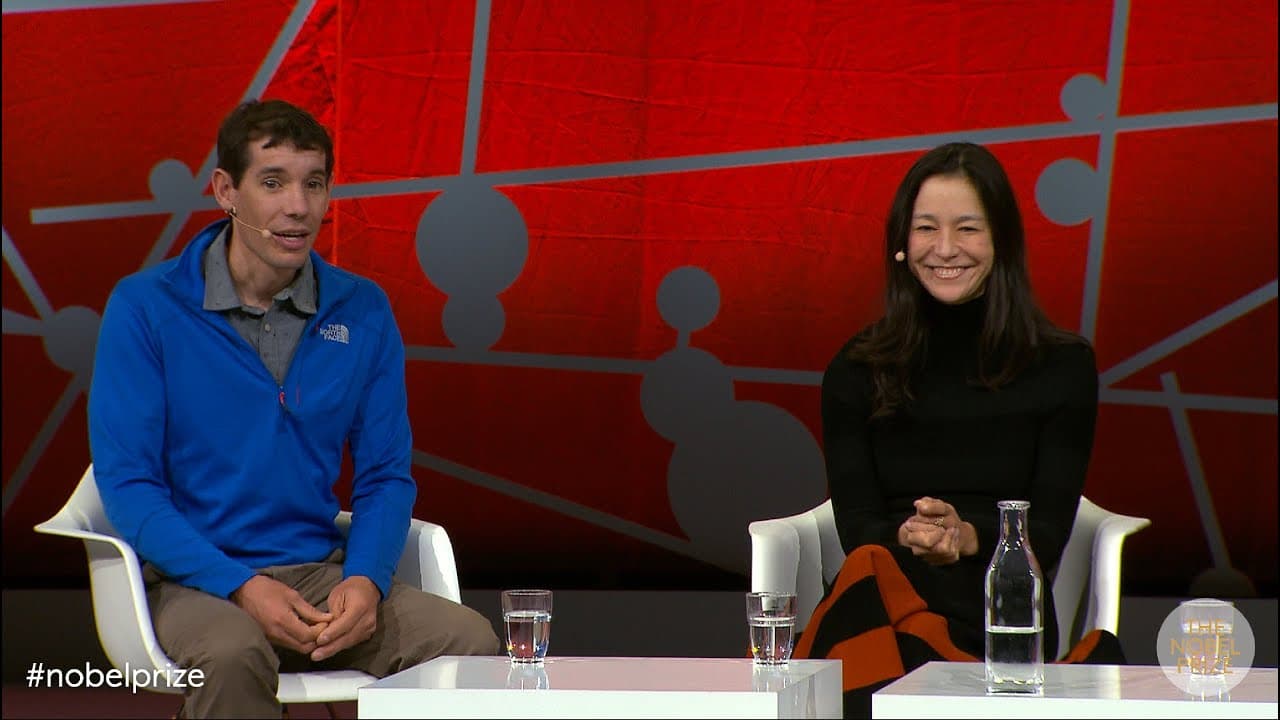
Free Solo! Alex Honnold and Chai Vasarhelyi discuss their award-winning film at Nobel Week Dialogue
TL;DR
Alex Honnold manages free-solo risk through extensive training, route rehearsal, and by never using an unroped ascent to test his limits. Before climbing El Capitan, he rehearsed its boulder problem roughly fifty or sixty times, while Chai Vasarhelyi and Jimmy Chin used a small team of elite climber-cinematographers to avoid adding danger or pressure. Read on to understand the preparation and filmmaking ethics behind Free Solo.
Transcript
so ladies gentlemen I am delighted to introduce Alex Honnold and chive SR le to have a conversation and Alex strangely told me that whenever the trailer starts playing he feels nervous that doesn't seem such a big deal to get nervous about so it's so beautiful watching you climb it's like a dance you just dance your way up the mountain it must be g... Read More
Key Insights
- Free soloing combines a low intended likelihood of failure with an extremely high consequence. Honnold says images alone cannot reveal actual risk because the difficulty of the terrain, the climber's training, and repeated practice determine how likely a fall is.
- Honnold's apparent grace is the result of about twenty years of practice and extensive training. What looks like a beautiful dance on the mountain becomes possible only after sustained preparation, and the experience feels fluid primarily when the climbing goes according to plan.
- Honnold's approach is to minimize risk while pursuing an experience he finds meaningful. He does not describe danger as the objective, but instead emphasizes purpose, careful preparation, practice, and making the climb as safe as possible within the consequences of climbing without ropes.
- The filmmakers faced an ethical question about whether documenting the ascent could make Honnold more likely to die. Vasarhelyi and Jimmy Chin proceeded only after considering his intentional choices and committing to reduce filming risks, pressure, equipment hazards, and visible anxiety.
- The production team consisted of elite professional climbers who were also cinematographers and knew Honnold well. Their climbing ability allowed them to film while suspended on ropes, keep pace with a very fast climber, and practice alongside him without introducing an unfamiliar crew.
- Failure is central to ordinary climbing training because it reveals a climber's limits. Honnold says he often fails while training, but free soloing requires a different rule: difficult moves must be rehearsed beforehand so the unroped ascent never becomes the place to discover that limit.
- The boulder problem was rehearsed roughly fifty or sixty times before the free solo ascent. Honnold had fallen on it previously and worried about it for years, so repeated practice was used to turn a difficult section into something he could execute when failure was unacceptable.
- Nonfiction filmmaking depends on events that cannot be fully predicted. Vasarhelyi did not anticipate Honnold meeting Sanni, falling in love, or being challenged personally, but these developments became part of the film because the crew remained present and treated his evolving life with respect.
Install to Summarize YouTube Videos and Get Transcripts
Explore YouTube Video Summarizer or Get YouTube Transcript Extractor
Questions & Answers
Q: How does Alex Honnold manage risk in free soloing?
Honnold minimizes the likelihood of falling through extensive training, repeated practice, and detailed preparation on the route. He does not use an unroped ascent to discover his physical limits; difficult moves are tested and rehearsed beforehand while protected.
Q: How does Alex Honnold distinguish risk from consequence?
Honnold treats risk as the likelihood of falling and consequence as what happens after a fall. In free soloing, the consequence is probably death, but he argues that preparation, terrain difficulty, and familiarity can make the likelihood of falling extremely low.
Q: How did Alex Honnold prepare to free solo El Capitan?
He hiked to the summit, rappelled down the face, and practiced difficult sections of the route. He rehearsed the boulder problem roughly fifty or sixty times so the unroped climb would not become the moment when he discovered whether he could perform its moves.
Q: Why does Alex Honnold climb without ropes?
Honnold says he seeks a beautiful experience and an activity that feels deeply meaningful and gives his life purpose. He does not describe danger as the goal; he tries to make the climb as safe as possible through training and practice.
Q: What ethical problem did the Free Solo filmmakers face?
Chai Vasarhelyi and Jimmy Chin questioned whether filming might encourage excessive risk or make Honnold more likely to die. They considered hazards such as dropped equipment, distraction, pressure, and visible anxiety before committing to minimize risks created by the production.
Q: How did the Free Solo crew reduce the danger of filming Alex Honnold?
The production used a small team of elite professional climbers who were also cinematographers and knew Honnold well. They practiced alongside him, filmed while suspended on ropes, and tried to insulate him from the crew's anxiety and pressure.
Q: Was making Free Solo stressful for Alex Honnold?
Honnold says his greatest stress was avoiding a fall, although the crew added complexity. He found filming ordinary life especially difficult because private conversations in his van could involve a camera operator, a boom microphone operator, and Vasarhelyi nearby.
Q: Why is failure useful in climbing training but unacceptable during free soloing?
Honnold says climbers normally find their limits by pushing until they cannot complete a move, so failure is a regular part of training. During free soloing, however, a fall can probably cause death, so difficult moves must be failed on, studied, and rehearsed while protected before the unroped attempt.
Summary
In this video, Alex Honnold and Chai Vasarhelyi discuss the filming of the documentary "Free Solo" and the risks and challenges involved in rock climbing without ropes. They also touch on the impact of the film and the personal toll it took on them.
Questions & Answers
Q: Why does Alex risk climbing without ropes?
Alex believes in minimizing the risk through extensive training and preparation. He finds climbing without ropes to be a beautiful and meaningful experience that gives purpose to his life.
Q: How did Chai cope with the risk involved in filming the climb?
Chai found it difficult but ultimately decided to embark on making the film because she believed in the power of the story and the inspiration it could bring to others. The film crew worked hard to minimize the risks and provide support to Alex during the climb.
Q: How did having a film crew around affect Alex's experience?
The film crew added an extra complexity to the climb, but the most challenging part for Alex was having the crew present during his everyday life. It was often difficult to have normal experiences with a camera crew following him around.
Q: How did Alex cope with the death of his friend Brad Gobright?
Alex acknowledges that the deaths of his friends in climbing accidents take a personal toll on him. However, he tries to approach climbing objectives with a clear-eyed perspective and minimize risks as much as possible.
Q: Why do you think the film "Free Solo" has been so successful?
The film resonates with audiences, particularly young people, because of Alex's story of hard work and achieving one's dreams. It is a communal and visceral experience that moves people. The film's success is also attributed to the charisma and talent of Alex Honnold.
Q: Do you climb, Chai?
Chai does not climb, but she occasionally climbs with her children in the gym for fun. She prefers to be cautious and prioritize her own safety, especially since they have small children.
Q: What were Chai's fears during the filming process?
Chai was concerned about Alex having a heart attack, potential earthquakes, or being stung in the eyes by bees. However, the actual filming process proved that these fears were not significant, although Alex was stung by hornets but continued without any major issue.
Q: Has this exposure to climbing tempted Chai to try it?
Chai does not feel the temptation to climb due to the risks and the fact that she wants to prioritize her safety and be there for her children.
Takeaways
"Free Solo" is a documentary that captures Alex Honnold's remarkable and risky feat of climbing El Capitan without ropes. The film explores the challenges and dangers involved in free soloing, as well as the impact it has on both the climber and the film crew. It highlights the importance of minimizing risks through training and preparation, and the personal toll of accidents in the climbing community. Ultimately, the film's success lies in Alex's inspiring story and the emotional connection it creates with audiences.
Summary & Key Takeaways
-
Alex Honnold describes elite climbing as the product of long practice rather than effortless physical control. He pursues free soloing because it gives his life meaning, while trying to reduce the chance of failure through training, rehearsal, and a clear distinction between the likelihood of falling and its potentially fatal consequence.
-
Chai Vasarhelyi and Jimmy Chin treated filming as an ethical problem because cameras, equipment, or pressure might increase Honnold's danger. Their solution was a small team of elite climbers who were also cinematographers, knew Honnold well, practiced alongside him, and tried to shield him from the crew's anxiety throughout production.
-
The documentary developed through uncertainty as Honnold prepared for El Capitan and formed a relationship with Sanni. Honnold found cameras in ordinary private moments more difficult than their presence during climbing, while the crew's friendship and practical assistance made some preparation easier by giving him trusted companions for rappelling and route work.
Read in Other Languages (beta)
Share This Summary 📚
Summarize YouTube Videos and Get Video Transcripts with 1-Click
Try YouTube Summary with ChatGPT & Claude or YouTube Transcript Generator
Explore More Summaries from Nobel Prize 📚
Summarize YouTube Videos and Get Video Transcripts with 1-Click
Try YouTube Summary with ChatGPT & Claude or YouTube Transcript Generator