Nobel Minds 2013
TL;DR
The Nobel Minds 2013 laureates approach science and markets through sustained work, judgment, evidence, and an acknowledgment of luck. Robert Shiller argues that human behavior and speculative bubbles can make partial prediction possible, while Eugene Fama finds no statistical evidence for reliably forecasting particular market movements. Their disagreement clarifies the difference between informed judgment, testable prediction, and long-term returns tied to risk. Read on for their arguments and memorable Nobel notification stories.
Transcript
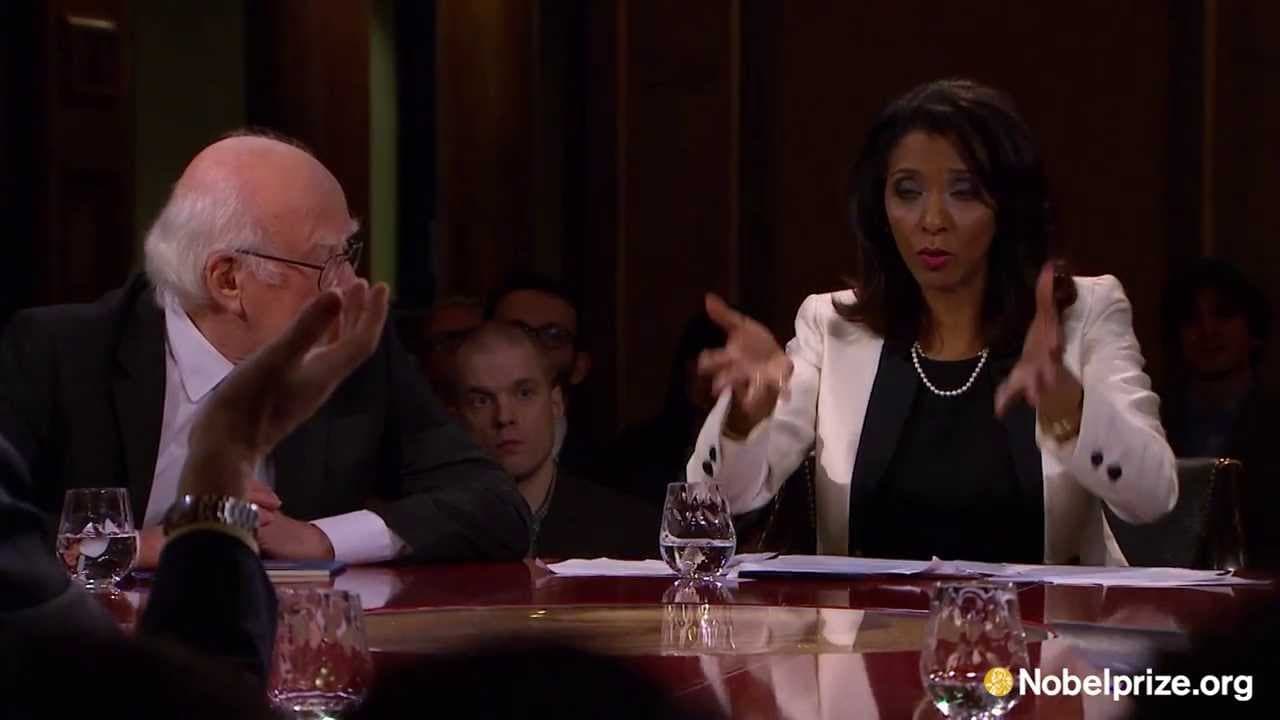
hello I'm Zena badawi welcome to the Magnificent Concert Hall here in Stockholm where this year's Nobel Prize winners received their awards from the king of Sweden the Nobel prizes are amongst the most prestigious accolades anywhere in the world and this is the first time that this year's Nobel laurates are appearing together on television they're ... Read More
Key Insights
- Nobel Prize notifications often reached the laureates unexpectedly, including while they were sleeping, traveling, exercising, leaving the shower, or preparing food. Several recognized the significance of an early call or a Swedish accent, while Peter Higgs learned from a former neighbor after avoiding media attention.
- Luck is part of the laureates' accounts, but it does not replace sustained work. Jim Rothman joked that pressing the correct phone button brought good fortune, and the exchange immediately recognized that receiving a Nobel Prize also reflects extensive effort.
- Robert Shiller's position is that smart people can partially predict markets and crises. He argues that such forecasts require broad judgment about human behavior, speculative bubbles, and influences extending beyond conventional economic data, rather than a claim of perfect prediction.
- Eugene Fama's position is that market data do not provide systematic evidence for reliable prediction of particular movements. He distinguishes beliefs about forecasting from results that can be found and tested in statistical records.
- The disagreement between Shiller and Fama is partly about interpretation rather than every underlying fact. Shiller emphasizes human nature and insights from several disciplines, while Fama stresses testable evidence and rejects the claim that specific stock-market movements can be forecast reliably.
- Risk-based portfolio construction is different from predicting the market's next movement. Fama says a stock portfolio may likely outperform bonds over the long term because stocks are riskier, but that relationship does not establish an ability to forecast what the stock market will do.
- Economics education is expected to help students understand real financial events and policy debates. The discussion raises concern that students may seek outside books when classroom instruction does not equip them to interpret current economic conditions or participate meaningfully in policy questions.
- Practical influence can emerge even when researchers disagree about theory. Shiller says Fama has had a major impact on financial practice, while their exchange shows that shared attention to real-world finance can coexist with opposing conclusions about market predictability.
Install to Summarize YouTube Videos and Get Transcripts
Explore YouTube Video Summarizer or Get YouTube Transcript Extractor
Questions & Answers
Q: How do the Nobel Minds 2013 laureates approach science and markets?
They emphasize sustained work, judgment, evidence, practical problems, and some luck. In the markets discussion, Robert Shiller draws on human behavior and speculative bubbles, while Eugene Fama stresses what systematic statistical records can actually support.
Q: What is the main disagreement between Robert Shiller and Eugene Fama?
They disagree over whether markets and financial crises can be predicted. Shiller believes smart observers can make partial predictions by examining speculative behavior and human nature, whereas Fama says market data do not provide reliable statistical evidence for forecasting particular movements.
Q: Can economists predict financial crises according to Robert Shiller?
Shiller argues that smart people can partially anticipate markets and crises, though not through a simple mechanical rule. He advocates broad judgment informed by bubbles, speculative behavior, psychology, sociology, anthropology, political science, neuroscience, and ideology.
Q: Why does Eugene Fama reject reliable market prediction?
Fama says systematic analysis of market records does not reveal statistical evidence that people can reliably predict particular movements. He distinguishes belief in forecasting ability from results that can actually be found and tested in the data.
Q: How is portfolio risk different from predicting the market?
Fama explains that a portfolio can target particular kinds of risk without forecasting the market's next move. Stocks may outperform bonds over the long term because stocks are riskier, but that expected compensation for risk does not establish reliable prediction of specific stock-market movements.
Q: How did the 2013 Nobel laureates hear that they had won?
Several laureates were sleeping or had recently gone to sleep when the news arrived. Robert Shiller was stepping out of the shower, Eugene Fama was doing back exercises while listening to Don Pasquale, Thomas Südhof was driving in Spain, and Peter Higgs learned from a former neighbor while walking home.
Q: Why did Peter Higgs initially miss the Nobel Prize announcement?
Higgs had a mobile phone, but only his family knew its number, so the Nobel committee could not reach him directly. After leaving home to avoid the media attention following the announcement, he learned about the award from a former neighbor who stopped him as he walked home.
Q: What do the laureates' notification stories reveal about Nobel recognition?
Their stories show major recognition arriving amid ordinary routines such as sleeping, exercising, showering, driving, and preparing banana toast. The laureates responded with surprise and humor, while the discussion presented winning a Nobel Prize as involving both good fortune and extensive hard work.
Summary
In this video, Nobel Prize winners from various fields discuss their reactions upon hearing the news of their awards and share their thoughts on the role of scientists in solving the world's problems. They also touch on topics such as the importance of communication between scientists and the public, the challenges and pressures faced by young scientists, the gender gap in science, and the need for continued support and funding for research.
Questions & Answers
Q: What were the Nobel laureates doing when they heard the news of their awards?
Professor Randy Schekman was deep asleep, but his wife heard the phone and woke him up. Professor Francoise Barre-Sinoussi was making banana toast for her grandchildren. Professor Peter Higgs found out while he was walking back home after intentionally avoiding the announcement.
Q: How did the Nobel laureates feel upon hearing the news?
Professor Randy Schekman felt a mix of shock, disbelief, and excitement. Professor Francoise Barre-Sinoussi was overjoyed and felt a sense of accomplishment. Professor Peter Higgs was pleasantly surprised and happy.
Q: Did any of the Nobel laureates have concerns about the misuse or misunderstanding of their discoveries?
Yes, some of the Nobel laureates expressed concerns about the potential misuse or misunderstanding of their discoveries. They acknowledged the ethical and social implications of their work and emphasized the need for responsible communication and public understanding of science.
Q: Do the Nobel laureates believe that scientists should play a greater role in solving societal problems?
Yes, the Nobel laureates believe that scientists have an important role to play in tackling the big problems of the day. They emphasized the need for rigorous analytical thinking, curiosity-driven research, and interdisciplinary collaboration in order to address complex problems and find innovative solutions.
Q: How do economists communicate with the public, and do they do a good job of it?
Economists have different approaches to public communication. Some economists write books that synthesize theory and practice, while others provide lectures or engage in media interviews. The Nobel laureates acknowledged that economists could be better at distinguishing between what is known based on research and what are personal opinions. They emphasized the importance of clear and evidence-based communication.
Q: Do the Nobel laureates think that scientists are running ahead of what society understands or finds acceptable?
Yes, the Nobel laureates acknowledged that there can be a disconnect or gap between scientific advancements and societal understanding or acceptance. They discussed the need for scientists to effectively communicate the magnitude of the challenges they are trying to solve and the limitations of their research. They also acknowledged that there can be hype or overselling of scientific discoveries, which can lead to misunderstandings.
Q: What were the Nobel laureates' thoughts on the gender gap in science?
The Nobel laureates discussed the gender gap in science and shared different perspectives. Some noted that there has been progress in increasing the representation of women in science, while others acknowledged the existing challenges and biases. They highlighted the need for equal opportunities, diversity, and support for women in science.
Q: Do the Nobel laureates believe that research funding and support are sufficient?
The Nobel laureates expressed concerns about the decline in public funding for research, particularly in the United States. They emphasized the importance of public investment in research and higher education. They also acknowledged the need for a longer-term view and a cosmopolitan outlook in supporting scientific research.
Q: How can scientists better communicate with the public and policymakers?
The Nobel laureates agreed that scientists should improve their communication with the public and policymakers. They emphasized the importance of clear and accessible communication, distinguishing between facts and opinions, and bridging the gap between scientific knowledge and public understanding. Some suggested utilizing social media platforms and online lectures to reach a wider audience.
Q: How do the Nobel laureates plan to use their newfound influence to better the world?
The Nobel laureates intend to use their influence to continue their respective research and work, contribute to economic output and advancement, address challenges in science and society, and advocate for support and funding for scientific research. They also emphasized the need for continued collaboration and the cultivation of young talent in science.
Takeaways
The Nobel laureates' discussions shed light on various aspects of science and its impact on society. They emphasized the importance of responsible communication, rigorous analytical thinking, interdisciplinary collaboration, and long-term perspectives in scientific research. The laureates recognized the need for improved public understanding of science and science-based decision-making. They also highlighted the challenges faced by younger scientists, the gender gap in science, and the need for continued support and funding for research. Overall, the laureates demonstrated a commitment to using their influence to contribute to the betterment of the world through scientific advancements.
Summary & Key Takeaways
-
The 2013 Nobel laureates gathered in Stockholm after receiving their awards from the king of Sweden. They recalled hearing the news in circumstances ranging from sleep and travel to exercise and cooking banana toast. Their stories combined surprise, humor, family involvement, media attention, hard work, and acknowledgment of luck.
-
The economics discussion exposed a disagreement between Robert Shiller and Eugene Fama about whether markets can be predicted. Shiller argued that smart observers can partially anticipate crises by examining bubbles, speculative behavior, and human judgment. Fama replied that systematic analysis does not reveal reliable predictive evidence in market data.
-
The laureates considered how academic research connects with practical problems and education. Shiller advocated combining economics with psychology, sociology, anthropology, political science, neuroscience, and ideology. Fama distinguished predicting broad long-term compensation for risk from forecasting particular stock-market movements, while both economists were described as strongly oriented toward real-world finance.
Read in Other Languages (beta)
Share This Summary 📚
Summarize YouTube Videos and Get Video Transcripts with 1-Click
Try YouTube Summary with ChatGPT & Claude or YouTube Transcript Generator
Explore More Summaries from Nobel Prize 📚
Summarize YouTube Videos and Get Video Transcripts with 1-Click
Try YouTube Summary with ChatGPT & Claude or YouTube Transcript Generator