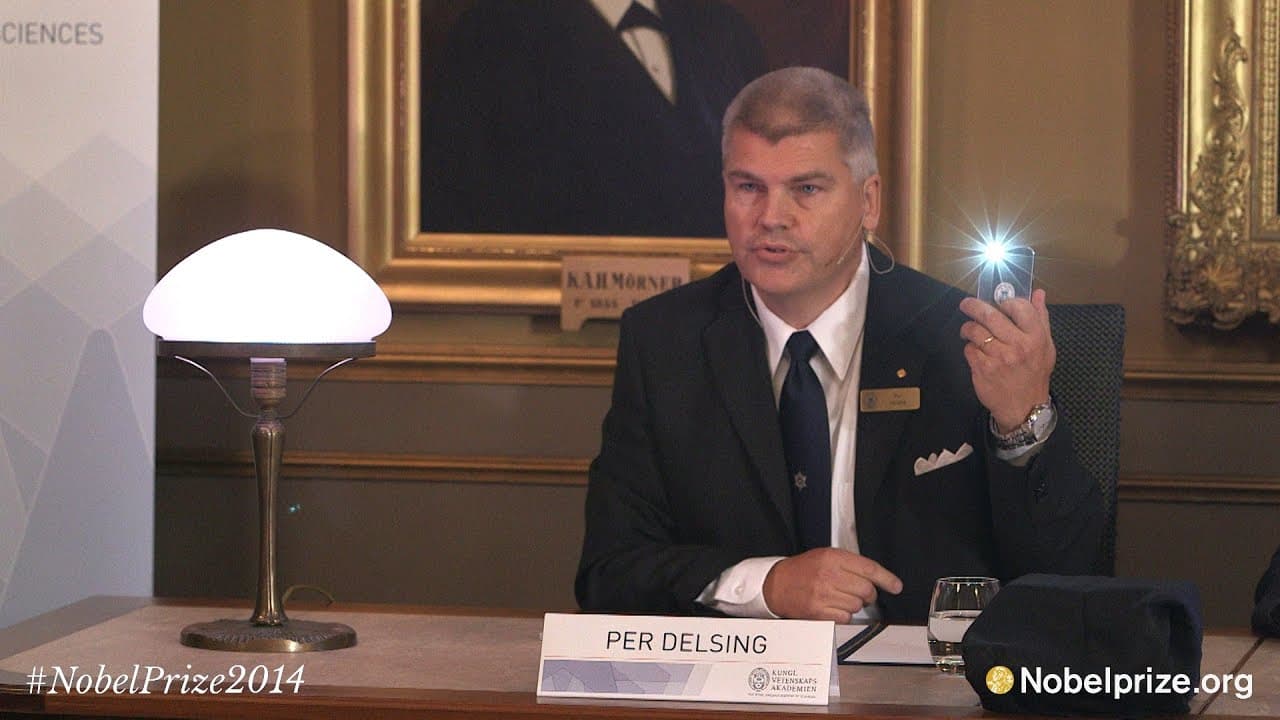
Announcement of the Nobel Prize in Physics 2014
TL;DR
Efficient blue light-emitting diodes made bright, energy-saving white light possible by supplying the color missing from existing red and green LEDs. The 2014 Nobel Prize in Physics honored Isamu Akasaki, Hiroshi Amano, and Shuji Nakamura for overcoming difficult semiconductor-material and diode-construction problems, enabling longer-lasting lighting, modern displays, optical storage, and other practical applications.
Transcript
this year prize is about light the Royal Swedish Academy of Sciences has decided to award the 2014 Nobel Prize and physics to Professor is akasaki at Mayo University Nagoya and Nagoya University Japan Professor Hiroshi Amano at Nagoya University Japan and Professor Judi Nakamura at University of California Santa Barbara usau for the invention of ef... Read More
Key Insights
- The 2014 Nobel Prize in Physics recognized Isamu Akasaki, Hiroshi Amano, and Shuji Nakamura for inventing efficient blue light-emitting diodes, an achievement that enabled bright, energy-saving white light sources and emphasized Alfred Nobel's goal of rewarding inventions benefiting mankind.
- Blue light was the missing component needed to complement red and green LEDs. Combining red, green, and blue light produces white light, while another common approach uses a blue or ultraviolet LED to illuminate a thin layer that absorbs the energy and converts it into other colors.
- LED lighting is highly energy-efficient and has a much longer lifetime than older lighting technologies. The announcement states that LEDs can last approximately 100 times longer than standard incandescent lamps while delivering much more light from much less electrical energy.
- Illumination accounts for something like one-fourth of electricity consumption in most industrialized economies. Improving the efficiency of electrical light generation can therefore have a large effect on energy use as LED technology replaces incandescent and fluorescent lighting.
- A light-emitting diode works through the recombination of electrons and holes in an active semiconductor layer. The two charge types travel at different energy levels, then meet in the intermediate layer and release light when they recombine.
- Gallium nitride materials were central to producing efficient blue LEDs. The laureates advanced the growth of gallium nitride and its alloys, solved problems involving dopant passivation, and built layered structures that confine electrons and holes so they can generate light efficiently.
- Blue LED technology supports applications beyond white illumination. The announcement identifies smartphone screens and flashlights, blue laser diodes for optical storage, future light-based communication, and blue or ultraviolet light for sterilizing water as important uses.
- Solar lanterns show how efficient LEDs can expand access to light where electricity networks are weak or unavailable. Small photovoltaic installations can generate electricity, store it in batteries, and power LED lighting at night because the lamps require relatively little electrical energy.
Install to Summarize YouTube Videos and Get Transcripts
Explore YouTube Video Summarizer or Get YouTube Transcript Extractor
Questions & Answers
Q: Why did blue LEDs receive the 2014 Nobel Prize in Physics?
Efficient blue LEDs received the prize because they supplied the missing color needed to create bright, energy-saving white light sources. Red LEDs had existed since the early 1960s, and green LEDs followed later, but blue light remained difficult to produce. Isamu Akasaki, Hiroshi Amano, and Shuji Nakamura overcame key material and device-construction problems, making practical blue light-emitting diodes possible.
Q: How do blue LEDs make white light possible?
Blue LEDs enable white light in two ways described during the announcement. Red, green, and blue LEDs can be combined so their colors mix into white light. Alternatively, a blue or ultraviolet LED can illuminate a thin conversion layer. That layer absorbs the LED's energy and converts it into other colors, producing the combined light perceived as white.
Q: How does a light-emitting diode produce light?
A light-emitting diode contains semiconductor layers designed to carry two types of charge: electrons and holes. These charges travel at different energy levels and enter an intermediate active layer. When electrons and holes meet and recombine there, they fall into each other and release energy as light. Layered structures help confine the charges so this light-producing recombination occurs effectively.
Q: Why was the blue LED difficult to invent?
The blue LED required semiconductor materials and structures that were difficult to manufacture successfully. Researchers attempted to produce blue light-emitting diodes for roughly three decades. The laureates developed ways to grow gallium nitride and its alloys in suitable geometries, solved dopant-passivation problems needed to form the diode, and created structures that confined electrons and holes for efficient light emission.
Q: What energy and lifetime advantages do LED lamps provide?
LED lamps generate much more light while using much less electricity than older lighting technologies, and they also operate for far longer. The announcement states that their lifetime may be 100 times longer than that of a standard incandescent lamp. Because something like one-fourth of electricity consumption in most industrialized economies goes to illumination, this increased efficiency can have a substantial impact.
Q: What applications use blue LED technology?
Blue LED technology appears in white lighting, smartphone screens, and smartphone flashlights. Related blue laser diodes are used for optical storage. The announcement also identifies possible future communication systems that use light instead of radio waves, as well as blue or ultraviolet light for sterilizing water. LEDs additionally support street lighting, vehicle lighting, colored displays, and illuminated public environments.
Q: How can LED lighting help areas without electricity grids?
Efficient LED lighting can work with small solar energy systems in places where electrical generation and distribution networks are unavailable. Solar photovoltaic equipment generates electricity during the day, and batteries store that energy for use at night. Because LED lamps produce substantial light from relatively little electricity, solar lanterns can provide practical nighttime illumination and broaden access to lighting.
Q: Who won the 2014 Nobel Prize in Physics for blue LEDs?
The Royal Swedish Academy of Sciences awarded the 2014 Nobel Prize in Physics jointly to Isamu Akasaki of Meijo University and Nagoya University, Hiroshi Amano of Nagoya University, and Shuji Nakamura of the University of California, Santa Barbara. They were honored for inventing efficient blue light-emitting diodes, which enabled bright, energy-saving white light sources.
Summary
The Royal Swedish Academy of Sciences awarded the 2014 Nobel Prize in Physics to Professor Isamu Akasaki at Nagoya University, Japan, Professor Hiroshi Amano at Nagoya University, Japan, and Professor Shuji Nakamura at the University of California, Santa Barbara, for their invention of efficient blue light-emitting diodes (LEDs) that enable bright and energy-saving white light sources. This breakthrough in LED technology has had a significant impact on energy efficiency and long-term sustainability in lighting.
Questions & Answers
Q: How did the invention of blue light-emitting diodes impact lighting technology?
The invention of blue LEDs allowed for the creation of white light sources with high energy efficiency and long lifetime. By combining red, green, and blue LEDs, it became possible to produce white light. This technology is replacing older lighting technologies and significantly reducing electricity consumption for illumination purposes.
Q: What is the historical background of lighting technology?
Lighting technology has evolved over millions of years of human evolution. Initially, people used lamps that burned fuels similar to the geometry of a modern lamp. In the last century, incandescent lighting and electric light became popular, followed by the introduction of fluorescent lamps. The invention of blue LEDs has led to a dramatic increase in power efficiency, resulting in more light for less electricity consumption.
Q: How are blue light-emitting diodes different from red and green LEDs?
While red and green LEDs have been around since the early 1960s, the invention of blue LEDs proved to be much more challenging. Blue LEDs are crucial for generating white light and other colors through color mixing. Their development required advancements in semiconductor technology and materials, particularly in creating gallium nitride and gallium nitride alloys. The unique structures of blue LEDs allow for the confinement of electrons and holes, generating light emission.
Q: What is the significance of blue light-emitting diodes?
Blue LEDs have enabled the creation of various optical environments, including streetlights, car lights, festival displays, and screen displays on smartphones. The use of blue LEDs has not only improved energy efficiency but also extended the lifetime of lighting devices by up to a hundred times when compared to standard incandescent lamps. Additionally, the absence of harmful elements like mercury in blue LEDs has reduced the environmental impact associated with previous lighting technologies.
Q: How do blue LEDs contribute to the global access to electricity?
Blue LEDs have played a role in increasing electricity access in areas with weak electrical power generation or no access to an electrical grid. The development of solar lanterns with LED technology, combined with other energy storage systems, such as batteries, has allowed for the provision of light with minimal electricity consumption. It is believed that blue LEDs will continue to contribute to improving global access to electricity in the future.
Q: What challenges did the inventors face in developing blue LEDs?
The inventors faced numerous challenges in developing blue LEDs. While there had been continuous efforts in industries to generate blue light-emitting diodes, the difficulty lay in the lack of previous success. The invention required the ability to grow gallium nitride and its alloys in specific geometries suitable for building diodes. It also involved solving problems related to passivation of dopants used in creating blue LEDs. After three decades of attempts, the inventions of Akasaki, Amano, and Nakamura finally made it possible to overcome these challenges.
Q: How have blue LEDs impacted various applications beyond lighting?
Blue LEDs have found uses beyond lighting, such as in blue laser diodes for optical storage and the future generations of communication technologies that may rely on light instead of radio waves or Wi-Fi. Blue or UV-emitting LEDs can also be used to sterilize water. Their versatility and potential in different industries make them an invaluable invention.
Q: What is the physical mechanism behind blue light emission in diodes?
Blue light emission in diodes is achieved through the combination of different semiconductor materials. These materials consist of layers that carry holes and layers that carry electrons, which transport charges at different energy levels. When these charges meet in the active layer of the diode, they recombine, turning energy into emitted light. The specific structures required to achieve this emission involve the deposition of multiple thin layers on top of each other, typically through vapor phase synthesis.
Q: How does the invention of blue LEDs align with Alfred Nobel's vision for the Nobel Prize?
Alfred Nobel intended for the Nobel Prize to be awarded to inventions that benefit mankind. The invention of blue LEDs aligns perfectly with this vision, as it has significant practical applications and improvements in various industries. The usefulness of blue LEDs in lighting, communication, and water sterilization demonstrates their positive impact on society and fulfills Nobel's intent.
Q: What was the reaction of the laureates upon receiving the Nobel Prize?
The laureates, Professor Akasaki and Professor Nakamura, were awakened with the news of winning the Nobel Prize in the middle of the night. Both expressed disbelief and excitement, finding it surreal to receive such a prestigious recognition. They were not expecting the call and were grateful for the honor bestowed upon them.
Q: How did the Academy communicate the news of the Nobel Prize to the laureates?
The Academy managed to reach two of the three laureates, Professor Akasaki and Professor Nakamura, over the phone. However, Professor Amano was unavailable as he was on a plane. The Academy expressed their congratulations and informed the laureates about the award during the phone call. The laureates were thrilled to receive the news and grateful for the recognition.
Takeaways
The invention of efficient blue light-emitting diodes (LEDs) by Professor Isamu Akasaki, Professor Hiroshi Amano, and Professor Shuji Nakamura has revolutionized lighting technology. Blue LEDs enable highly energy-efficient and long-lasting white light sources, significantly reducing electricity consumption. These LEDs have found applications in various industries beyond lighting, including communication technologies and water sterilization. The recognition of this invention with the Nobel Prize aligns with Alfred Nobel's vision of honoring inventions that benefit humanity.
Summary & Key Takeaways
-
The Royal Swedish Academy of Sciences awarded the 2014 Nobel Prize in Physics jointly to Isamu Akasaki, Hiroshi Amano, and Shuji Nakamura. Their invention of efficient blue light-emitting diodes completed the set of red, green, and blue LEDs needed to produce bright white light with high energy efficiency and a long operating lifetime.
-
Blue LEDs rely on semiconductor structures containing layers that carry electrons and holes at different energy levels. When these charges meet and recombine in an active intermediate layer, light is produced. The laureates developed methods for growing gallium nitride materials, forming functional diodes, activating dopants, and confining charges effectively.
-
LED lighting provides much more light from less electricity and may last 100 times longer than a standard incandescent lamp. It also avoids the mercury associated with fluorescent tubes. Its low electricity requirement supports solar lanterns in areas without electrical grids, while related technology serves smartphones, optical storage, communication, and water sterilization.
Read in Other Languages (beta)
Share This Summary 📚
Summarize YouTube Videos and Get Video Transcripts with 1-Click
Try YouTube Summary with ChatGPT & Claude or YouTube Transcript Generator
Explore More Summaries from Nobel Prize 📚






Summarize YouTube Videos and Get Video Transcripts with 1-Click
Try YouTube Summary with ChatGPT & Claude or YouTube Transcript Generator