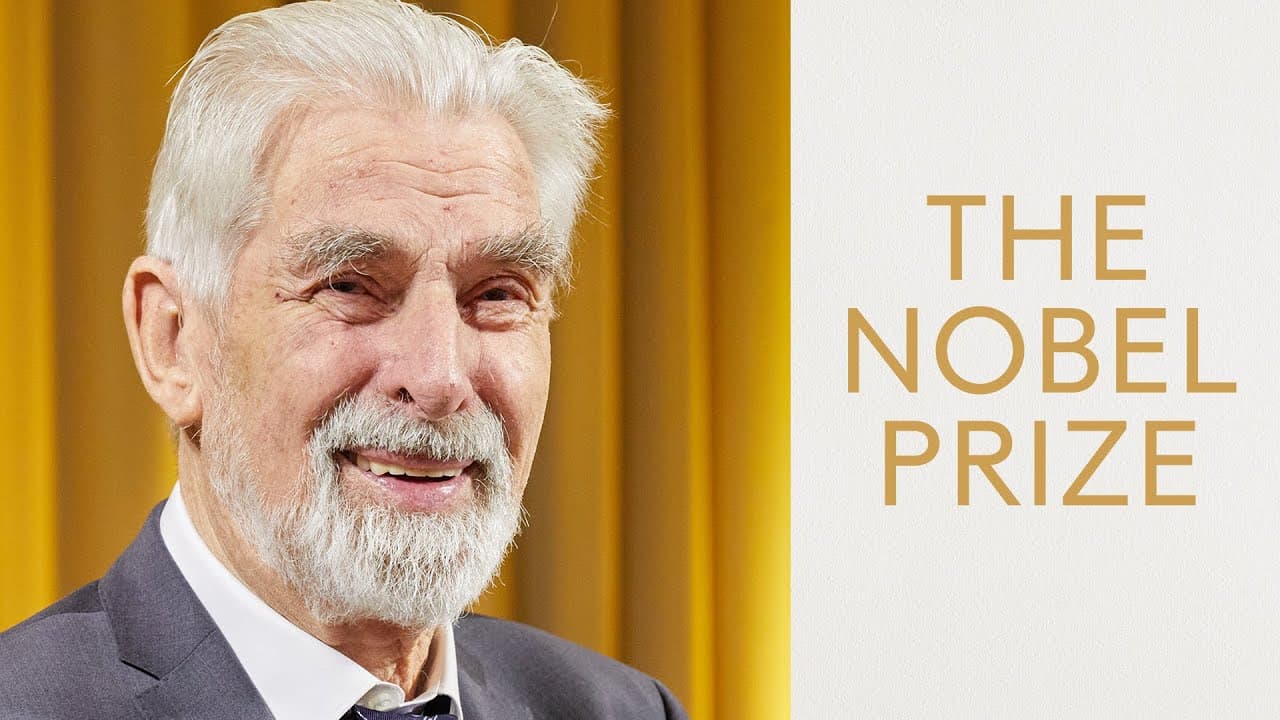
Klaus Hasselmann: Nobel Prize lecture in physics 2021
TL;DR
Short-term random weather fluctuations can generate long-term internal climate variations because the slower climate system integrates them over time. Hasselmann’s framework separates this internal variability, treated as noise, from externally forced signals and compares detected signals with predicted fingerprints to assess whether factors such as elevated greenhouse gas concentrations caused the observed changes.
Transcript
the second lecture on the theme of climate is given by professor hasselman who was also born in 1931 and spent his early years in the united kingdom after returning to germany after the second world war he studied at the universities of hamburg and gertingen his career progressed via appointments at renowned institutions in europe and the united st... Read More
Key Insights
- The natural greenhouse effect makes Earth habitable by absorbing part of the infrared radiation emitted by the surface and returning some energy downward. Without this effect, Earth would be 30 degrees cooler, the oceans would freeze, less sunlight would be absorbed, and temperatures would fall further.
- The climate system balances incoming solar energy against outgoing infrared radiation. Clouds reflect part of the sunlight, while the remaining energy heats the surface. Water vapor and trace gases, notably CO2, absorb some surface radiation before it escapes and then re-emit that energy in multiple directions.
- Short-term weather fluctuations can trigger long-term internal climate variations. Hasselmann’s stochastic climate model represents rapid atmospheric variability as random forcing that is integrated by slower, more inert components of the climate system, producing persistent variations across much longer time periods.
- The ocean acts as the long-term memory of climate because it responds slowly to rapid atmospheric changes. Hasselmann illustrated this relationship through an analogy in which many light tennis balls strike a heavy medicine ball until their accumulated impacts cause the heavier object to move.
- Weather and climate operate on distinct time scales in Hasselmann’s framework. Weather consists of short-term stochastic, stationary fluctuations over days and weeks, while climate includes variations extending from years to millennia and beyond, including both internally generated behavior and responses to external factors.
- A red climate spectrum indicates that variability is stronger at longer time scales. Hasselmann explained this pattern using an autoregressive process of first order, in which short-term fluctuations are integrated by the inert climate system and transformed into slower, persistent variations.
- Climate attribution requires separating external signals from internal stochastic variability. Internal variability is treated as noise, while a potential signal is a change that cannot be explained by that noise. Attribution follows when the signal sufficiently resembles the expected fingerprint of a particular external factor.
- Ocean wave energy is redistributed through nonlinear interactions. Hasselmann’s equation included energy transfer from the peak of the wave spectrum toward both lower and higher frequencies, described by a six-dimensional Boltzmann integral and verified through a 1969 North Sea experiment.
Install to Summarize YouTube Videos and Get Transcripts
Explore YouTube Video Summarizer or Get YouTube Transcript Extractor
Questions & Answers
Q: How can short-term weather create long-term climate variations?
Short-term atmospheric fluctuations act as random forces on the slower and more inert climate system. Although the ocean initially responds little to individual fluctuations, it integrates their accumulated effects over time. This process converts rapidly changing weather, associated with days and weeks, into persistent internal climate variations that can extend across years, millennia, or even longer periods.
Q: Why is the ocean considered the long-term memory of climate?
The ocean is considered climate’s long-term memory because its inertia allows it to integrate repeated short-term atmospheric fluctuations. Hasselmann compared the atmosphere to light tennis balls randomly striking a heavy medicine ball that represents the ocean. The heavier object initially remains nearly still, but accumulated impacts eventually produce slow movement and long-term climate variability.
Q: What is Hasselmann’s stochastic climate model?
Hasselmann’s stochastic climate model is a theoretical framework showing how random, short-term weather variability can excite long-term internal climate changes. It separates fast atmospheric fluctuations from slow climate responses and predicts that the inert climate system integrates short-term variations. This integration produces a red spectrum resembling an autoregressive process of first order.
Q: What is the difference between weather and climate time scales?
Weather is represented by short-term stochastic and stationary fluctuations occurring over days and weeks, with a white spectrum. Climate refers to much longer variations extending from years to millennia and beyond. These long-term variations can arise internally when the climate system integrates weather fluctuations, or they can be forced by external factors such as greenhouse gases.
Q: How does climate fingerprinting identify external causes?
Climate fingerprinting begins by defining the range of internal variability, described as noise, using observations or extended model simulations. Researchers then construct expected responses, called fingerprints, for different forcing factors. If an observed signal cannot be explained by internal variability and closely resembles an expected fingerprint, the change is attributed to the corresponding external factor.
Q: Why must climate attribution account for internal variability?
Climate attribution must account for internal variability because the climate system can generate substantial changes without an external cause. Random weather fluctuations can produce long-term stochastic excursions after being integrated by slower system components. Treating every climate-related variation as externally forced risks confusing natural noise with a genuine signal caused by factors such as elevated greenhouse gas concentrations.
Q: How does the greenhouse effect warm Earth’s surface?
Sunlight that is not reflected, mostly by clouds, heats Earth’s surface. The warmed surface emits infrared radiation, but water vapor and trace gases, notably CO2, absorb some of that energy before it escapes to space. These gases re-emit the absorbed energy in multiple directions, including back toward the surface, requiring additional surface warming to balance incoming solar heating.
Q: What did Hasselmann discover about ocean wave energy transfer?
Hasselmann developed an ocean wave energy-balance equation that included a nonlinear term missing from earlier treatments. This term describes energy moving away from the peak of the wave spectrum toward lower and higher frequencies through a six-dimensional Boltzmann integral. A 1969 North Sea experiment verified the process, including the wind-enhanced peak shifting toward lower frequencies.
Summary
Professor Hasselman, a renowned climate scientist, delivers a lecture on climate change and his groundbreaking research. He expresses gratitude for receiving the Nobel Prize and discusses his early work on developing an equation for the energy balance in ocean wave spectra. He explains the significance of his research in understanding weather and climate variability and how it led to insights on climate change. He goes on to discuss his involvement in establishing a new Max Planck Institute to study the climate problem and the importance of understanding the impact of greenhouse gas emissions. Professor Hasselman also talks about his research on stochastic climate models and the concept of internal climate variability. He highlights the detection and attribution of climate change as a central focus in his work. He concludes by emphasizing the need for urgent action to address global warming and the critical role of scientists and engineers in finding solutions.
Questions & Answers
Q: How did Professor Hasselman's research on ocean wave spectra contribute to his interest in climate change?
Professor Hasselman's early work involved developing an equation for the energy balance in ocean wave spectra. He discovered that there was an important term missing in the previous equations - the transfer of energy from the peak of the wave spectrum to lower and higher frequencies. This insight led him to further explore wave dynamics and interactions, which eventually expanded his interest to include weather and climate.
Q: How did Professor Hasselman's career progress after returning to Germany?
After returning to Germany, Professor Hasselman studied at the universities of Hamburg and Göttingen. His career advanced through appointments at renowned institutions in Europe and the United States until he became the director of the Max Planck Institute for Meteorology in Hamburg, where he is currently active. His work at the institute provided crucial insights into the relationship between weather and climate and led to the development of fingerprinting methods used to assess human impact on Earth's climate.
Q: What does Professor Hasselman mean by the term "stochastic climate system"?
The term "stochastic climate system" refers to the understanding that climate variability is driven by both deterministic and random processes. In this context, stochasticity refers to the random fluctuations and variability observed in the climate system. Professor Hasselman developed stochastic climate models that showed how short-term weather fluctuations can trigger long-term climate variations. This stochastic approach helped explain the formation of long-term internal variations in climate excited by short-term random weather fluctuations.
Q: How did Professor Hasselman's research on stochastic climate models contribute to the detection and attribution of climate change?
Professor Hasselman's research on stochastic climate models allowed for the discrimination between climate variations due to external factors and those related to internal variability. By isolating the expected signal (external factors) from the noise (internal variability) in climate data, he developed the concept of fingerprints to detect and attribute climate change. This approach involves comparing observed climate signals with the expected responses to different forcing factors, such as elevated greenhouse gas concentrations, and assessing the similarity between them.
Q: How did Professor Hasselman's research on fingerprints contribute to understanding the human impact on climate change?
Professor Hasselman's research on fingerprints aimed to identify the expected climate responses associated with human activities, specifically the emission of greenhouse gases. By analyzing climate data and constructing fingerprints based on expected climate signals and internal variability, he was able to detect the human signal of climate change. This provided scientific evidence that human activities are changing the climate and emphasized the need to reduce global greenhouse gas emissions.
Q: How did Professor Hasselman's research on stochastic climate systems influence climate modeling?
Professor Hasselman's research on stochastic climate systems influenced the design of climate models by advocating for the separation of signal and noise components in modeling. Climate models represent only a smaller part of the dynamics explicitly and resolve the larger scales, while the smaller scales or variables not explicitly considered represent the noise. The effects of these unresolved scales are parametrized to capture their influence on the resolved dynamics. This separation allows for efficient modeling and analysis of climate phenomena, facilitating predictions and assessments of climate change.
Q: What were some of the challenges Professor Hasselman faced in communicating his research to the public and policymakers?
Professor Hasselman admits that he struggled with communicating his research to the public and policymakers effectively. He preferred to concentrate on research rather than public communication, which posed a challenge in raising awareness and understanding of climate change. He highlights the importance of colleagues such as Mvhib Latif and Myron Ebell-Kölher, who successfully bridged the gap between climate research and the public. Despite the efforts to communicate research findings, he expresses frustration over the lack of adequate political reactions and the need for society and politicians to think in longer-term timescales.
Q: How did Professor Hasselman incorporate economic dimensions into climate modeling?
Professor Hasselman recognized the importance of incorporating economic dimensions into climate models to address the complexities of the climate system. He worked with his wife and later Dmitry Kovalevsky to develop coupled climate and economic models. These models aimed to capture the dynamic and multi-timescale nature of both the natural sciences and the human aspects of the climate system. He believed that considering the inherent uncertainty of all model components and integrating statistical optimization models were crucial for guiding policy-making and addressing the uncertainties associated with climate change.
Q: What urgent actions does Professor Hasselman emphasize in response to global warming?
Professor Hasselman highlights the urgent need for society and politicians to take action to address global warming. He stresses that listening to scientists and engineers who understand the necessary changes to mitigate the effects of climate change is imperative. He mentions the importance of transforming current practices, as further delay will only make the necessary transformations more expensive. He highlights the cost of climate-related damages, extreme weather conditions, pandemic diseases, and global mass migration, underscoring the urgency of taking immediate action to reduce greenhouse gas emissions.
Q: What is the significance of the young girl's school strike for climate change?
Professor Hasselman references a young girl, who at the age of 15, initiated a school strike for climate change in front of the Swedish parliament. This act sparked the worldwide movement for climate justice called Fridays for Future, led by Greta Thunberg. The significance lies in the fact that young people, like Greta Thunberg, have taken up the cause and become powerful advocates for climate action. Their activism has helped raise awareness and pressure policymakers to prioritize climate change mitigation.
Q: How do the graphs presented by Professor Hasselman demonstrate the urgency of addressing global warming?
The graphs presented by Professor Hasselman show the variations in CO2 levels and differences in temperatures over hundreds of thousands of years. The black curve represents CO2 variations, the blue lines represent temperature differences, and the colored overlays display mean temperature rise patterns. These graphs demonstrate the increasing trend of global warming, with the mean temperature rising noticeably since 1970. The standard deviations also illustrate the variability associated with climate change. Professor Hasselman uses these graphs to emphasize that global warming has been escalating and urgent action is needed to curb its effects.
Takeaways
Professor Hasselman's lecture provides insights into his pioneering research on weather, climate variability, and climate change. His work on stochastic climate models and fingerprinting methods led to valuable contributions in detecting and attributing climate change to human activities. He emphasizes the need for urgent action to address global warming and highlights the role of scientists, engineers, policymakers, and public awareness in finding solutions. He also emphasizes the importance of effective communication and the integration of economic dimensions into climate modeling. The lecture serves as a reminder of the critical need for collective action to mitigate the effects of climate change.
Summary & Key Takeaways
-
Hasselmann’s early research focused on wave dynamics, especially the transfer of energy within ocean wave spectra. He developed an energy-balance equation containing a six-dimensional Boltzmann integral, and experiments in the North Sea later verified its nonlinear transfer term. This work expanded his physical understanding of oceans and complex interacting systems.
-
After becoming director of a new Max Planck institute in 1974, Hasselmann prioritized the theoretical foundations of climate change. His stochastic climate model showed how rapidly varying, random weather can excite slower climate behavior. The ocean supplies long-term memory by integrating short-lived atmospheric fluctuations into variations lasting years, millennia, or longer.
-
The stochastic framework created a need to distinguish internally generated climate variability from externally forced change. Hasselmann described internal variability as noise and externally induced change as a signal. Detection requires estimating the noise, constructing expected response patterns called fingerprints, identifying an unexplained signal, and comparing it with responses expected from different forcing factors.
Read in Other Languages (beta)
Share This Summary 📚
Summarize YouTube Videos and Get Video Transcripts with 1-Click
Try YouTube Summary with ChatGPT & Claude or YouTube Transcript Generator
Explore More Summaries from Nobel Prize 📚


Summarize YouTube Videos and Get Video Transcripts with 1-Click
Try YouTube Summary with ChatGPT & Claude or YouTube Transcript Generator