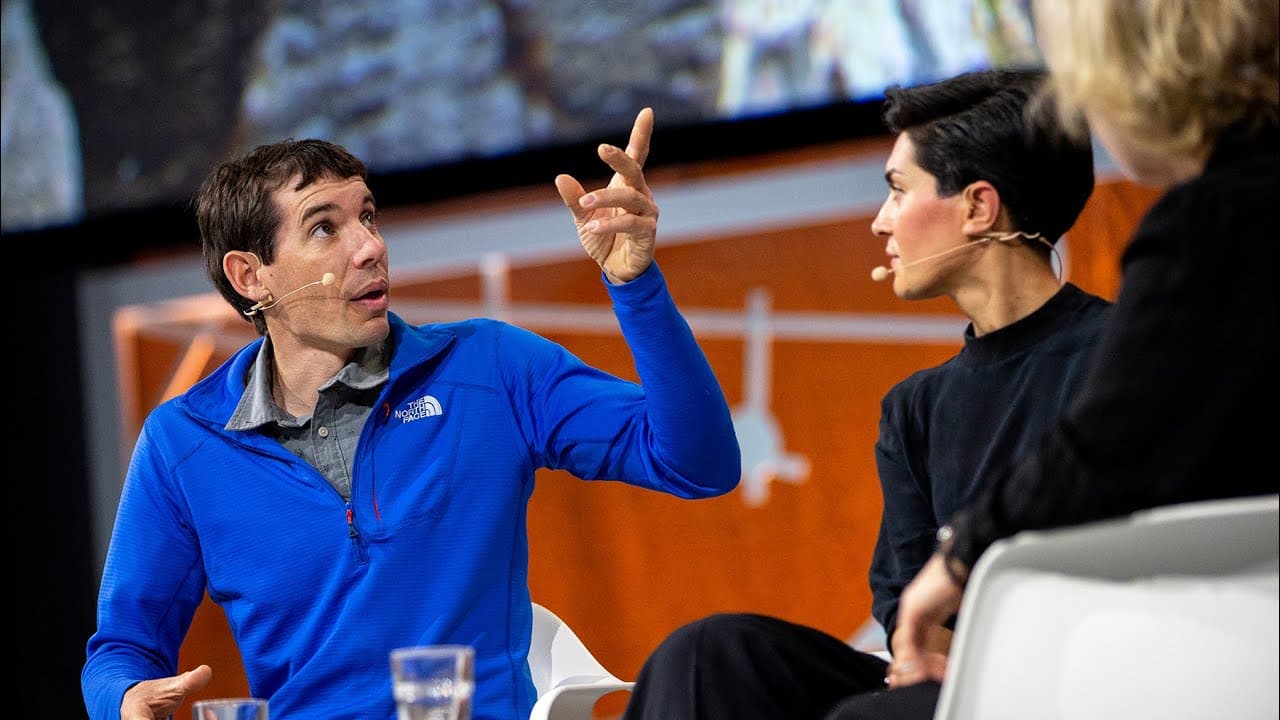
Alex Honnold discusses fear with psychology researcher Armita Golkar - Nobel Week Dialogue 2019
TL;DR
Fear combines an adaptive response to danger with a subjective feeling, and those two components do not always occur together. Familiar risks can seem ordinary even when their consequences are serious, while rare activities attract greater concern. Deliberate preparation, knowledge, mastery, and control can help people distinguish rational warnings from perceived fear and manage chosen risks more thoughtfully.
Transcript
welcome to our meet a gold card and to Alex Honnold we are going to talk about fear and from different perspectives I would say that you are both explorers you are meta explores human emotional learning as a research in psychology and you Alex explores physical and mental capacity when when you when you climb I meter what is the best thing with bei... Read More
Key Insights
- Fear is both an adaptive survival response to danger and a subjective conscious experience. These components are related, but one does not necessarily cause the other, so a person can display a fear response without experiencing fear in precisely the same way.
- Familiarity can reduce how seriously people evaluate risk and uncertainty. Common activities such as driving become normalized through repetition and social acceptance, even though they can still have deadly consequences and depend partly on the unpredictable behavior of other people.
- Free solo climbing involves a spectrum of difficulty rather than uniform danger across an entire route. Honnold describes a 900-meter wall where roughly four meters were exceptionally hard, while about 200 meters were easy enough for him to climb recreationally.
- Chosen risk can be managed through careful thought, training, preparation, and intentional execution. Honnold contrasts this process with uncalculated behavior, such as becoming incapacitated while partying and then driving home while assuming that repeated success makes the danger insignificant.
- Control and mastery can change how fear is experienced. Extensive knowledge of a task allows a person to understand its demands more clearly, reduce avoidable hazards, and respond differently than someone attempting an unfamiliar activity without comparable preparation or practice.
- The central challenge in climbing is distinguishing rational fear from perceived fear. Rational fear can signal an actual danger that deserves attention, while a subjective feeling of fear may not always correspond to the objective conditions or require the same response.
- Uncertainty differs from risk because its probabilities are unknown. Risk is described through situations where both possible outcomes and their probabilities are known, while uncertainty may include a known possible outcome, such as death, without a reliable probability for that outcome.
- Research is a disciplined way to reduce uncertainty while remaining open about incomplete knowledge. Golkar describes psychological research as directing curiosity toward understanding human behavior, creating observable products, asking further questions, and treating uncertainty as a legitimate part of the researcher’s work.
Install to Summarize YouTube Videos and Get Transcripts
Explore YouTube Video Summarizer or Get YouTube Transcript Extractor
Questions & Answers
Q: What is fear from a psychological perspective?
Fear has two distinguishable components: an adaptive survival response to a threat or a predictor of danger, and the conscious, subjective feeling described as being afraid. The components are related, but they do not necessarily occur together or cause each other directly. The survival response supports harm avoidance, while conscious fear can also arise from internally generated thoughts.
Q: How does familiarity change the perception of risk?
Familiarity can make risky or uncertain behavior feel normal because people repeatedly encounter it and see others doing the same. Driving is one example: serious consequences remain possible, and drivers cannot control everyone else in traffic, yet the activity receives less attention than rare dangers. Frequent exposure can therefore cause people to devalue uncertainty and potential harm.
Q: Why can free solo climbing appear more dangerous than everyday activities?
Free solo climbing is rare, visually extreme, and can have a deadly outcome if a climber falls, so observers focus closely on its consequences. Everyday activities can also involve uncertainty and deadly outcomes, but repetition makes them seem ordinary. The contrast in perception comes partly from familiarity and frequency, although the specific circumstances of each activity still matter.
Q: How does Alex Honnold manage risk while free solo climbing?
Honnold manages chosen risk by thinking about it for a long time, training, preparing, understanding the route, mitigating hazards where possible, and executing the climb as well as he can. He views danger as a spectrum that changes across a route, rather than treating every meter as equally difficult or risky. His approach depends heavily on deliberate preparation and mastery.
Q: What is the difference between rational fear and perceived fear?
Rational fear is the body’s meaningful response to an actual danger, so it can provide information that should be heeded. Perceived fear is the subjective feeling of being afraid, which may not always match the objective threat. In climbing, the challenge is to distinguish the two accurately, responding to genuine danger while deciding when a felt fear does not require obedience.
Q: What is the difference between risk and uncertainty?
Risk refers to situations in which the possible outcomes and their probabilities are known, with roulette offered as an example. Uncertainty involves fewer known features. A possible outcome may be identifiable, including death, while the probability of that outcome remains unknown. Because uncertainty offers less information, it can be harder to evaluate than a clearly defined risk.
Q: How can mastery and control affect fear?
Mastery, control, and knowledge can modify conscious feelings of fear and may also influence more fundamental fear responses. A person who has trained extensively and knows a task almost by heart approaches it differently from someone attempting something unfamiliar. Preparation provides a clearer understanding of conditions, abilities, and limits, which supports more informed reactions to perceived danger.
Q: Why does Alex Honnold find climbing rewarding?
Honnold values the physical sensation of climbing, the movement upward, and the experience of flow. He also appreciates curiosity about the unknown, testing limits, and discovering what he can do. One of the most satisfying elements is gradual improvement: working hard on something that once seemed impossible until it eventually becomes achievable through persistent practice and development.
Summary
In this video, Alex Honnold, a professional climber, and the researcher within psychology, Mette Løvbjerg points discuss fear from different perspectives. They talk about the benefits of curiosity and uncertainty in their respective fields and how it relates to fear. Alex shares his love for climbing, the physical act, and the feeling of improvement. They also discuss the relationship between danger and uncertainty and how humans are inclined to adapt to frequent risks and uncertainties. They touch upon the importance of preparation, visualization, and accumulation of safe experiences in combating fear.
Questions & Answers
Q: What is the best thing about being a researcher in psychology?
Mette explains that the best thing about being a researcher in psychology is the opportunity to direct curiosity into something tangible and see the product of their research. They can be creative in looking at the products they create. Being uncertain is also a part of the job as it allows for expressing uncertainty about things and reducing uncertainty through research.
Q: What does Alex like about climbing?
Alex shares that he loves the physical act of climbing and the sensation of moving upward. He also mentions the curiosity about the unknown, pushing the limits, and the feeling of improvement. He finds it satisfying to take something that seemed impossible before and eventually being able to do it.
Q: How does Alex view danger in relation to climbing?
Alex explains that climbing has a spectrum of risk and danger, depending on the circumstances. He uses the example of a photo where he is climbing the hardest part of a 900-meter wall, stating that only a small portion of it is truly dangerous, while the rest is relatively easy and pleasurable. He compares climbing to everyday activities like driving, emphasizing that everything we do has a certain level of risk and uncertainty.
Q: How does uncertainty affect our perception of danger?
Mette explains that uncertainty plays a significant role in how we perceive danger. She states that the frequent or common behaviors that we engage in, like driving, become familiar and less evaluated in terms of risk and uncertainty. On the other hand, rare and extreme actions, like free solo climbing, attract more attention and are seen as more dangerous due to their rarity. She also mentions that the consequences of certain actions, like having a child, can be extremely risky and uncertain, yet they are still common decisions made by adults.
Q: How does knowledge and mastery affect fear and uncertainty?
Alex expresses that knowledge and mastery are essential in combating fear and uncertainty in climbing. He mentions that through visualization and preparation, he acquires a wide range of experience and builds a broad comfort zone. This allows him to perform on autopilot without overthinking during the actual climb. Mette adds to this by stating that safe experiences and learning from mistakes are key to reducing uncertainty and fear in any field.
Q: How do fear and uncertainty relate from a psychological perspective?
Mette explains that fear has both adaptive survival responses to potential threats and subjective conscious feelings. While these aspects of fear are related, one does not necessarily cause the other. Humans, unlike most animals, are more flexible in their fear response as they have to learn what is truly threatening or dangerous. She emphasizes the importance of safe experiences and reducing uncertainty to combat fear.
Q: How do you cope with fear from others about your climbing?
Alex acknowledges that people may be scared for him when it comes to his climbing, but ultimately their fear does not change the likelihood of him falling or the consequences of a fall. He values the opinions of his peers and professional climbers, but ultimately, only he knows how prepared he is and how he feels about the climb. He trusts in his own abilities and preparation.
Q: How does visualization play a role in dealing with fear and uncertainty?
Alex explains that visualization helps him mentally prepare for the climb and imagine different scenarios, including potential falls. By thinking through every position and anxieties ahead of time, he feels more confident during the actual climb. Visualization allows him to experience the climb many times before attempting it physically. Mette adds that visualization is a form of safe experience that helps in reducing uncertainty and fear.
Q: How do you differentiate between fear and excitement?
Alex mentions that he reframes fear as excitement in his mind, especially in situations like public speaking. He explains that fear and excitement often feel similar within the body, and shifting his mindset to excitement helps him deal with the fear.
Q: What is the biggest enemy of fear?
Mette suggests that the biggest enemy of fear is safe experiences. Accumulating safe experiences helps combat the sense of potential danger and reduces uncertainty. By having experiences that contradict the intuitive sense of something being threatening, one gains knowledge and prepares oneself against fear.
Takeaways
In summary, fear and uncertainty are complex phenomena that can be approached from different perspectives. Both psychology and climbing require the ability to navigate and manage fear. Preparation, knowledge, visualization, and safe experiences play vital roles in combating fear and reducing uncertainty. Humans have the flexibility to adapt and learn from their experiences, which allows them to engage in various risky and uncertain activities. Ultimately, fear can be reframed as excitement, and accumulating safe experiences is key to combating fear and understanding the unpredictable nature of life.
Summary & Key Takeaways
-
Alex Honnold describes climbing as rewarding because of its physical movement, sense of flow, exploration of personal limits, and gradual improvement. He particularly values working toward something that initially seems impossible, then developing the ability to accomplish it through sustained effort, preparation, practice, and increasing mastery of the activity.
-
Armita Golkar explains that people often undervalue risks embedded in familiar activities because repetition makes those activities feel normal. Driving, trusting other people in traffic, and having a child all involve uncertainty, but their frequency makes them seem more reasonable and less threatening than rare activities such as free solo climbing.
-
The discussion distinguishes risk from uncertainty and adaptive fear from consciously felt fear. Risk generally involves outcomes and probabilities that are known, while uncertainty involves unknown probabilities. Knowledge, preparation, mastery, and control can modify subjective fear, helping someone identify which fearful signals reflect genuine danger and which may be safely disregarded.
Read in Other Languages (beta)
Share This Summary 📚
Summarize YouTube Videos and Get Video Transcripts with 1-Click
Try YouTube Summary with ChatGPT & Claude or YouTube Transcript Generator
Explore More Summaries from Nobel Prize 📚


Summarize YouTube Videos and Get Video Transcripts with 1-Click
Try YouTube Summary with ChatGPT & Claude or YouTube Transcript Generator