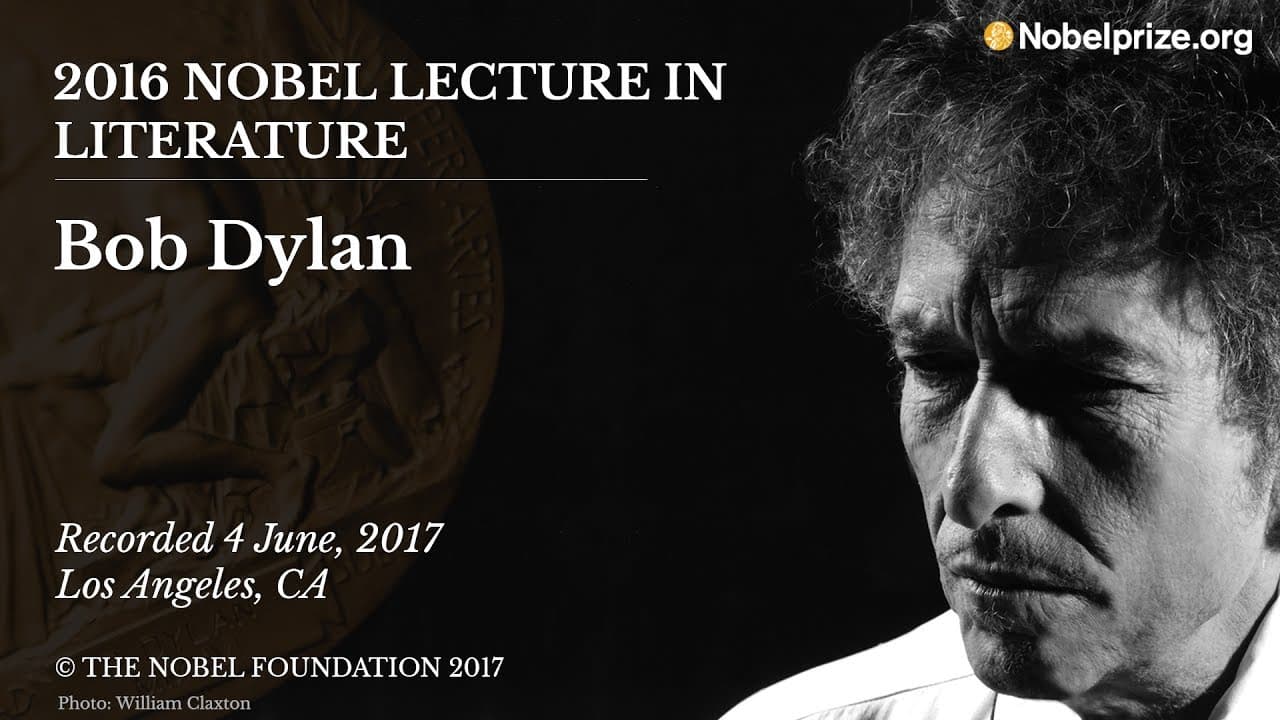
Bob Dylan 2016 Nobel Lecture in Literature
TL;DR
Bob Dylan connects his songwriting to two formative sources: the language of folk music and the themes of classic literature. Buddy Holly and a Leadbelly record awakened his musical direction, while books such as Moby Dick gave him enduring perspectives on obsession, conflict, human nature, illusion, and fate that entered his lyrics both deliberately and unintentionally.
Transcript
When I first received this Nobel Prize for Literature, I got to wondering exactly how my songs related to literature. I wanted to reflect on it and see where the connection was. I'm going to try to articulate that to you. And most likely it will go in a roundabout way, but I hope what I say will be worthwhile and purposeful. If I was to go back to ... Read More
Key Insights
- Buddy Holly was Dylan's early artistic archetype because he combined country western, rock and roll, and rhythm and blues while writing imaginative verses and strong melodies. Seeing Holly perform at close range gave Dylan conviction and left a powerful impression shortly before Holly died.
- A Leadbelly recording of Cottonfields changed Dylan's direction by introducing him to a musical world he had not known. The record led him toward artists advertised in its booklet and created an urgent desire to learn folk music, leave home, and meet the people who performed it.
- Folk songs were more vibrant and truthful to life for Dylan than the radio songs he had previously heard. Success in the folk world depended on knowing a broad repertoire, playing the melody, understanding the audience, and choosing whether a particular song required intimacy or force.
- The folk vernacular became Dylan's first songwriting vocabulary through repeated listening and performance. Singing ragtime blues, work songs, sea shanties, Appalachian ballads, cowboy songs, ancient ballads, and country blues helped him internalize their rhetoric, characters, narrative devices, techniques, details, and mysteries.
- Grammar-school literature gave Dylan an informed view of the world, an understanding of human nature, and standards by which to measure experience. Themes from books entered his songs knowingly and unintentionally, supplementing the folk language he had already absorbed through performance.
- Moby Dick is presented as a straightforward pursuit story filled with complex layers. Captain Ahab chases the white whale as an embodiment of evil, but the narrative also mixes dramatic dialogue, religious allegory, mythology, geography, philosophy, whaling facts, pseudo-science, discrimination, prophecy, and poetic language.
- Ahab's obsession is defined by his refusal to release an old injury and his willingness to pursue an abstract goal toward disaster. Captain Boomer, who also lost a limb to Moby, responds with gratitude for survival, showing how different people can react differently to similar experiences.
- The surface of Moby Dick permits many interpretations of what lies beneath it. Its mixture of highbrow and lowbrow material, illusion and death, rational and irrational ideas, resurrection imagery, omens, prophecy, and memorable poetic phrases demonstrates how many traditions can coexist within one narrative.
Install to Summarize YouTube Videos and Get Transcripts
Explore YouTube Video Summarizer or Get YouTube Transcript Extractor
Questions & Answers
Q: How did Buddy Holly influence Bob Dylan's musical direction?
Buddy Holly represented the kind of artist Dylan wanted to become. Holly combined country western, rock and roll, and rhythm and blues into one recognizable form, wrote songs with beautiful melodies and imaginative verses, and sang in multiple voices. Watching him perform from only six feet away, Dylan found his presence powerful, electrifying, mesmerizing, and full of permanence and conviction.
Q: Why was the Leadbelly record important to Bob Dylan?
The Leadbelly record containing Cottonfields introduced Dylan to a world of music he had never known and immediately changed his life. Its booklet advertised other unfamiliar folk performers, encouraging him to seek out their work. The experience made him want to learn this music, leave home, meet its performers, and temporarily set aside the music on which he had grown up.
Q: How did Bob Dylan learn the language of folk music?
Dylan learned folk language by listening to early performers and singing their songs himself. Working through ragtime blues, work songs, Georgia sea shanties, Appalachian ballads, cowboy songs, ancient ballads, and country blues helped him internalize the vernacular. Repeated performance taught him the finer points, narrative details, rhetoric, techniques, recurring characters, secrets, and mysteries carried by those traditions.
Q: What skills did small folk performances teach Bob Dylan?
Performing for small crowds, sometimes only four or five people in a room or on a street corner, required Dylan to maintain a wide repertoire. He had to recognize what to play and when to play it. Some songs demanded an intimate approach, while others had to be shouted to be heard, making judgment and adaptability essential parts of performance.
Q: How did classic literature affect Bob Dylan's songwriting?
Classic literature gave Dylan principles, sensibilities, an informed worldview, an understanding of human nature, and standards for measuring experience. Books read in grammar school, including Don Quixote, Ivanhoe, Robinson Crusoe, Gulliver's Travels, A Tale of Two Cities, Moby Dick, All Quiet on the Western Front, and The Odyssey, supplied themes that entered his songs consciously and unconsciously.
Q: What is Bob Dylan's interpretation of Moby Dick?
Dylan treats Moby Dick as a direct story about Captain Ahab pursuing the white whale that took his leg, but he emphasizes how much the book contains beneath that plot. It combines dramatic dialogue, religious allegory, pagan and Greek mythology, whaling facts, geography, philosophy, pseudo-scientific theories, prophecy, resurrection imagery, discrimination, obsession, illusion, death, and memorable poetic phrases.
Q: What does Captain Ahab's pursuit of Moby represent?
Ahab's pursuit represents an obsessive commitment to an abstract and destructive purpose. He views Moby as his nemesis and the embodiment of evil, interprets events according to his fixed goal, and rejects advice to let the past go. His pursuit ends with Moby sinking the Pequod and Ahab becoming tangled in harpoon lines and thrown into a watery grave.
Q: How does Moby Dick show different responses to injury?
Moby Dick contrasts Captain Ahab with Captain Boomer, although both have lost a limb to the whale. Boomer accepts what happened and feels fortunate to have survived, while Ahab turns his loss into a consuming desire for vengeance. The contrast supports Dylan's observation that the same kind of experience can lead different people toward tolerance, bitterness, or destructive obsession.
Summary
In this video, the speaker reflects on the connection between his songs and literature after receiving the Nobel Prize for Literature. He shares personal stories about the influence of artists like Buddy Holly and Leadbelly on his music. The speaker also discusses the impact of literature, such as books like Moby Dick, All Quiet on the Western Front, and The Odyssey, on his songwriting. He emphasizes that songs, like literature, should be experienced through listening and singing rather than just reading the lyrics.
Questions & Answers
Q: How did the speaker feel when he first received the Nobel Prize for Literature?
When the speaker first received the Nobel Prize for Literature, he wondered how his songs related to literature and wanted to explore the connection.
Q: Who were the musical influences on the speaker during his youth?
The speaker was influenced by artists like Buddy Holly, who played a mix of country western, rock 'n' roll, and rhythm and blues, and Leadbelly, whose record "Cottonfields" changed the speaker's life.
Q: What impact did Buddy Holly have on the speaker?
The speaker felt a deep connection to Buddy Holly's music and saw him as an archetype of the kind of artist he aspired to be. Holly's powerful presence and captivating performance left a lasting impression on the speaker.
Q: How did Leadbelly's music influence the speaker?
Leadbelly's record introduced the speaker to a world of music he had never known before. It illuminated the darkness and inspired him to learn and play that kind of music. The speaker acknowledges that Leadbelly's songs were different from the radio hits and resonated more deeply with him.
Q: How did the speaker's early experiences as a folk singer shape his songwriting?
As a folk singer, the speaker played for small crowds and learned to have a wide repertoire of songs. He honed his skills by listening to early folk artists and singing various genres, such as ragtime blues, work songs, sea shanties, Appalachian ballads, and cowboy songs. This immersion in the vernacular enriched his understanding of different musical styles and storytelling techniques.
Q: Which books from the speaker's grammar school days influenced his songwriting?
The speaker was influenced by books such as Don Quixote, Ivanhoe, Robinson Crusoe, Gulliver's Travels, Tale of Two Cities, and others. These books provided him with a way of looking at life and an understanding of human nature, which he incorporated into his song lyrics.
Q: How did specific books like Moby Dick, All Quiet on the Western Front, and The Odyssey shape the speaker's songwriting?
The speaker reflects on the themes and stories from these books that have influenced not only his songs but also the work of many other songwriters. He emphasizes that the meanings of songs are subjective and can vary for each listener.
Q: What are the themes and plot of Moby Dick?
Moby Dick tells the story of Captain Ahab, an egomaniacal captain pursuing the great white whale, Moby Dick, who took his leg. The novel explores themes of obsession, good vs. evil, and the unpredictable nature of life. The speaker finds connections between the characters and events in the book and his own songs.
Q: How does All Quiet on the Western Front depict the horrors of war?
All Quiet on the Western Front portrays the devastating effects of war on soldiers. It shows the loss of innocence, faith, and concern for individuals. The speaker relates the themes of disillusionment, violence, and the dehumanizing nature of war to his own songwriting.
Q: What are the key elements of The Odyssey that have influenced the speaker's songs?
The Odyssey follows the journey of Odysseus, who faces various obstacles and trials on his way back home after fighting in a war. The speaker identifies with the themes of wanderlust, struggles, and the desire for homecoming portrayed in the epic poem. He sees parallels between Odysseus' experiences and his own songs.
Q: How does the speaker emphasize the importance of experiencing songs through listening and singing?
The speaker highlights the difference between songs and literature, stating that songs are meant to be sung and heard rather than just read. He encourages listeners to engage with his lyrics through listening to his music in concerts or on recordings.
Takeaways
In this video, the speaker explores the connection between his songs and literature. He shares personal anecdotes about his musical influences and the impact of specific books on his songwriting. The speaker emphasizes that songs, like literature, should be experienced by listening and singing rather than reading the lyrics alone. He invites listeners to interpret the meanings of his songs for themselves, just as he found inspiration in various literary works.
Summary & Key Takeaways
-
Dylan traces his musical awakening to Buddy Holly, whose fusion of country western, rock and roll, and rhythm and blues provided an artistic archetype. Soon after Holly's death, a Leadbelly recording of Cottonfields introduced Dylan to folk traditions and inspired him to seek out unfamiliar musicians, songs, and communities.
-
Performing ancient ballads, country blues, work songs, sea shanties, cowboy songs, and other folk forms taught Dylan their vernacular, rhetoric, techniques, stories, and mysteries. When he began composing, this inherited language became his primary lyrical vocabulary, joined by principles and perspectives formed through the literature he had read in grammar school.
-
Dylan presents Moby Dick as a layered story about Captain Ahab's destructive pursuit of the white whale. Its dramatic dialogue, religious allegory, mythology, factual material, poetic language, and contrasting responses to injury show how a straightforward plot can contain many meanings. Those themes later worked their way into several of Dylan's songs.
Read in Other Languages (beta)
Share This Summary 📚
Summarize YouTube Videos and Get Video Transcripts with 1-Click
Try YouTube Summary with ChatGPT & Claude or YouTube Transcript Generator
Explore More Summaries from Nobel Prize 📚




Summarize YouTube Videos and Get Video Transcripts with 1-Click
Try YouTube Summary with ChatGPT & Claude or YouTube Transcript Generator