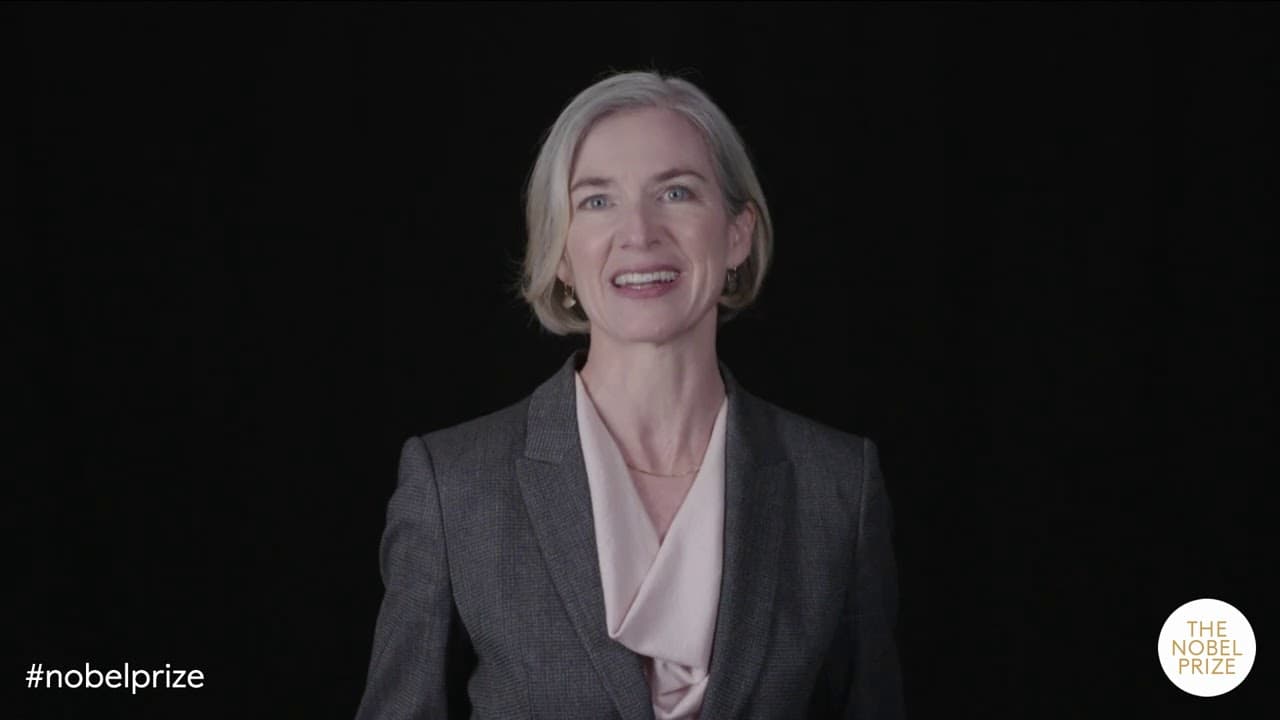
Nobel Lecture: Jennifer Doudna, Nobel Prize in Chemistry 2020
TL;DR
CRISPR-Cas9 is a dual-RNA-guided protein that bacteria evolved as an adaptive immune system, cutting viral DNA at sequences matching its guide RNA. Doudna and Charpentier engineered the two natural RNAs into a single guide RNA, turning Cas9 into a programmable two-component tool that cuts double-stranded DNA at any chosen sequence, enabling precise genome editing.
Transcript
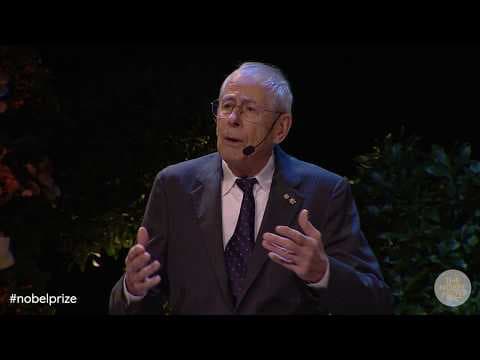
jennifer downer was born in 1964 in washington d.c in 1989 she received her phd from harvard medical school in boston she currently serves as a professor at university of california berkeley in the u.s jennifer doudna i now welcome you on to the stage we are very much looking forward hearing your lecture i'd like to begin by thanking the royal swed... Read More
Key Insights
- CRISPR is a bacterial adaptive immune system that lets cells acquire protection against viral infection in real time by integrating small pieces of viral DNA into the genome and using that record to detect and destroy the virus later.
- The CRISPR locus stores integrated viral sequences called spacers between repeated sequences, and the cell copies these into RNA that guides detection and cleavage of matching viral DNA or sometimes viral RNA.
- Cas9 in nature is a dual-RNA-guided protein: it uses a CRISPR RNA to target matching DNA plus a second RNA called tracer required for assembly with the Cas9 protein, together directing Cas9 to cut the DNA double helix.
- The 2011 collaboration with Emmanuelle Charpentier and Krzysztof Chylinski investigated the function of Cas9 in Streptococcus pyogenes, a bacterium that infects humans and uses Cas9 to protect cells from viral infection.
- The key engineering breakthrough was fusing the two natural RNAs into a single guide RNA carrying both targeting information and the structural requirement for Cas9 assembly, making Cas9 a programmable DNA cleaver.
- Cas9 requires a PAM, a protospacer adjacent motif, located next to the target sequence in the DNA; the PAM plus the guide RNA match are the two elements needed for Cas9 to recognize and cleave DNA.
- In eukaryotic cells, double-strand breaks are repaired either by non-homologous end joining, which can introduce a small disruption, or by homology-directed integration that incorporates new genetic information at the break site.
- Genome editing works because Cas9 enters the nucleus, searches for a 20-base-pair sequence matching the 20-nucleotide guide RNA, unwinds and cuts each DNA strand, then hands the broken ends to repair enzymes that alter the genome at a precise place.
Install to Summarize YouTube Videos and Get Transcripts
Explore YouTube Video Summarizer or Get YouTube Transcript Extractor
Questions & Answers
Q: What is CRISPR and where did it come from?
CRISPR is an adaptive immune system in bacteria, discovered through microbiology research at least two decades before this lecture. It lets cells acquire protection against viral infection in real time by integrating small pieces of viral DNA into a genomic site called CRISPR. The cell then makes an RNA copy of that sequence, which provides the information needed to detect and cleave viral DNA using CRISPR-associated (Cas) proteins.
Q: How does Cas9 work in nature to target DNA?
In nature Cas9 is a dual-RNA-guided protein. It uses a CRISPR RNA molecule to direct it to a DNA sequence that matches the CRISPR RNA, and it also requires a second RNA called tracer that provides the interaction with the CRISPR RNA required for assembly with Cas9. Together these two RNAs guide Cas9 to the target DNA, where the protein makes a cut in the double helix of DNA.
Q: What was the key engineering breakthrough that made CRISPR a technology?
Once the team understood how nature uses a dual-RNA system to guide Cas9, they engineered the two RNAs into a single guide RNA that included both the targeting information and the structural requirement for assembly with Cas9 in one molecule. This experiment, done by Martin Jinek and Krzysztof Chylinski, showed Cas9 could be programmed with single guide RNAs and directed to cleave double-stranded DNA at a desired sequence, turning it into a simple two-component system.
Q: What is a PAM and why is it important for Cas9?
PAM stands for protospacer adjacent motif, a sequence that occurs right next to the target sequence in the DNA. For Cas9 to recognize and cleave DNA, two elements are required: the actual targeting information in the CRISPR RNA molecule, and the PAM sequence. Together these requirements are sufficient for Cas9 to function as an RNA-guided DNA cleaver, cutting only where both the guide match and the adjacent PAM are present.
Q: How did the plasmid experiment prove Cas9 is programmable?
Martin Jinek designed guide RNAs recognizing five different sites, marked in red, within a circular double-stranded plasmid DNA. He added those single guide RNAs to purified Cas9, incubated them with the plasmid in a test tube, and separated the cleaved DNA products on an agarose gel. Depending on where each guide RNA was directed, Cas9 generated a cut, releasing DNA fragments of different sizes, confirming Cas9 could be programmed to cut chosen sequences.
Q: How does CRISPR-Cas9 edit genes in human, animal, and plant cells?
Cas9 is directed into the nucleus of a eukaryotic cell where, with its guide RNA, it searches the genome for a 20-base-pair sequence matching the 20 nucleotides of the guide RNA. When that match occurs, Cas9 unwinds the DNA and generates a precise double-stranded break by cleaving each strand. The broken ends are then handed off to repair enzymes, and during repair a change can be introduced at a precise place, which is the definition of genome engineering.
Q: How do eukaryotic cells repair the double-strand breaks that Cas9 makes?
Eukaryotic cells like plant, animal, and human cells detect and repair double-strand breaks before they can cause cell death. Repair happens through one of two pathways: non-homologous end joining, which can sometimes introduce a small disruption to the DNA sequence, or integration of DNA that has homology to the sequence flanking the break, in which case new genetic information is incorporated into the genome at the site of the original break.
Q: Why was the collaboration with Emmanuelle Charpentier significant?
In 2011 Doudna's lab began a collaboration with Emmanuelle Charpentier and her student Krzysztof Chylinski to answer what the protein CRISPR-Cas9 does. Charpentier's group studied Streptococcus pyogenes, a bacterium that infects humans and has a Cas9 protein implicated in protecting cells from viral infection. Through biochemical experiments with purified Cas9 and its guide RNAs, the collaboration revealed Cas9 as a dual-RNA-guided protein, which then led to the single-guide-RNA engineering breakthrough.
Summary
In this video, Jennifer Doudna discusses the science behind CRISPR-Cas9 as a genome editing technology. She explains the origin of the CRISPR system in bacteria and how it acts as an adaptive immune system. Doudna describes the three steps of CRISPR acquired immunity: adaptation, expression, and interference. She then delves into the discovery of CRISPR-Cas9's function as a dual RNA-guided protein and how it can be engineered to target specific DNA sequences. Doudna highlights the potential applications of CRISPR-Cas9 in correcting disease-causing mutations and the ethical considerations surrounding germline editing. She also discusses the diversity of CRISPR systems in nature and the future possibilities for CRISPR technology.
Questions & Answers
Q: What is the origin of the CRISPR system?
The CRISPR system originated in bacteria as an adaptive immune system to protect against viral infection. It allows bacteria cells to acquire small pieces of viral DNA into the CRISPR locus in their genome and use that information to detect and cleave viral DNA using CRISPR-associated proteins.
Q: How does CRISPR-Cas9 function as a genome editing technology?
CRISPR-Cas9 is a dual RNA-guided protein that can be programmed with single guide RNAs to target specific DNA sequences. When a guide RNA matches a sequence in the DNA, Cas9 cuts the DNA, triggering repair mechanisms in the cell. This repair process can introduce desired changes to the genome, allowing for precise genome editing.
Q: What are the three steps of CRISPR acquired immunity?
The three steps of CRISPR acquired immunity are adaptation, expression, and interference. Adaptation involves integrating small pieces of viral DNA into the CRISPR locus of the genome. Expression refers to the process of making RNA copies of the integrated viral sequences. Interference is the stage where RNA-guided detection of viral DNA occurs and Cas proteins cleave the viral DNA, providing protection to the cell.
Q: How did the collaboration with Emmanuel Charpentier and Christophe Chylinski contribute to the understanding of CRISPR-Cas9's function?
The collaboration with Emmanuel Charpentier and Christophe Chylinski helped answer the question of the function of the protein Crispr-Cas9. Their research showed that Crispr-Cas9 is a dual RNA-guided protein that uses a Crispr RNA molecule and a tracer RNA molecule to guide Cas9 to target DNA sequences. This finding allowed for the engineering of a simple two-component system for directing DNA double-stranded cutting.
Q: How was the agency to program Cas9 with single guide RNAs discovered?
Martin Yanick, working in collaboration with Jennifer Doudna and Christophe Chylinski, discovered that Cas9 can be programmed with single guide RNAs. By designing guide RNAs that recognize different target sequences in a plasmid DNA, they demonstrated that Cas9 could cleave the DNA at the desired sequences. This breakthrough enabled the programmability of Cas9 for precise genome editing.
Q: How are double-stranded breaks in DNA repaired in eukaryotic cells?
In eukaryotic cells, double-stranded breaks in DNA can be repaired through two main pathways. The non-homologous end-joining pathway can sometimes introduce small disruptions to the DNA sequence, while the homology-directed repair pathway can integrate DNA with homology to the flanking sequence of the break. Cas9-triggered breaks can stimulate these repair pathways, leading to changes in the genome.
Q: What challenges and opportunities are associated with genome editing in somatic and germ cells?
Genome editing in somatic cells, which are fully differentiated cells, can correct mutations but is not heritable. In contrast, genome editing in germ cells, such as sperm or egg cells, has the potential to introduce heritable changes. While somatic cell editing offers opportunities in disease correction, germ cell editing raises ethical and societal concerns, especially in the context of human germline editing. Responsible use and transparency are vital in these areas of research.
Q: How could CRISPR-Cas9 be applied in the correction of disease-causing mutations?
The precision of CRISPR-Cas9 makes it a promising tool for correcting disease-causing mutations. One example is the correction of sickle cell anemia-causing mutations. By using Cas9 to edit the specific mutation, researchers have shown that this technology can effectively and safely correct genetic diseases.
Q: What are some potential future applications of CRISPR technology?
The applications of CRISPR technology extend across various areas, including public health, agriculture, and biomedicine. In addition to disease correction, CRISPR technology can be used for detection and specificity in viral testing. The versatility and programmability of CRISPR systems open up countless possibilities for future innovations in fundamental research and practical solutions to real-world problems.
Q: What are the challenges and future prospects for CRISPR technology?
Challenges in the future of CRISPR technology include improving delivery methods for CRISPR-Cas9 and related proteins into different cell types, particularly for human patients. Additionally, ongoing fundamental research is crucial for expanding our understanding of the diversity and potential of CRISPR systems. Responsible use of CRISPR in human germline editing is essential, and international efforts are underway to establish guidelines and criteria for its use. Collaboration, transparency, and careful consideration of ethical implications will continue to shape the future of CRISPR technology.
Takeaways
CRISPR-Cas9 has revolutionized genome editing by offering a precise and programmable tool for manipulating DNA. It originated from the adaptive immune system of bacteria and has been harnessed as a technology for genome editing in various organisms. The ability to program Cas9 with single guide RNAs enables targeted cleavage of specific DNA sequences. CRISPR technology holds immense potential for correcting disease-causing mutations, but it also raises ethical considerations, particularly in human germline editing. Future advancements involve improving delivery methods, exploring the diversity of CRISPR systems, and applying CRISPR technology for detection, specificity, and real-world applications in human health and the environment. Responsible use, transparency, and collaboration are essential for the ethical and effective use of CRISPR technology.
Summary & Key Takeaways
-
CRISPR originated from microbiology research showing bacteria have an adaptive immune system. Cells integrate small pieces of viral DNA into a genomic site called CRISPR, copy it into RNA, and combine that RNA with tracer RNA and Cas9 to form a surveillance complex that finds and cuts matching viral DNA.
-
Working with Charpentier and Chylinski from 2011, Doudna's lab used biochemistry with purified Cas9 and its guide RNAs to show Cas9 is a dual-RNA-guided protein. Martin Jinek and Chylinski then engineered a single guide RNA, and a plasmid experiment cutting five different target sites proved Cas9 is a programmable two-component DNA cutter.
-
Because eukaryotic cells repair double-strand breaks by end joining or homology-directed integration, Cas9's programmed cutting can trigger precise genome changes. Guided into the nucleus, Cas9 finds a 20-base-pair match, cuts both strands, and repair enzymes then introduce a change at that exact location, defining genome engineering.
Read in Other Languages (beta)
Share This Summary 📚
Summarize YouTube Videos and Get Video Transcripts with 1-Click
Try YouTube Summary with ChatGPT & Claude or YouTube Transcript Generator
Explore More Summaries from Nobel Prize 📚


Summarize YouTube Videos and Get Video Transcripts with 1-Click
Try YouTube Summary with ChatGPT & Claude or YouTube Transcript Generator