Martin Luther King Jr. Nobel Peace Prize Acceptance Speech
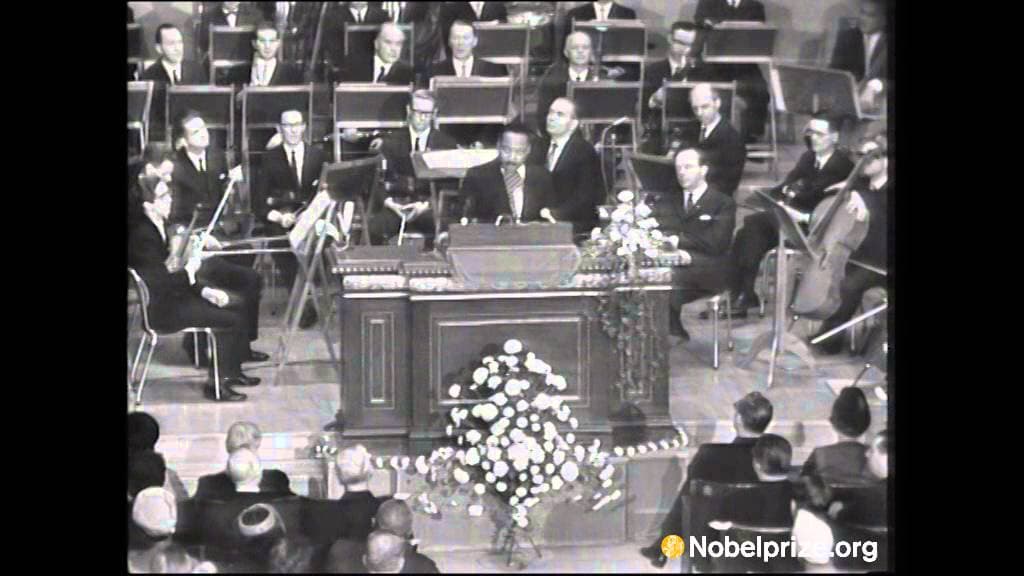
Transcript
[Applause] your majesty your Royal Highness Mr President excellencies ladies and gentlemen I accept the Nobel Prize for Peace at a moment when 22 million Negroes of the United States are engaged in a creative battle to end the long night of racial Injustice I accept this award on behalf of a civil rights movement movement which is moving with deter... Read More
Install to Summarize YouTube Videos and Get Transcripts
Explore YouTube Video Summarizer or Get YouTube Transcript Extractor
Summary
In this speech, the speaker accepts the Nobel Peace Prize on behalf of the civil rights movement in the United States. They acknowledge the struggles and injustices faced by African Americans, including violence, poverty, and discrimination. The speaker reflects on why a movement still in the midst of its fight for peace and equality would receive such an award, and concludes that non-violence is the answer to achieving political and moral transformation. They emphasize the power of love and the need for all people to live together in peace. The speech is optimistic about the future and expresses faith in humanity's ability to overcome racism, war, and despair.
Questions & Answers
Q: Why does the speaker accept the Nobel Peace Prize on behalf of the civil rights movement?
The speaker accepts the Nobel Peace Prize on behalf of the civil rights movement because it represents a recognition that non-violence is the answer to the crucial political and moral questions of our time. Despite the ongoing struggles and injustice that African Americans face, the movement's commitment to unrelenting struggle demonstrates their determination to establish a reign of freedom and a rule of justice. By accepting the award, the speaker also acknowledges the movement's profound impact on the progress and hope of all Americans.
Q: What does the speaker mean by saying non-violence is not sterile passivity, but a powerful moral force?
The speaker means that non-violence is far from being a passive or weak approach to addressing oppression. Instead, it is a strong and principled moral force that has the power to bring about social transformation. Just as the people of India, as well as African Americans in the United States, have shown, non-violence can be a powerful tool in the fight against injustice. It is a method that rejects revenge, aggression, and retaliation, and instead relies on love as its foundation. By choosing non-violence, the civil rights movement challenges the notion that civilizations must rely on violence.
Q: Why does the speaker believe that all the peoples of the world will have to discover a way to live together in peace?
The speaker believes that all the peoples of the world will have to discover a way to live together in peace because civilization and violence are fundamentally opposed. In order to overcome oppression and violence, it is necessary to reject resorting to violence and aggression. The speaker draws inspiration from the example of the civil rights movement and the non-violent methods employed by African Americans and the people of India. They believe that these examples serve as proof that non-violence is a powerful moral force that can bring about social transformation. Ultimately, the speaker envisions a world where peace and brotherhood triumph and all people can coexist peacefully.
Q: Why does the speaker refuse to accept despair as the final response to the ambiguities of history?
The speaker refuses to accept despair as the final response to the ambiguities of history because they believe in the power of hope and the audacious faith in the future of mankind. They reject the idea that humanity is incapable of reaching for a higher moral standard and making positive change in the world. Despite the current challenges and the presence of racism, war, and nuclear annihilation, the speaker maintains their belief in the power of unarmed truth, unconditional love, and redemptive goodwill. Their refusal to accept despair is rooted in their faith that truth, love, justice, and peace will ultimately prevail.
Q: What is the overall message of the speaker's speech?
The overall message of the speaker's speech is one of optimism, hope, and faith in humanity's ability to overcome injustice, discrimination, and violence. They believe in the power of non-violence as a moral force that can bring about social transformation. The speaker stresses the importance of love, unity, and peace in creating a better world. They refuse to accept despair as the final response to historical challenges and envision a future where all people can live together in peace and harmony. The speech is a call for individuals and societies to strive for justice, equality, and freedom, and to never lose sight of the potential for a brighter tomorrow.
...
Takeaways
The speech by the Nobel Peace Prize recipient highlights the power of non-violence as a moral force in the fight against injustice. It emphasizes the need for all people to live together in peace and the importance of love and unity in overcoming oppression and violence. The speaker rejects the notion that despair is the final response to the challenges of history and expresses faith in humanity's capacity for positive change. The speech serves as an inspiration to continue the ongoing struggle for peace, justice, and equality, reminding us that even in the darkest of times, there is hope for a brighter tomorrow.
Read in Other Languages (beta)
Share This Summary 📚
Summarize YouTube Videos and Get Video Transcripts with 1-Click
Try YouTube Summary with ChatGPT & Claude or YouTube Transcript Generator
Explore More Summaries from Nobel Prize 📚
Summarize YouTube Videos and Get Video Transcripts with 1-Click
Try YouTube Summary with ChatGPT & Claude or YouTube Transcript Generator