Donna Strickland: Nobel Lecture in Physics 2018
TL;DR
Chirped pulse amplification creates extremely intense, short laser pulses without destroying the amplifying medium, overcoming a major limit on peak power. The underlying story begins with photons, the photoelectric effect, multiphoton interactions, and the laser’s ability to concentrate coherent, single-color light into one directed beam.
Transcript
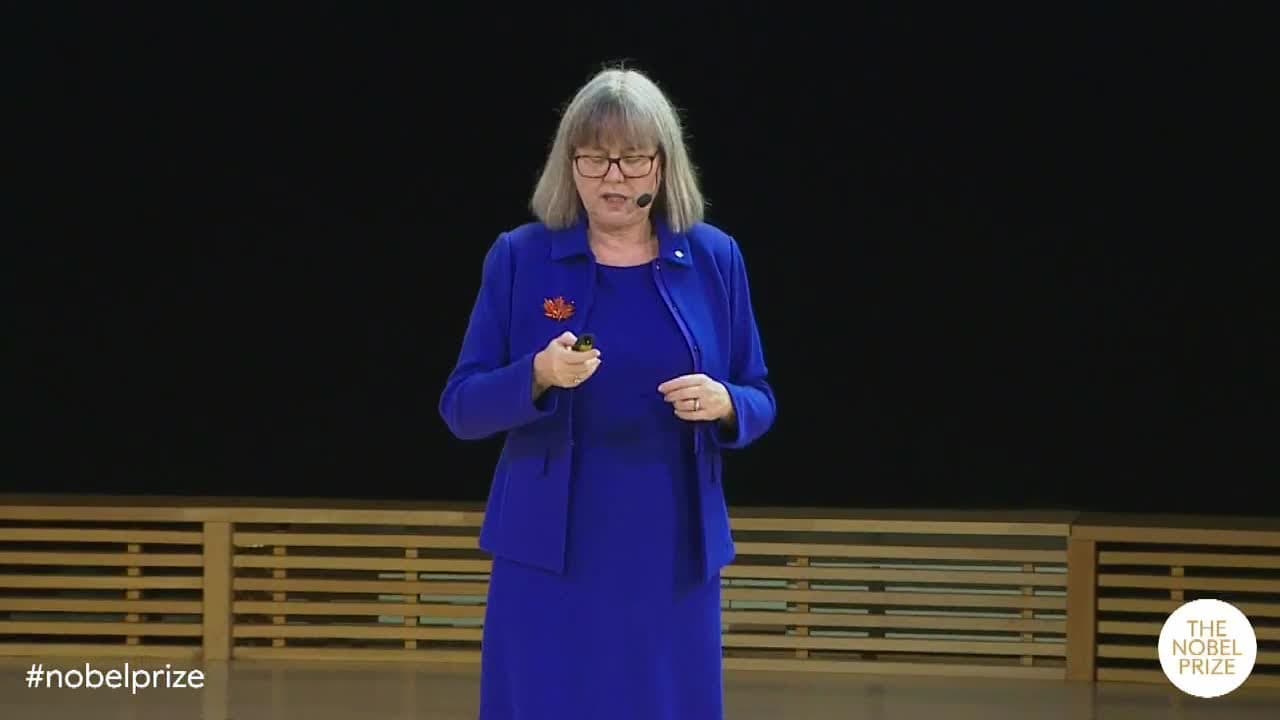
our next speaker is Donna Strickland Donna is a Canadian experimental physicist born in May 1959 in the City of Guelph in southwestern Ontario she received her bachelor's degree in engineering physics from McMaster University in Canada in 1981 and obtained a PhD in optics from the University of Rochester New York in 1999 where she and her doctoral ... Read More
Key Insights
- Light is quantized into photons, and each photon carries an energy determined by its wavelength. The total energy of a light beam depends on both the energy of each individual photon and the number of photons present.
- The photoelectric effect shows that brighter light releases more electrons without necessarily increasing their speed. Electron speed depends on the energy of individual photons, while increased power supplies more photons that can interact with more atoms.
- Red light cannot eject an electron when each photon carries less energy than the atom requires for release. Adding more red photons does not solve the problem under the ordinary one-photon, one-atom model of light interacting with matter.
- Violet photons eject faster electrons than green photons because their shorter wavelength corresponds to greater individual photon energy. Increasing the number of violet photons produces more emitted electrons, but those electrons continue to leave with the same characteristic speed.
- Multiphoton ionization is an interaction in which two or more photons combine their energy at an atom. Maria Goeppert Mayer proposed this possibility during her doctoral work, although no one observed a related multiphoton effect until about thirty years later.
- Second harmonic generation occurs when an atom momentarily absorbs two red photons and releases their combined energy as one photon with twice the energy. Peter Franken’s group at the University of Michigan first observed this multiphoton effect in 1961.
- Laser light is concentrated, directional, single-colored, and coherent. Its photons move together with their wave crests aligned, producing a larger collective wave and a greater photon density than ordinary light, whose photons travel independently in many directions.
- Chirped pulse amplification is a method for greatly amplifying short laser pulses without destroying the amplifying medium. Donna Strickland and her doctoral supervisor developed the technique, published it in a three-page paper in 1985, and made it the subject of her thesis.
Install to Summarize YouTube Videos and Get Transcripts
Explore YouTube Video Summarizer or Get YouTube Transcript Extractor
Questions & Answers
Q: How does chirped pulse amplification increase laser intensity?
Chirped pulse amplification allows a short laser pulse to be amplified immensely without destroying the material used for amplification. Destruction of the amplifying medium had severely limited achievable peak power. Donna Strickland and her doctoral supervisor developed the method during her doctoral research and described it in a three-page scientific paper published in 1985.
Q: What does the photoelectric effect reveal about photons?
The photoelectric effect reveals that light energy is quantized into individual photons. A photon must carry enough energy to overcome an atom’s hold on an electron. Increasing brightness adds photons and can release more electrons, but it does not make each emitted electron faster. The electron’s speed instead depends on the energy of the individual photon.
Q: Why can violet light eject faster electrons than green light?
Violet light has a shorter wavelength than green light, and its individual photons carry more energy. When a violet photon transfers energy to an atom, more energy remains for the released electron after overcoming the atom’s hold, so the electron travels faster. Greater brightness increases the number of electrons emitted, not their characteristic speed.
Q: Why does brighter red light fail to eject electrons?
A red photon does not carry enough individual energy to overcome the energy with which an atom holds its electron. Under the ordinary photoelectric interaction, one photon meets one atom at a time, so adding more red photons only creates more insufficient individual encounters. Brightness alone therefore cannot cause electron emission in that model.
Q: What is multiphoton ionization?
Multiphoton ionization is an interaction in which more than one photon contributes energy during a single encounter with an atom. Two lower-energy red photons, for example, can combine to provide energy comparable to one higher-energy violet photon and release an electron. Maria Goeppert Mayer proposed this possibility in doctoral work published in 1931.
Q: What is second harmonic generation?
Second harmonic generation is a nonlinear optical effect in which an atom momentarily absorbs two photons and then releases their combined energy as one photon with twice the energy. The lecture describes Peter Franken’s group at the University of Michigan observing this effect in 1961 using red photons, following the laser’s first demonstration in 1960.
Q: Why did lasers make nonlinear optical effects observable?
Lasers concentrate photons much more effectively than ordinary light. Their light travels in one direction, has one color, and remains coherent, meaning the photons move together with aligned wave crests. This organization creates a large collective wave and greater photon density, making cooperative multiphoton interactions sufficiently likely to be observed experimentally.
Q: What made Donna Strickland’s laser research significant?
Donna Strickland helped develop a method that immensely amplified the intensity of short laser pulses without destroying the amplifying medium, which had been a severe limitation on peak power. Chirped pulse amplification revolutionized laser science and supported advances in multiple fields, including medicine and eye treatments. It was also the subject of her doctoral thesis.
Summary
Donna Strickland, a Canadian experimental physicist, discusses how light interacts with matter and how intense light can change this interaction. She explains the concept of photons and their energy, and how different colors of light have varying effects on electrons. She also discusses the work of Albert Einstein and Maria Goeppert-Mayer in understanding the quantized nature of light energy and the concept of multiphoton ionization. Strickland then describes her own research in developing intense laser pulses using chirped pulse amplification (CPA) technique. She explains the process of pulse stretching and amplification using laser rods, gratings, and optical fibers. Finally, she discusses her experiments with multiphoton ionization and the unexpected behavior of intense laser light interacting with atoms.
Questions & Answers
Q: How did early scientists investigate the interaction between light and matter?
Early scientists wondered whether light was made up of particles or waves. They shone different colors of light on materials and observed the behavior of electrons being ejected. Initially, they believed that red light did not cause electrons to come off, while green light caused electrons to come off but with low speed. However, violet light caused electrons to come off with higher speeds.
Q: How did Albert Einstein contribute to the understanding of light energy?
Albert Einstein explained the observation that light energy was quantized into individual photons. He proposed that light was made up of particles called photons, and the energy of a photon was determined by its wavelength. He received a Nobel Prize for his explanation of the photoelectric effect, which demonstrated that light energy was carried by discrete packets or quanta.
Q: What did Maria Goeppert-Mayer contribute to the study of light and matter interaction?
Maria Goeppert-Mayer's research focused on the concept of multiphoton ionization, which involves the interaction of multiple photons with atoms. She hypothesized that if multiple photons could interact with an atom simultaneously, they could collectively provide enough energy to liberate an electron. However, her idea was not immediately observed experimentally, and it took several decades before her predictions were confirmed.
Q: How were multiphoton effects finally observed?
It was not until the 1960s, with the invention of the laser, that researchers were able to observe multiphoton effects. The first experimental observation of multiphoton ionization was done by Peter Franken's group at the University of Michigan in 1961, using atoms that temporarily absorbed two red photons and emitted one photon with double the energy. This phenomenon is known as second harmonic generation.
Q: What is the difference between a regular light source and laser light?
Regular light sources emit photons of all colors in random directions, which results in low photon density and lack of coherence. Laser light, on the other hand, is a single-color, highly coherent beam of photons. In a laser, the photons are in phase and work together to create a concentrated, directed beam of light.
Q: How did Donna Strickland and Gerard Mourou develop intense laser pulses?
Donna Strickland and Gerard Mourou developed a technique called chirped pulse amplification (CPA). They started with a short laser pulse and stretched it out using a process called pulse stretching. Then, they amplified the stretched pulse, which increased its energy. Finally, they compressed the amplified pulse back to its original duration using gratings. This process allowed them to create intense laser pulses with high peak power.
Q: Why did Donna Strickland need fiber optics in her laser experiment?
Donna Strickland used fiber optics in her experiment for several reasons. Firstly, she needed more colors in her laser beam to create a shorter pulse. By adding different wavelengths of light in the fiber, the pulse could be stretched to a greater extent. Secondly, the fiber allowed her to transport the laser beam to another part of the laboratory, where she built the laser amplifier. Finally, fiber optics helped to avoid damage caused by nonlinear effects that occurred inside laser rods.
Q: How did Donna Strickland use pulse compression to shorten the laser pulse again?
Pulse compression was achieved using a pair of parallel gratings, which act like prisms to separate light of different colors. As the stretched pulse passed through the gratings, the different colors were sent out at different angles, with the red color leading the way and the blue color trailing behind. When the colors passed through the second grating, they all converged at the same time, resulting in a compressed, short pulse.
Q: What was Donna Strickland's initial goal for the intense laser pulses?
Donna Strickland's initial goal was to study harmonic generation using intense laser pulses. She wanted to explore the possibility of grabbing multiple photons with one atom to generate higher energy photons. Specifically, she aimed to use nine photons to ionize twice ionized nickel. However, due to technical difficulties and the limitations of the CPA technique, she shifted her focus to multiphoton ionization.
Q: How did intense laser light interact with matter in Donna Strickland's experiments?
In Donna Strickland's experiments, the intense laser light created a giant wave-like structure with high photon density. This wave interacted with atoms, causing them to be pushed and pulled by the electric field of the light. The interaction was so strong that electrons were released from the atoms and accelerated by the electric field. This resulted in the emission of high-energy particles within femtoseconds.
Takeaways
Donna Strickland's research in developing intense laser pulses using chirped pulse amplification (CPA) technique has revolutionized the field of laser science. She demonstrated how light interacts with matter and how intense light can change this interaction. The CPA technique allows researchers to create high-intensity laser pulses with short durations and high photon density. This has opened up new possibilities for studying light-matter interactions and has led to advancements in various fields, including medicine and eye treatment. Strickland's work highlights the importance of pushing the boundaries of scientific understanding and continually innovating in the field of laser science.
Summary & Key Takeaways
-
Light’s interaction with matter depends on photon energy and quantity. Red light cannot eject electrons when individual photons lack sufficient energy. Green photons can release slow electrons, while violet photons release faster ones. Raising power increases the number of emitted electrons, but it does not increase their individual speeds.
-
Einstein explained the photoelectric effect by treating light as quantized energy composed of photons. Maria Goeppert Mayer later proposed that multiple photons could cooperate in one interaction, allowing their combined energy to affect an atom. This idea, now called multiphoton ionization, was predicted decades before related effects were observed experimentally.
-
Lasers enabled nonlinear optical effects because their photons are concentrated, travel in one direction, share one color, and remain synchronized as a coherent wave. Strickland and her doctoral supervisor later developed chirped pulse amplification, a technique that greatly increased short-pulse intensity without destroying the amplifying material and advanced laser science and medicine.
Read in Other Languages (beta)
Share This Summary 📚
Summarize YouTube Videos and Get Video Transcripts with 1-Click
Try YouTube Summary with ChatGPT & Claude or YouTube Transcript Generator
Explore More Summaries from Nobel Prize 📚



Summarize YouTube Videos and Get Video Transcripts with 1-Click
Try YouTube Summary with ChatGPT & Claude or YouTube Transcript Generator