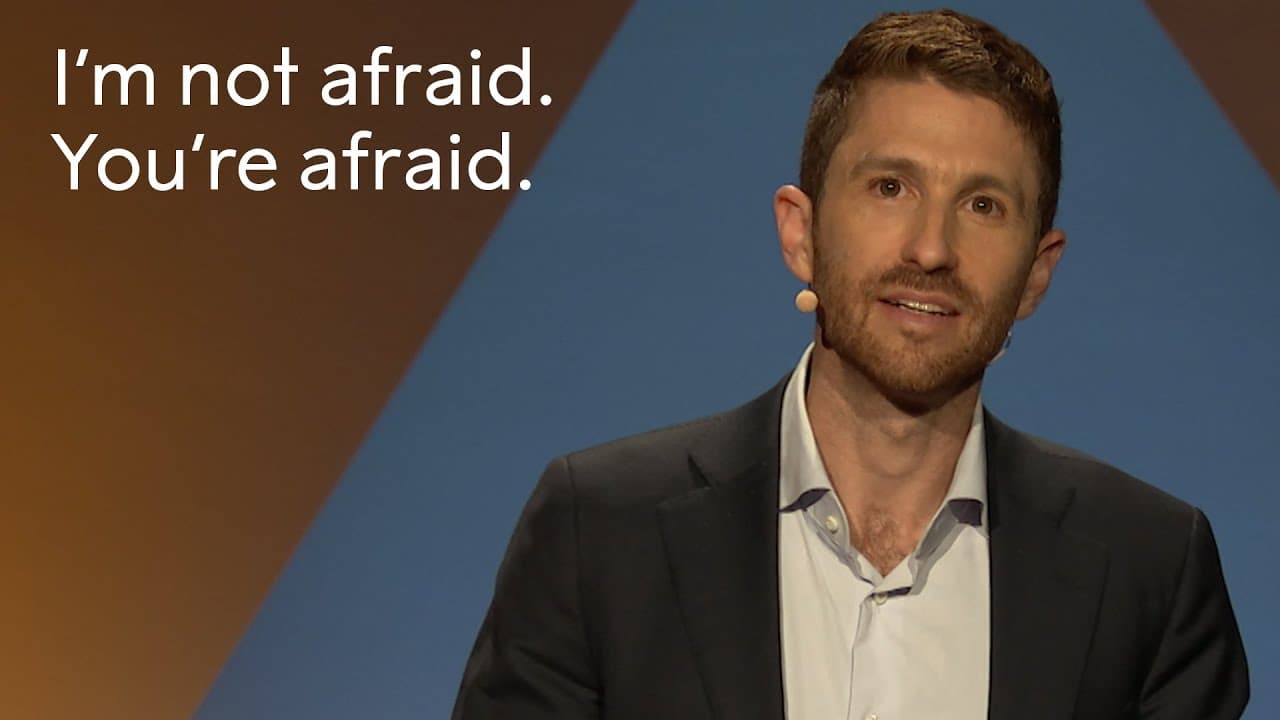
I'm not afraid. You're afraid | Tristan Harris | Nobel Prize Summit 2023
TL;DR
Tristan Harris argues that social media and AI are misaligned with human cognition, rewiring attention and information while institutions struggle to keep pace. At the Nobel Prize Summit 2023, he describes social media as humanity’s first contact with AI and cites consequences including doomscrolling, loneliness, polarization, bots, deepfakes, and the breakdown of shared reality. Read on for his explanation of engagement-driven technology and its collective effects.
Transcript
[Applause] um it's great to be here uh with all of you and so great to see the broad range of of topics that have been covered because it's really more it's so much more than just misinformation we often think about social media as kind of creating the climate change of culture and what I hope to do is sort of broaden and maybe zoom out a bit on wh... Read More
Key Insights
- Social media acts as a supercomputer targeting human cognition, affecting attention and information flow.
- The alignment problem in AI extends to aligning human brains with societal institutions and technology.
- Social media's business model relies on maximizing user engagement, often at the cost of user well-being.
- Fake news spreads faster than true news, creating a distorted representation of societal voices.
- Current institutions struggle to address the complexity of modern technological challenges.
- Runaway technology like AI amplifies existing threats, necessitating upgraded governance and regulation.
- Human institutions need to evolve to address diffuse, long-term harms rather than just acute issues.
- Binding technology's power to wisdom and responsibility is critical to prevent societal harm.
Install to Summarize YouTube Videos and Get Transcripts
Explore YouTube Video Summarizer or Get YouTube Transcript Extractor
Questions & Answers
Q: What does Tristan Harris say about social media and AI?
Tristan Harris says social media was humanity’s first contact with an AI that rewired attention and information flows. He argues that this system was misaligned with humanity and produced collective effects resembling a climate change of culture.
Q: How does Tristan Harris describe social media’s effect on human cognition?
He says that swiping on TikTok, Twitter, or YouTube activates a supercomputer pointed at the user’s brain. It calculates the next item to show based on what three billion other human social primates have watched, seen, or viewed.
Q: Why does Tristan Harris call social media humanity’s first contact with AI?
He says social media already used AI to determine what content would capture each person’s attention. In his account, that system rewired society’s flows of attention and information before the arrival of large language models.
Q: What harms does Tristan Harris associate with social media?
He lists information overload, doomscrolling, loneliness, influencer culture, the sexualization of young children, polarization, bots, deepfakes, and the breakdown of shared reality. He presents these outcomes as collective effects that extend beyond misinformation alone.
Q: Why does social media maximize engagement, according to Tristan Harris?
Harris says users pay nothing for TikTok, YouTube, or Facebook accounts, while the companies sell their attention. This creates a race to maximize engagement through features such as pull-to-refresh mechanics, likes, rapid sharing, and personalized content.
Q: How do social media platforms encourage validation seeking?
Harris argues that a person who seeks attention and validation from others is more profitable than someone who does not. Platforms therefore use features such as likes, beautification filters, larger reach, and instant sharing to keep people seeking attention.
Q: What does Tristan Harris mean by a race to the bottom of the brain stem?
He describes platforms copying attention-capturing features because they risk losing users if competitors offer stronger rewards. His examples include beautification filters and platforms competing to give creators more views and faster social feedback.
Q: Why does Tristan Harris believe institutions struggle with advancing technology?
He says humanity has Paleolithic emotions or brains, medieval institutions, and godlike technology. Because AI and large language models move far faster than human brains and institutions, he argues that humanity lacks an adequate steering wheel for controlling their effects.
Summary
In this video, the speaker discusses the collective effects of technology and humanity, and how social media has influenced our minds. They talk about the misalignment between our brains and technology and describe social media as the "first contact" between humanity and AI. The speaker also highlights the negative consequences of social media, such as information overload, loneliness, and the breakdown of our shared reality. They emphasize the need to upgrade our institutions and align our sense-making and decision-making abilities with the complexity of the world. The video ends with a call to recognize the need to bind and limit the power of technology with wisdom and responsibility.
Questions & Answers
Q: How does the speaker describe the collective effects of technology and humanity?
The speaker describes the collective effects of technology and humanity by comparing it to the climate change of culture. They highlight the misalignment between our brains and technology, and how social media has rewired our flows of attention and information.
Q: What is meant by "first contact" with AI?
"First contact" with AI refers to the initial interaction between humanity and AI, which occurred through social media. When users swipe their finger on platforms like TikTok, Twitter, or YouTube, they activate a powerful algorithm that analyzes billions of interactions to determine what content to show next. This interaction between humans and AI has already had profound effects on society.
Q: What are some of the negative consequences of social media?
The negative consequences of social media mentioned by the speaker include information overload, doom scrolling, a loneliness crisis, influencer culture, sexualization of young kids, polarization, bots, deep fakes, and the breakdown of our shared reality. These effects collectively contribute to the "climate change of culture" caused by social media.
Q: How did we lose in the "first contact" with social media?
We lost in the "first contact" with social media because the stories we told ourselves about its benefits, such as connecting people and giving them what they want, hid the underlying race to maximize engagement. Social media companies prioritized keeping users addicted to attention and validation in order to be more profitable. This led to design decisions like slot machine mechanics and instant sharing features, which resulted in the spread of fake news and the amplification of extreme voices.
Q: How does technology contribute to the complexity of our problems?
Technology, specifically AI, steepens the curve of complexity by supercharging existing threats like synthetic biology and misinformation. For example, generative media can create convincing fake images or information that can have serious consequences, such as devaluing a currency or causing panic. Technology amplifies and accelerates the complexity of the issues we face, which our current institutions and decision-making processes struggle to keep up with.
Q: What needs to be done to solve the problems caused by social media and AI?
The speaker suggests that the solution is not just content moderation or fact-checking, but rather an upgrade of our institutions to match the complexity of the world. This involves embracing our Paleolithic brains, upgrading our medieval institutions to address long-term cumulative harms, and recognizing the race dynamics of technology. They also emphasize the need for wisdom and responsibility to accompany the power of technology.
Q: How can technology embrace our Paleolithic brains?
Technology can embrace our Paleolithic brains by designing interfaces and features that align with how our brains operate. This includes considering confirmation bias, the social rewards of belonging, and the need for human connection. For example, social media platforms could prioritize showcasing actual physical communities and facilitating in-person interactions rather than virtual groups.
Q: What does it mean to upgrade our medieval institutions?
Upgrading our medieval institutions refers to transforming them to address not only acute harms but also diffuse, chronic, and cumulative harms. Current institutions are often ill-equipped to handle long-term and complex issues like climate change or the impact of social media on mental health. The speaker suggests the need for liability for AI companies and the development of institutions that are capable of dealing with the multifaceted challenges of the modern world.
Q: How can we bind the power of technology?
Binding the power of technology requires recognizing and addressing the race dynamics involved. Instead of solely blaming individuals or CEOs, it is important to focus on limiting the power itself. This involves considering the consequences and effects that technology can have on society and implementing appropriate boundaries and regulations.
Q: What is the main message of the video?
The main message of the video is that humanity needs to upgrade its institutions and align its sense-making and decision-making abilities with the increasing complexity of the world. This requires recognizing the power of technology, embracing our Paleolithic brains, upgrading our medieval institutions, and binding the power of technology with wisdom and responsibility.
Takeaway
The speaker highlights the need to address the collective effects of technology and humanity, particularly in the context of social media and AI. They emphasize the misalignment between our brains and technology and the damaging consequences of current social media practices. The solution lies in upgrading our institutions, recognizing the race dynamics of technology, and ensuring that the power of technology is bound with wisdom and responsibility.
Summary & Key Takeaways
-
Tristan Harris discusses the misalignment between rapidly advancing technology and outdated human cognition and institutions. He highlights how social media's engagement-driven model leads to misinformation and societal issues like loneliness. Harris argues for upgrading our institutions to match the complexity of technological advancements, emphasizing the need for responsible governance and regulation.
-
Social media's influence on human cognition is likened to a climate change of culture, affecting attention, misinformation, and societal trust. Harris stresses the importance of aligning technology with human values and institutions, suggesting that our current systems are ill-equipped to handle the rapid pace of technological evolution.
-
Harris proposes that to manage the complexities introduced by advanced technologies like AI, we must upgrade our institutions and societal frameworks. He highlights the need for a balanced approach that considers human cognitive limitations and the godlike pace of technological advancements, advocating for responsible innovation and governance.
Read in Other Languages (beta)
Share This Summary 📚
Summarize YouTube Videos and Get Video Transcripts with 1-Click
Try YouTube Summary with ChatGPT & Claude or YouTube Transcript Generator
Explore More Summaries from Nobel Prize 📚



Summarize YouTube Videos and Get Video Transcripts with 1-Click
Try YouTube Summary with ChatGPT & Claude or YouTube Transcript Generator