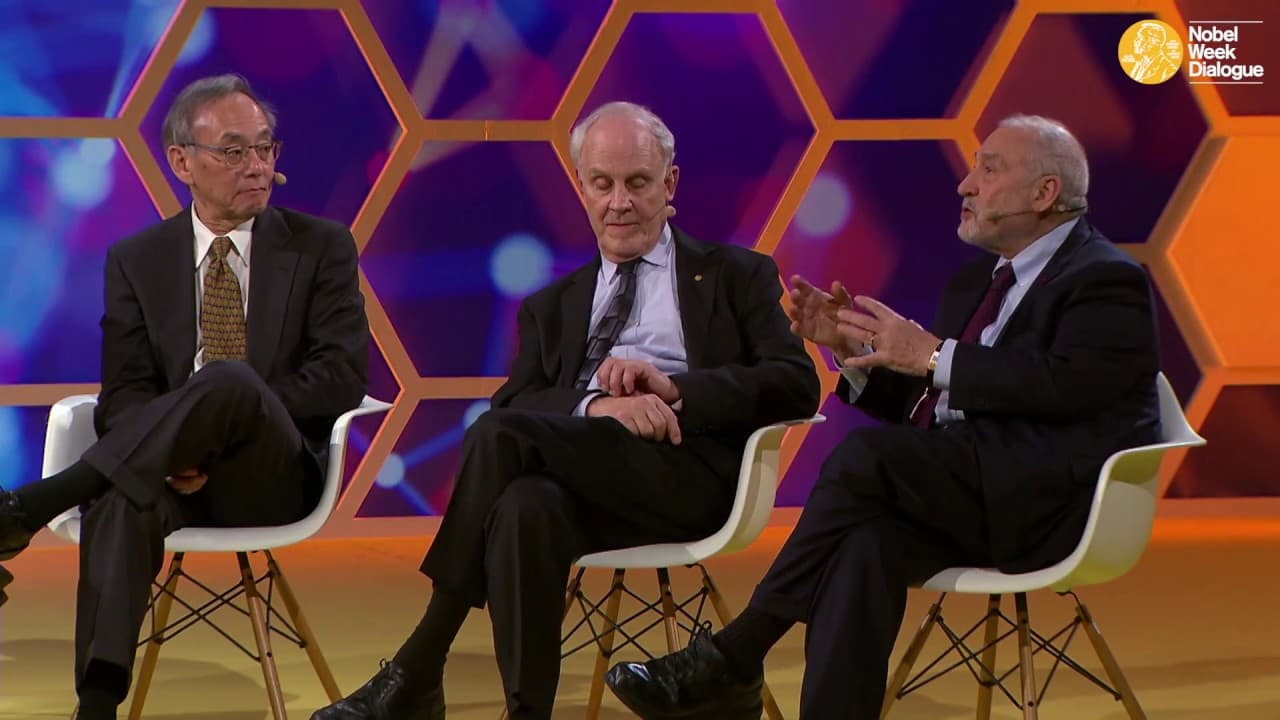
The Search for Truth panel discussion with seven Nobel laureates at Nobel Week Dialogue 2017
TL;DR
Creativity cannot be taught because no one knows where it comes from, though it can be encouraged. Nobel laureates agree it emerges from deep concentration, immersion in a problem, skepticism of accepted wisdom, and exposure to different ideas. Breakthroughs often come from entering a field as an outsider, unencumbered by its established perceptions.
Transcript
so we've called this session the search for truth I shan't introduce everybody I think you've met everybody already but just to name them Michael Levitt Frank Vil Tech Peter Doherty Sharon Abadi Steven Chu David gross and Joseph Stiglitz we've called it the search for truth because in a way in their own disciplines that is what unites them their se... Read More
Key Insights
- Creativity is mysterious and its source is unknown; the panelists agree that because we do not know where it comes from, it cannot be taught, only encouraged through favorable conditions.
- Concentration is crucial to creativity: focusing on a problem in a bulldog fashion engages the unconscious mind, which does the actual work and produces new ways of looking at things.
- Creative insight often arises from the unconscious rather than the conscious mind; David Gross describes saying novel things that surprise himself, suggesting ideas come from a non-conscious place in the brain.
- Immersion in a subject followed by annoyance drives creativity; Frank Wilczek's best work came from getting annoyed that something could be better or that possibilities were unexplored.
- Skepticism of standard wisdom is a starting point for creativity; Joseph Stiglitz says it begins with discounting what you were taught and being exposed to very different ideas that form a creative melting pot.
- Entering a new field as an outsider fuels discovery because you are not trapped by the field's perceptions; Steven Chu and Peter Doherty both note fresh, unencumbered questions spark excitement and insight.
- For Shirin Ebadi, creativity means immersing herself in an idea to fight injustice, drawing on personal experience with oppressed and homeless people, but she stresses it is useless without a democratic government to implement results.
- Better technology drives biomedical breakthroughs because seeing more clearly lets scientists understand and measure better; Peter Doherty notes many advances depend on physicists and chemists improving measurement.
Install to Summarize YouTube Videos and Get Transcripts
Explore YouTube Video Summarizer or Get YouTube Transcript Extractor
Questions & Answers
Q: Can creativity be taught?
According to the panelists, creativity cannot be taught because no one knows where it comes from. David Gross states that unfortunately they have no idea of its source, which is why it cannot be taught. However, he and others say there are ways to encourage or foster it, such as concentration, immersion in a problem, skepticism, and exposure to different ideas, even though the underlying mechanism remains unknown.
Q: What conditions make people most creative?
The panelists point to intense concentration on a problem in a bulldog fashion, which engages the unconscious mind to do the actual work. Frank Wilczek describes immersing himself in a subject until he gets annoyed that something could be better. Michael Levitt observes creative ideas often arrive during non-scientific activities like walking the dog, taking showers, or watching TV, suggesting relaxation also matters.
Q: Why does creativity often come from entering a new field?
Peter Doherty and Steven Chu explain that entering a field from outside means you are not trapped by that field's established perceptions. Chu says he gets most excited going into a new area unencumbered with knowledge, asking naive questions of experts. Doherty adds that scientists are often terrified of discovery because it puts them outside the norm, so an outsider's fresh perspective enables insight.
Q: How do the Nobel laureates describe the role of the unconscious mind in creativity?
David Gross says creativity comes from a non-conscious place, recounting how he sometimes says novel, surprising things that he has never heard before, suggesting the conscious self is not fully in control. Wilczek similarly notes the unconscious part of the brain does the real work after concentration. They describe the brain as consisting of many modules, with creativity located somewhere that surprises the conscious self.
Q: What is the connection between skepticism and creativity?
Joseph Stiglitz argues creativity begins with skepticism and discounting what you were taught or the standard model. It starts not just with wanting to answer a question but with sensing that the standard wisdom is wrong. He adds that being exposed to very different sources of ideas is essential, so those ideas can meet the problem and produce a creative melting pot from which new thinking emerges.
Q: How does Shirin Ebadi define creativity in her work?
Shirin Ebadi says her view of creativity differs from her scientist colleagues. She becomes creative by immersing herself in an idea to see how it can fight injustice, such as coming up with legislation for social justice in Vermont. She stays in touch with homeless and displaced people to learn from them, and stresses that creativity is useless without political results and a democratic government to implement ideas.
Q: How does the brain function as a community during creative thinking?
Frank Wilczek describes the brain as a community of different pieces with different skills and languages: some logical, some based on pattern recognition or aesthetics that want patterns to click and make sense. An important ingredient of creativity is getting all these parts communicating and pulling in the same direction. This produces intuition, where you identify a goal without knowing the logical path, then reconstruct one.
Q: Why is the creative person often described as annoying?
Peter Doherty says creative people can be extremely annoying to be around because they see things differently from everyone else, making them discomforting and sometimes social outcasts. He cites Francis Crick and Jim Watson, two very different personalities who talked endlessly, annoyed everyone, and pulled ideas from others to make a creative synthesis. This social friction, which he calls the curse of creativity, often accompanies breakthrough thinking.
Summary
In this video, a group of Nobel laureates discuss the topic of creativity and its role in their respective fields. They explore the origins of creativity, the importance of concentration, and the impact of exposure to new ideas. The panelists also touch on the relationship between hard work and creativity, the future of truth, and their individual perspectives on optimism.
Questions & Answers
Q: What is creativity and where does it come from?
According to the panelists, creativity is a mysterious concept, as even creative individuals are unsure of its origins. It seems to come from unexpected sources such as walking the dog or taking showers. There is a certain level of messiness that seems to contribute to creativity.
Q: Can creativity be taught?
The panelists agree that while creativity cannot be taught, it can be encouraged. They believe that creativity is related to the subconscious mind and is often a surprise to the conscious self. However, certain conditions, such as concentration and exposure to new ideas, can foster creativity.
Q: Can creativity be found in any discipline?
The panelists emphasize that creativity exists in all disciplines, not just science. They give examples of creativity in fields such as legislation and economics. Creativity can be a means to question existing knowledge and explore new possibilities.
Q: What are the conditions that foster creativity?
The panelists identify concentration, immersion in a subject or problem, exposure to different ideas, skepticism, and questioning the standard model or wisdom as conditions that foster creativity. They emphasize the importance of communication between different parts of the brain and the need for collaboration with others who are willing to explore new ideas.
Q: Is creativity more important than hard work?
The panelists believe that hard work is necessary for any achievement. Creativity, on the other hand, brings a unique perspective and new ideas to the table. They acknowledge that the creative process can be challenging and uncomfortable, but it is often the best part of science.
Q: What is the future of truth?
The panelists express varying degrees of optimism about the future of truth. Some believe that truth will prevail in the long run, as errors fall away and facts become evident. Others caution that political and societal factors could influence the future of truth, and active opposition is necessary to protect it.
Q: How does concentration and exposure to new influences impact creativity?
Concentration is seen as crucial for creativity, as it allows the unconscious mind to work on a problem. Immersion in a subject or problem, as well as exposure to different ideas, can help spark creativity by allowing different parts of the brain to communicate and combine observations in new ways.
Q: Is creativity important in scientific discovery?
The panelists stress that creativity plays a significant role in scientific discovery. They explain that breakthroughs often result from better technology or a fresh perspective brought in from outside the field. Creativity helps scientists see things differently and find new solutions to problems.
Q: Can creativity contribute to social justice?
One panelist, a Nobel laureate in economics, believes that creativity can contribute to social justice by questioning the standard wisdom and being exposed to different ideas. They emphasize the need for new ideas and perspectives to address societal issues effectively. However, they also stress that political action and implementation are essential for the effectiveness of creative solutions.
Q: Does optimism play a role in creativity?
The panelists express varying levels of optimism. Some emphasize the importance of optimism in science, as scientists need to be optimistic to keep trying and exploring new ideas despite failures. Others are cautiously optimistic, recognizing the challenges and uncertainties in the world today.
Takeaways
The panelists believe that creativity is a vital aspect of their disciplines and its origins are still mysterious. While creativity cannot be taught, it can be fostered through concentration, exposure to new influences, and skepticism. The future of truth is seen with optimism, as truth prevails in the long run, but caution is advised to protect truth from political and societal factors. Hard work is necessary for any achievement, but creativity brings a unique perspective and new ideas to scientific discovery. Creativity can also contribute to social justice by questioning the status quo and exploring new solutions. Optimism plays a role in science, keeping scientists motivated despite failures and uncertainty.
Summary & Key Takeaways
-
Seven Nobel laureates discuss creativity, agreeing it is a mysterious force whose origin is unknown. Michael Levitt notes creative ideas often arrive during non-scientific activities like walking the dog or showering, and that a certain messiness seems to make some people creative.
-
David Gross and Frank Wilczek describe the brain as a community of modules with different skills, some logical and some pattern-recognizing. Creativity involves getting these parts to communicate and pull together, producing intuition where you sense a goal before finding the logical path.
-
Panelists identify concentration, immersion, skepticism of received wisdom, and exposure to outside ideas as conditions that foster creativity. Peter Doherty argues discovery often comes from entering a field as an outsider, and Shirin Ebadi ties creativity to pursuing justice through democratic implementation.
Read in Other Languages (beta)
Share This Summary 📚
Summarize YouTube Videos and Get Video Transcripts with 1-Click
Try YouTube Summary with ChatGPT & Claude or YouTube Transcript Generator
Explore More Summaries from Nobel Prize 📚


Summarize YouTube Videos and Get Video Transcripts with 1-Click
Try YouTube Summary with ChatGPT & Claude or YouTube Transcript Generator