Interview about the 2019 Nobel Prize in Physics "This is a discovery of the universe, in a sense."
Transcript
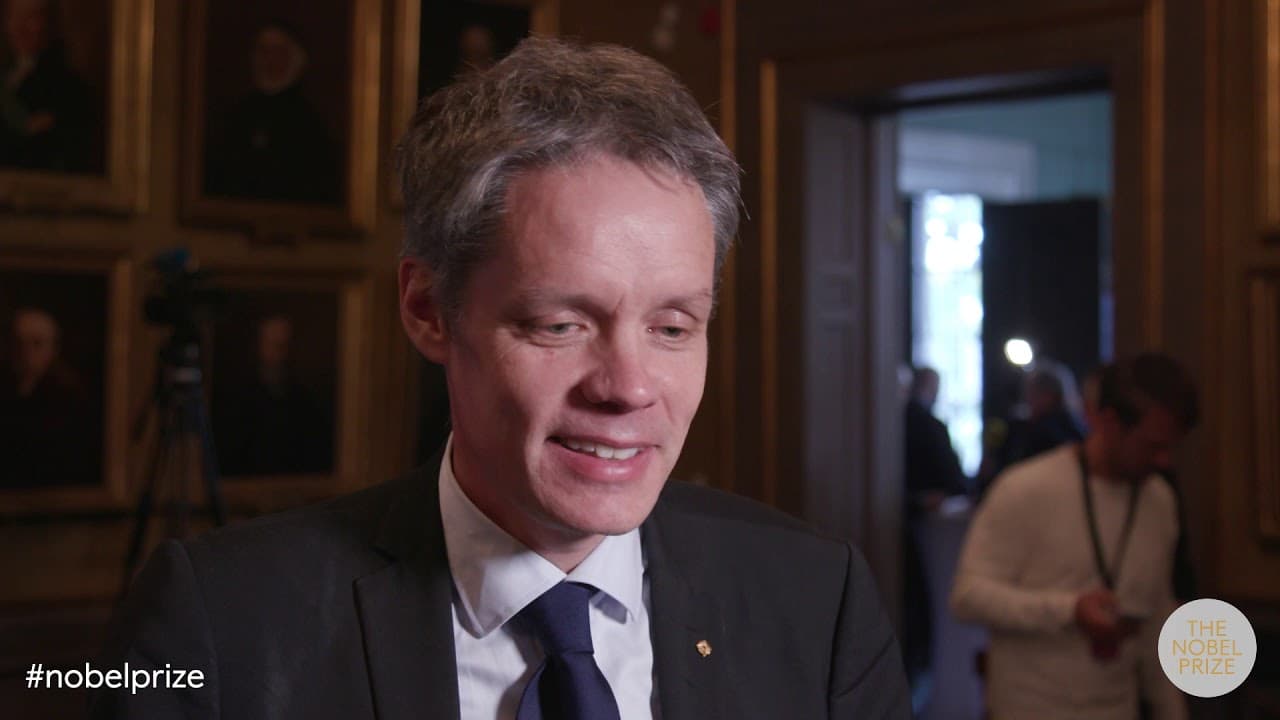
professor Daniel some member of the Nobel Committee for physics this year's Nobel Prizes twofold so let's start with the first part about the universe what did your work sorry what was the award about award was about really the discovery of the universe in a sense the whole history of the universe and the contents of the universe and James Peebles ... Read More
Install to Summarize YouTube Videos and Get Transcripts
Explore YouTube Video Summarizer or Get YouTube Transcript Extractor
Summary
This video features Professor Daniel, a member of the Nobel Committee for Physics, discussing the Nobel Prizes awarded this year. The first part of the discussion focuses on the discovery of the universe and its contents, including dark matter and dark energy. The second part discusses the discovery of planets outside our solar system and the potential for finding life elsewhere in the universe.
Questions & Answers
Q: What was the award about?
The award was about the discovery of the universe, its history, and its contents, including dark matter and dark energy. James Peebles, a cosmologist, made significant contributions to understanding the properties of these unknown components that make up 95% of the energy in the universe. By studying the cosmic microwave background radiation, which has been traveling to us for almost 14 billion years, Peebles was able to uncover the basic properties of our universe.
Q: What is dark matter and dark energy?
Dark matter is similar to regular matter in that it clumps together and can form gigantic clouds around galaxies. Its presence is known through its gravitational influence on other matter and its necessity for the formation of galaxies. However, its actual nature remains unknown. On the other hand, dark energy is spread uniformly throughout the universe and has the unique property of accelerating the expansion of the universe. While we know it dominates the energy of our universe, we still do not understand what it is.
Q: Can you explain the metaphor used to describe the universe?
One metaphor that Professor Daniel likes to use is comparing the universe to a cup of coffee. The coffee itself represents the dark energy, while the cream or milk represents the dark matter. These two components make up the majority of the universe's energy. The tiny amount of sugar in the coffee represents ordinary matter, which includes stars, planets, and everything that we are familiar with. The act of stirring the coffee represents the dynamic and interconnected nature of our universe.
Q: What was the discovery regarding planets outside our solar system?
The first major discovery in this field was the identification of a planet orbiting a solar-type star, similar to our own sun. This planet, however, was very different from those in our solar system. It was as big as Jupiter but incredibly close to its star, completing an orbit in just a few days. This close proximity makes it extremely hot and distinguishes it from the planets in our solar system. Since this discovery, scientists have found many different kinds of planetary systems, indicating a diverse range of planets in our universe.
Q: Why was it initially difficult to discover planets outside our solar system?
Discovering planets outside our solar system was challenging because the planet itself is hidden within the intense light of the star it orbits. However, there are techniques that can measure the star's wobbling motion caused by the gravitational pull of the planet. By carefully analyzing the color of the star, scientists can observe its back-and-forth motion, indicating the presence of a planet. Additionally, another method involves observing a slight dip in the star's light curve when a planet passes in front of it. In both cases, the planet itself is not directly visible, but its effects on the star provide evidence of its existence.
Q: Will we ever find life outside of Earth?
The recent discoveries and advancements in understanding other planetary systems provide us with a step closer to answering this existential question. In the future, with improved technology and observation methods, we might be able to detect the atmospheres of planets and analyze their composition, including the presence of gases like oxygen or water vapor. This information could offer insights into the potential for life on these planets. While it cannot be definitively stated at this point, many scientists, including Professor Daniel, believe that there is a high likelihood of life existing somewhere in the universe.
Q: Did Michel Mayor and Didier Queloz work together on this discovery?
Yes, Michel Mayor and Didier Queloz collaborated on the discovery of the first planet outside our solar system. They co-authored a key paper discussing this groundbreaking finding.
Q: What is most exciting about this year's Nobel Prize?
Professor Daniel finds the common theme of both Nobel Prizes to be the most exciting aspect. Both prizes provide essential insights into our place in the universe. The discoveries in cosmology, exploring the history and origin of the universe, and the search for planets and potential life outside of Earth contribute to our understanding of the universe and our place within it.
Takeaways
The Nobel Prizes awarded this year highlight significant advancements in our understanding of the universe. James Peebles' work on cosmology and the discovery of dark matter and dark energy sheds light on the composition of the universe. Furthermore, the finding of planets outside our solar system, along with efforts to detect potential life, broadens our perspective on our place in the universe. These discoveries prompt us to consider the vastness and diversity of the cosmos, fueling further exploration and research.
Read in Other Languages (beta)
Share This Summary 📚
Summarize YouTube Videos and Get Video Transcripts with 1-Click
Try YouTube Summary with ChatGPT & Claude or YouTube Transcript Generator
Explore More Summaries from Nobel Prize 📚
Summarize YouTube Videos and Get Video Transcripts with 1-Click
Try YouTube Summary with ChatGPT & Claude or YouTube Transcript Generator