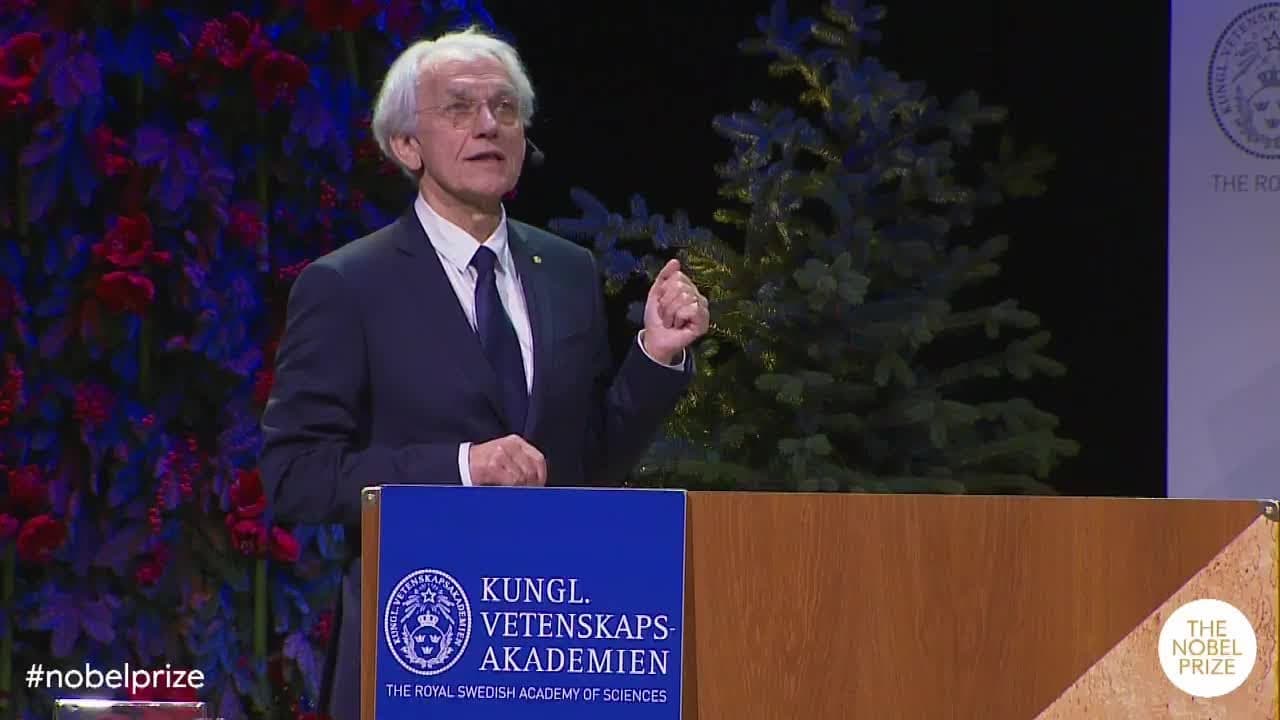
Gérard Mourou: Nobel Lecture in Physics, 2018
TL;DR
Chirped pulse amplification produces extreme peak power by stretching a pulse, amplifying it, and compressing it, while avoiding damage inside the laser. When tightly focused, these short pulses create extraordinary intensity and pressure, accelerate particles toward the speed of light, open new regimes of relativistic physics, and enable precise applications such as removing material by micromachining.
Transcript
our next speaker is Professor Geronimo who who is a French scientist and a pioneer in the field of laser physics he was born in June 1944 in Alda havilah in the French Alps a town probably best known for hosting the 1992 Winter Olympics at least until now Moreau started his career in physics at the University of Grenoble ALP getting his diploma in ... Read More
Key Insights
- Chirped pulse amplification works by stretching a laser pulse, amplifying it, and then compressing it. Stretching reduces damaging intensity inside the solid-state amplifier, while final compression restores a short duration and creates very high peak power for experiments and applications.
- Material breakdown was the barrier that caused laser intensity to plateau. Increasing power through earlier approaches damaged solid-state amplifiers, so chirped pulse amplification changed the process to avoid this limit and allowed laser intensity to continue climbing into new physical regimes.
- Petawatt laser power exists only for an extremely short pulse, but its peak is about a thousand times the total power of the world grid. Concentrating that brief power onto a micrometer-scale spot produces a very large energy density and intense photon pressure.
- Relativistic optics begins when a strong laser field drives electrons in atoms at speeds close to the speed of light. Mourou places this regime around 10 to the 18 watts per square centimeter and connects it with particle physics, nuclear physics, cosmology, QED, and general relativity.
- Proton acceleration requires greater laser intensity because protons are about 2,000 times the mass of electrons. Mourou describes a regime around 10 to the 25 watts per square centimeter where protons can also be driven near the speed of light.
- Vacuum interaction is expected at still greater intensity, around 10 to the 28 to 10 to the 29 watts per square centimeter. Mourou describes this as separating real particles from virtual particles in vacuum and, in his words conceptually, materializing or boiling the vacuum.
- Extreme-light facilities are designed to extend accessible laser intensity. Mourou identifies the Apollon laser project in France and the European Extreme Light Infrastructure in Romania, Hungary, and the Czech Republic as major efforts intended to produce increasingly powerful lasers.
- Short-pulse lasers support precise micromachining by removing material from a target. Mourou presents this practical capability alongside the fundamental scientific possibilities of extreme light, showing that the same broad field can connect controlled material processing with relativistic particle acceleration.
Install to Summarize YouTube Videos and Get Transcripts
Explore YouTube Video Summarizer or Get YouTube Transcript Extractor
Questions & Answers
Q: How does chirped pulse amplification create high-power laser pulses?
Chirped pulse amplification first stretches a short laser pulse, then amplifies the stretched pulse, and finally compresses it. Stretching lowers the intensity while the pulse passes through the solid-state amplifier, helping prevent breakdown and damage. After amplification, compression restores the short duration, so the pulse delivers very high peak power during an extremely brief interval.
Q: Why was chirped pulse amplification needed for stronger lasers?
Laser intensity had reached a plateau because stronger pulses damaged the material inside solid-state amplifiers. That breakdown prevented researchers from simply increasing power through the existing approach. Chirped pulse amplification addressed the barrier by stretching the pulse before amplification, keeping its intensity lower inside the laser, and compressing it only after the amplification stage was complete.
Q: What happens when a petawatt laser pulse is tightly focused?
A petawatt pulse has peak power about a thousand times the total power of the world grid, although it lasts only for a femtosecond-scale interval. When focused onto a spot near the wavelength of light, typically on the micrometer scale, it creates an extraordinary energy density and photon pressure in a very small region.
Q: What is relativistic optics in extreme-light research?
Relativistic optics is the regime in which a laser field drives electrons in atoms at speeds close to the speed of light. Mourou associates its onset with intensities around 10 to the 18 watts per square centimeter. This behavior opens a broad field connected with particle physics, nuclear physics, cosmology, QED, general relativity, and related questions.
Q: How can extreme light accelerate electrons and protons?
Extreme light exerts fields strong enough to agitate and accelerate charged particles. Electrons reach speeds close to the speed of light first because they are comparatively light. Protons require much greater intensity because they are about 2,000 times more massive than electrons, but Mourou describes a higher regime where protons can also approach the speed of light.
Q: How could an extreme laser interact with vacuum?
Mourou proposes that sufficiently intense light could enter a regime where it interacts directly with vacuum. At intensities around 10 to the 28 to 10 to the 29 watts per square centimeter, he describes the process as separating real particles from virtual particles. The conceptual result is that the laser effectively materializes, or boils, the vacuum.
Q: What facilities are developing more powerful extreme-light lasers?
The Apollon laser project in France is intended to reach multi-petawatt operation. The European Extreme Light Infrastructure is another major effort, with facilities in Romania, Hungary, and the Czech Republic. Mourou presents these projects as steps toward higher laser intensities that will let researchers cross into new regimes of relativistic and vacuum physics.
Q: What practical use does Mourou identify for short-pulse lasers?
Mourou identifies micromachining as a practical use for short-pulse lasers. These lasers can remove material from a blade or another target with high precision. The example illustrates how the extreme-light field is not limited to fundamental studies of electrons, protons, and vacuum, but can also support controlled processing of physical materials.
Summary
Professor Geronimo is a French scientist and a pioneer in the field of laser physics. He discusses the history and development of high intensity lasers and the various applications they have in a wide range of fields, including quantum optics, particle acceleration, medical therapy, and nuclear waste transmutation. He highlights the importance of extreme light in generating large fields, high temperatures, and pressures, and expresses optimism for the future of science and technology in this field.
Questions & Answers
Q: What is the background of Professor Geronimo?
Professor Geronimo is a French scientist and pioneer in laser physics. He was born in Alda havilah, France in June 1944 and started his career in physics at the University of Grenoble ALP, obtaining his diploma in 1967. He later received his doctorate from Pierre and Marie Curie University in Paris in 1973. He spent a major part of his career in the United States, particularly at the laboratory of laser energetics at the University of Rochester, where he worked with Donna Strickland.
Q: What is the chair-pose amplification technique?
The chair-pose amplification technique is a technique developed by Professor Geronimo and Donna Strickland that is at the core of most high-powered laser facilities in the world. It involves the use of chirped pulse amplification (CPA), where the pulse of a laser is stretched out in time, amplified, and then compressed back to its original duration, resulting in extremely high peak powers.
Q: What are the applications of high intensity lasers?
High intensity lasers have a wide range of applications. They can be used in quantum optics to slow down and cool atoms, in particle acceleration to accelerate particles like electrons to near the speed of light, in medical therapy for precise laser surgery, and in nuclear waste transmutation to mitigate radioactive waste. They can also generate extremely high pressures and temperatures, leading to discoveries in fields like high-energy physics and cosmology.
Q: How are femtosecond lasers used in micromachining?
Femtosecond lasers are used in micromachining because their short pulses allow for precise material removal without heating surrounding areas. This is because the heat generated by the laser has no time to propagate before the material is ablated. This precise and clean micromachining technique has applications in various industries, including electronics and medical devices.
Q: What are the advantages of proton therapy for cancer treatment?
Proton therapy is a form of radiation therapy for cancer treatment that uses protons instead of other types of radiation. It is advantageous because protons have a higher mass compared to other particles, which allows them to deposit their energy more precisely in tumors without damaging surrounding healthy tissue. This makes proton therapy especially suitable for treating tumors near critical organs or in pediatric patients.
Q: Can high intensity lasers be used in energy production?
High intensity lasers themselves are not used in energy production, but they can contribute to nuclear energy by transmuting nuclear waste. By changing the isotopes of the waste through laser interactions, it is possible to convert highly radioactive isotopes into stable or short-lived isotopes, reducing the long-term hazard of the waste. This could potentially make nuclear energy a more sustainable and environmentally friendly option.
Q: How are high intensity x-rays used in laser Wakefield acceleration?
High intensity x-rays are used in laser Wakefield acceleration to penetrate solid materials and produce plasma waves that can trap and accelerate electrons. By using high intensity lasers and x-rays, these acceleration techniques can produce high energy particles in a compact device. The goal is to develop high energy x-ray lasers that can be used for proton therapy, materials science, and even to explore the fundamental properties of the vacuum itself.
Q: What are the challenges in transmuting nuclear waste?
Transmuting nuclear waste is a challenging task. One of the challenges is finding a suitable form of nuclear waste that can be effectively transmuted. Additionally, the process of transmutation requires precise control over the nuclear reactions, as well as ensuring the safety and containment of the waste materials. It is an ongoing area of research and development that aims to find solutions for dealing with the long-term radioactive waste generated by nuclear energy production.
Takeaways
Professor Geronimo's talk emphasizes the incredible possibilities and potential of extreme light and high intensity lasers. From slowing down atoms to accelerating particles, from precise micromachining to cancer therapy, and from investigating the nature of vacuum to cleaning up nuclear waste, high intensity lasers offer a wide range of applications in science and technology. With advancements in laser technology and the development of compact devices, the future of high intensity lasers looks bright.
Summary & Key Takeaways
-
Gérard Mourou presents extreme light as a platform for exploring physics and developing applications. Chirped pulse amplification made much higher peak powers possible by overcoming the material-damage barrier that had caused laser intensity to plateau. The method enabled solid-state lasers to deliver exceptionally short, powerful pulses without damaging their amplifying components.
-
A petawatt pulse can briefly reach about a thousand times the total power of the world grid. Focusing that power onto a spot near the wavelength of light produces enormous energy density and photon pressure. Mourou compares the resulting pressure with millions of Eiffel Towers concentrated on the top of a finger.
-
As intensity increases, laser interactions move through new physical regimes. Electrons can first be driven near the speed of light, followed at greater intensity by much heavier protons. At still higher intensity, Mourou anticipates interactions with vacuum that separate real particles from virtual particles, alongside practical uses such as precise micromachining.
Read in Other Languages (beta)
Share This Summary 📚
Summarize YouTube Videos and Get Video Transcripts with 1-Click
Try YouTube Summary with ChatGPT & Claude or YouTube Transcript Generator
Explore More Summaries from Nobel Prize 📚



Summarize YouTube Videos and Get Video Transcripts with 1-Click
Try YouTube Summary with ChatGPT & Claude or YouTube Transcript Generator