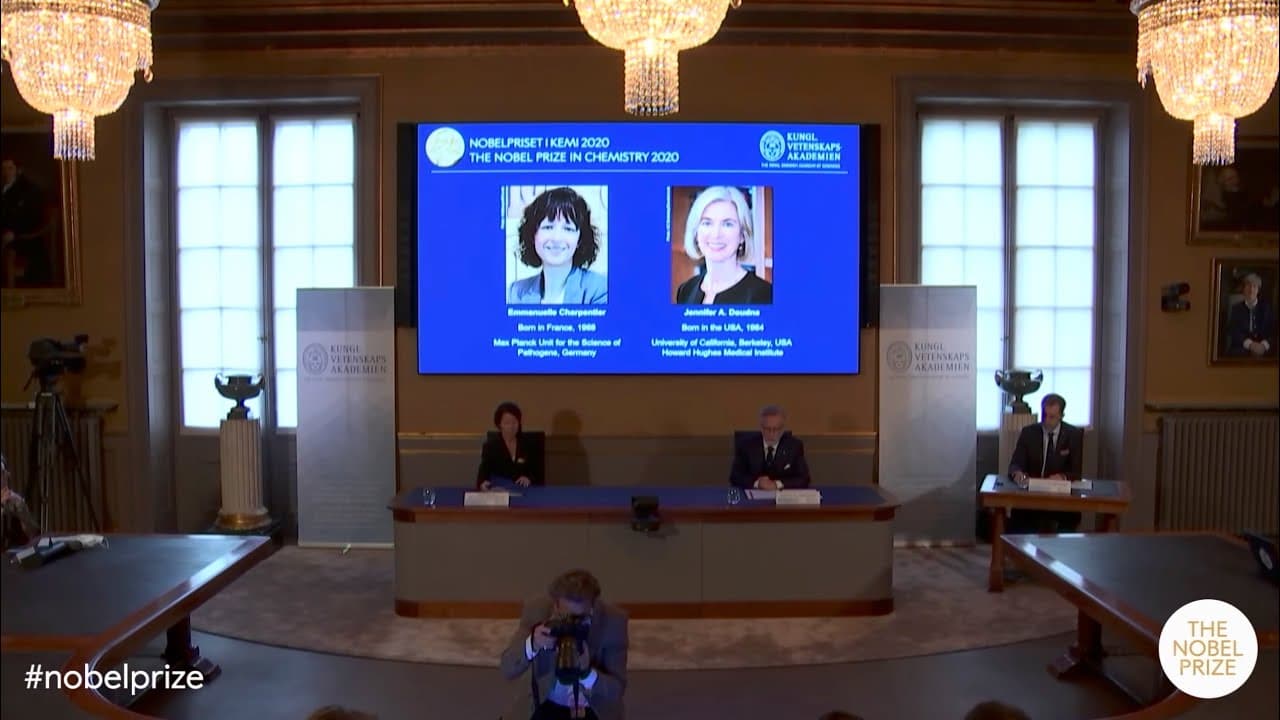
Announcement of the 2020 Nobel Prize in Chemistry
Transcript
Read and summarize the transcript of this video on Glasp Reader (beta).
Install to Summarize YouTube Videos and Get Transcripts
Explore YouTube Video Summarizer or Get YouTube Transcript Extractor
Summary
The Royal Swedish Academy of Sciences announced the 2020 Nobel Prize in Chemistry jointly awarded to Emmanuel Charpentier and Jennifer Doudna for their groundbreaking development of the CRISPR-Cas9 method for genome editing. This technology allows for precise DNA editing and has revolutionized the field of molecular biology. The laureates made significant discoveries while working at Umeå University in Sweden and the University of California, Berkeley. Despite the limitations imposed by the pandemic, the Nobel Prize events will be held digitally, including lectures and the prize ceremony. The academicians also discussed the ethical implications of this technology and emphasized the importance of responsible use. The discovery of CRISPR-Cas9, which originated from the study of an ancient bacterial immune system, has allowed scientists to edit genomes in a wide range of organisms and has opened up countless possibilities for genetic research and medical applications.
Questions & Answers
Q: What is the Nobel Prize in Chemistry awarded for this year?
The Nobel Prize in Chemistry has been awarded jointly to Emmanuel Charpentier and Jennifer Doudna for their development of the CRISPR-Cas9 method for genome editing. This technology allows for precise editing of DNA and has revolutionized the field of molecular biology.
Q: Can you provide more information about the laureates?
Emmanuel Charpentier was born in France and obtained her PhD from Institut Pasteur in Paris. She is currently the director of the Max Planck Unit for the Science of Pathogens in Berlin. Jennifer Doudna, born in the United States, received her PhD from Harvard Medical School and is currently a professor at the University of California, Berkeley.
Q: How will the Nobel Prize events be conducted this year?
Due to the constraints posed by the pandemic, the Nobel Prize events will be held digitally. Instead of the laureates traveling to Stockholm, there will be digital lectures and a virtual prize ceremony where the laureates will participate via video links.
Q: What are the practical implications of the CRISPR-Cas9 technology?
The CRISPR-Cas9 system allows for precise cutting of DNA at specific locations, enabling scientists to easily edit genomes in various organisms. It is now widely used in biochemical and molecular biology labs, as well as in plant breeding and novel treatments for human diseases.
Q: Can you provide a more detailed explanation of the CRISPR-Cas9 system?
The CRISPR-Cas9 system is derived from an ancient bacterial immune system. When bacteria are infected by a virus, they keep a piece of the viral DNA as a memory in a region called CRISPR. This memory is transcribed into RNA and processed into small RNA molecules, which, along with the Cas9 protein, form a complex that acts as genetic scissors. These scissors recognize and cut DNA sequences that match the RNA, thereby disarming the virus. Charpentier and Doudna further simplified this system by fusing the RNA molecules into a single guide RNA, making it easier to target specific DNA sequences for cutting.
Q: How can the CRISPR-Cas9 system be used for genome editing?
By cutting DNA at specific locations, the cell's DNA repair machinery can introduce changes to the genetic material. If the cut is simply repaired by the cell, there may be errors introduced that can inactivate genes. However, by providing a short DNA template similar to the target region, scientists can guide the repair machinery to make specific changes, allowing for precise editing of the genome.
Q: What are the potential applications of CRISPR-Cas9 technology?
The CRISPR-Cas9 system has transformed molecular life sciences by providing a tool for editing genomes. It can be used to study gene functions, develop new treatments for genetic diseases, and improve plant breeding. For example, it has the potential to cure genetic disorders like sickle cell anemia by correcting the genetic mutation responsible. The technology also holds promise for developing new vaccines and treatments for diseases like COVID-19, although it is not directly used as a vaccine itself.
Q: Are there any ethical considerations surrounding the use of CRISPR-Cas9?
Yes, ethics, laws, and regulations are crucial when using this technology. The scientific community is actively developing guidelines and regulations to ensure responsible use. There is ongoing work to establish the ethical framework for the use of genetic technologies like CRISPR-Cas9.
Q: How did Emmanuel Charpentier and Jennifer Doudna collaborate on their research?
Charpentier and Doudna worked closely together in their research on CRISPR-Cas9. They discovered the essential components and mechanisms of the system, including the fusion of RNA molecules, which made the system more efficient. They conducted experiments both in vitro and in cellular organisms to demonstrate the functionality and versatility of the technology.
Q: Is this the first time that women have been awarded the Nobel Prize in Chemistry?
No, this is not the first time, but it is still significant. Many great female scientists have received the Nobel Prize in Chemistry in the past. However, the awarding of the prize to Charpentier and Doudna highlights the contributions and impact of women in the field of science, and it serves as an inspiration for young girls aspiring to pursue careers in science.
Takeaways (in one paragraph)
The Nobel Prize in Chemistry has been jointly awarded to Emmanuel Charpentier and Jennifer Doudna for their development of the CRISPR-Cas9 method for genome editing. This groundbreaking technology allows for precise DNA editing and has revolutionized the field of molecular biology. The laureates made significant discoveries while working at Umeå University in Sweden and the University of California, Berkeley. Despite the limitations imposed by the pandemic, the Nobel Prize events will be held digitally, including lectures and the prize ceremony. The CRISPR-Cas9 system has transformed the life sciences by providing a tool for editing genomes, studying gene functions, and developing treatments for genetic diseases. However, ethical considerations and regulations are crucial to ensure responsible use. The awarding of the prize to Charpentier and Doudna also highlights the contributions of women in science and serves as an inspiration for aspiring scientists, particularly young girls.
Read in Other Languages (beta)
Share This Summary 📚
Summarize YouTube Videos and Get Video Transcripts with 1-Click
Try YouTube Summary with ChatGPT & Claude or YouTube Transcript Generator
Explore More Summaries from Nobel Prize 📚

Summarize YouTube Videos and Get Video Transcripts with 1-Click
Try YouTube Summary with ChatGPT & Claude or YouTube Transcript Generator