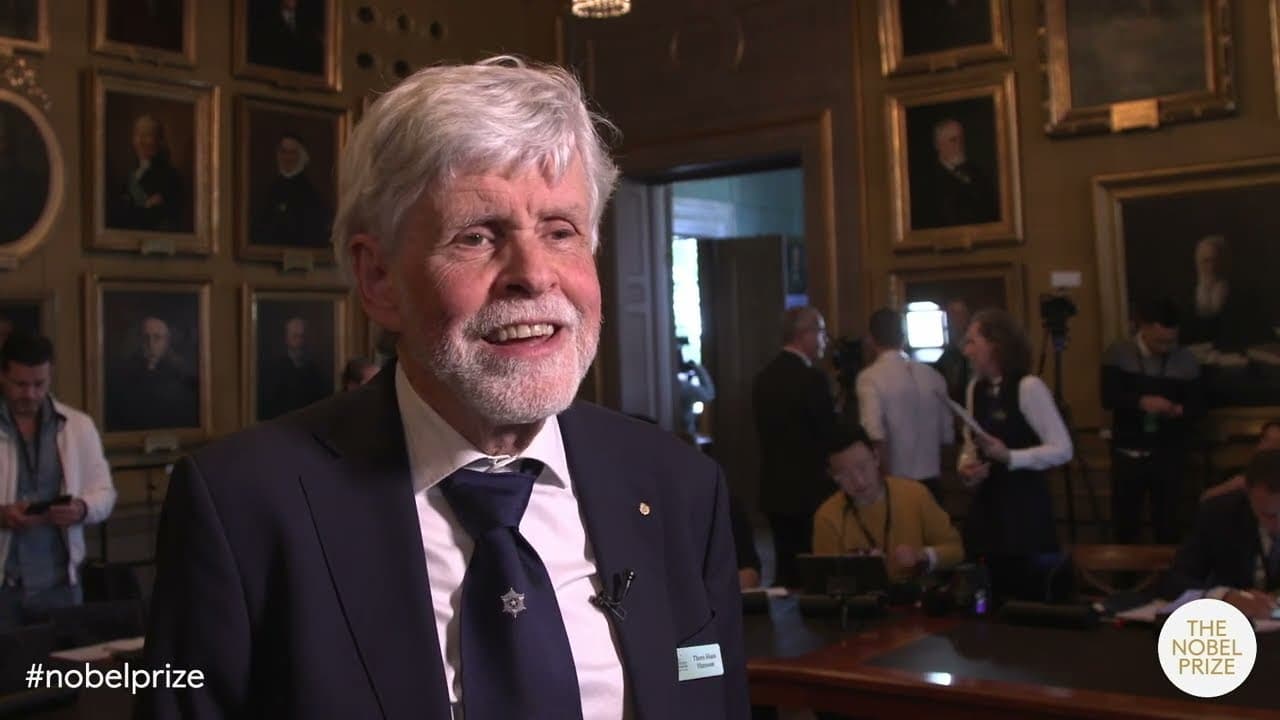
"This work has made clear what quantum mechanics really means." Interview on the 2022 physics prize.
TL;DR
Quantum entanglement means that parts of a shared quantum state cannot be treated as completely independent, because observing one is connected to what happens to another. Experiments with entangled photons established violations of Bell inequalities, clarified this unusual feature of nature, and helped pioneer quantum information science, including quantum cryptography and possible future quantum computers.
Transcript
Professor tours Hanson member of the novel committee please explain what is this year's price about this year's prize is about quantum mechanics and I'm sure you've heard of quantum mechanics and it usually is portrayed as something which is sort of very weird very mystical and it's true there are weird and almost mystical aspects of it but this ye... Read More
Key Insights
- Quantum entanglement is a property of quantum states in which individual parts cannot be treated as completely independent. The interview contrasts this with ordinary billiard balls, whose separately observed colors have no effect on one another.
- The 2022 Nobel Prize in Physics recognized experiments with entangled photons. The cited achievements were establishing the violation of Bell inequalities and pioneering quantum information science, which helped clarify the nature of a peculiar feature of quantum mechanics.
- Quantum mechanics is often portrayed as weird or mystical, but the honored experimental work made its meaning clearer. The laureates helped researchers understand more about what occurs in entangled states rather than leaving the subject only as an abstract mystery.
- The value of fundamental research is not limited to immediate everyday applications. Hansson argues that understanding something about nature that was previously misunderstood or not properly understood can itself be worthy of recognition by the Nobel Committee.
- Quantum cryptography is a practical application of entanglement that already exists. It uses the unusual quantum property to send secret messages in a way described as preventing interception or eavesdropping, and devices based on it can already be purchased.
- Quantum computers are presented as a possible future application rather than a completed technology. The interview states that they remain in development, so their eventual importance and practical role cannot yet be stated with certainty.
- The prize followed a long progression from early experiments to clearer appreciation of their implications. Hansson says the consequences of the development became clearer much later, particularly within approximately the last 10–20 years.
- Quantum mechanics inspired Hansson to become a physicist instead of a mathematician. He describes the quantum world as a subject that researchers never finish thinking about because they continually reconsider its meaning and seek deeper understanding.
Install to Summarize YouTube Videos and Get Transcripts
Explore YouTube Video Summarizer or Get YouTube Transcript Extractor
Questions & Answers
Q: What does quantum entanglement mean?
Quantum entanglement means that parts of a quantum state cannot be considered entirely separate in the familiar way that ordinary objects can. With billiard balls, observing that one ball is yellow says nothing about the colors of other balls. In an entangled state, observing one part is connected to what happens to another, which makes entanglement a particularly strange feature of quantum mechanics.
Q: Why was the 2022 Nobel Prize in Physics awarded?
The Royal Swedish Academy of Sciences awarded the 2022 Nobel Prize in Physics to Alain Aspect, John F. Clauser, and Anton Zeilinger. They were recognized for experiments with entangled photons, establishing the violation of Bell inequalities, and pioneering quantum information science. According to the interview, this work made the peculiar nature of quantum mechanics clearer and improved understanding of entanglement.
Q: How is quantum entanglement different from ordinary objects?
Ordinary objects can generally be examined independently in the example given during the interview. If several billiard balls are placed apart, the color of one ball has nothing to do with the colors of the others. Entangled quantum states work differently because looking at one part and identifying its condition is somehow connected to what happens to another part of the shared state.
Q: How can quantum entanglement affect everyday life?
Entanglement may affect practical life through technologies such as quantum cryptography, which the interview describes as an existing application. It uses entanglement to transmit secret messages in a way that cannot be intercepted or eavesdropped on. Devices using this approach can already be purchased, although Hansson says he does not know whether they will become broadly important or remain specialized tools.
Q: What is quantum cryptography used for?
Quantum cryptography is used to send secret messages while preventing interception or eavesdropping, according to the interview. It relies on entanglement, the unusual quantum property connecting parts of a shared state. Hansson identifies it as a practical application that already exists and says devices can be purchased, while leaving open how important or widespread the technology may become in the future.
Q: Do quantum computers already exist according to the interview?
Quantum computers are described as a possible future application that is still in development. Hansson explicitly says that a quantum computer is not yet available and responds to its future prospects with uncertainty. The interview therefore distinguishes quantum computing from quantum cryptography, which is presented as an application that already exists and is available through purchasable devices.
Q: Why was the entanglement research recognized at this time?
The first experiments occurred early, but the implications of the development they began did not become clear until much later. Hansson says greater clarity emerged within roughly the last 10–20 years. He does not explain why this exact candidate won in this exact year, noting that the committee has many alternatives and does not answer why one choice comes out on top.
Q: Why is understanding quantum mechanics valuable without immediate applications?
Understanding nature can be valuable even when it has no direct effect on everyday life. Hansson says that discovering something about the cosmos may have no practical consequence but can still be wonderful because it expands human understanding. The committee regarded clarifying something about nature that had not previously been understood, or had not been understood properly, as worthy of recognition in itself.
Summary
This video features Professor Hogström, a member of the Nobel Committee, discussing this year's Nobel Prize in quantum mechanics. He explains that quantum mechanics is often seen as weird and mystical, but this year's laureates have made significant contributions to our understanding of its true meaning. Quantum mechanics involves entangled states, where the properties of one object are connected to the properties of another object. This year's prize aims to shed light on this peculiar feature of quantum mechanics. While some may question the practical implications of this research, Professor Hogström emphasizes that understanding the nature of quantum mechanics itself is worthy of recognition. However, he does mention one application of entanglement called quantum cryptography, which allows for secure communication that cannot be intercepted. Quantum computers, although still in development, could also have significant practical applications in the future. Professor Hogström's personal excitement about this prize stems from his own love for quantum mechanics and his curiosity to keep delving deeper into its mysteries.
Questions & Answers
Q: What is this year's Nobel Prize about?
This year's prize is about quantum mechanics and aims to clarify its meaning and help us better understand its peculiar features, such as entanglement.
Q: How does quantum mechanics differ from classical mechanics?
In classical mechanics, the properties of objects are independent of each other, but in quantum mechanics, objects can be "entangled," meaning their properties are interconnected. For example, you cannot observe the color of one entangled object without somehow affecting the other entangled object.
Q: What have the laureates done to contribute to our understanding of quantum mechanics?
The laureates have made significant advancements in our understanding of the peculiar features of quantum mechanics, particularly in relation to entanglement. Their work has helped shed light on the nature of quantum mechanics and its implications.
Q: Does quantum mechanics have any practical implications for our daily lives?
While some may question the practical applications of quantum mechanics, it is still valuable to understand the mysteries of nature. However, one practical application mentioned is quantum cryptography, which uses entanglement to send secure messages that cannot be intercepted.
Q: Can you explain more about quantum cryptography and its significance?
Quantum cryptography utilizes the unique properties of entanglement to ensure secure communication. By using entangled particles to encode information, it becomes impossible for anyone to intercept or eavesdrop on the messages being sent. While it may currently be limited to specialized devices, it has the potential to become more widespread in the future.
Q: How might quantum computers impact our future?
Quantum computers are still in the development stage, but they have the potential to revolutionize various fields. Unlike classical computers, which use binary code (bits), quantum computers use quantum bits (qubits) that can exist in multiple states simultaneously. This allows for parallel processing and could dramatically improve computational power for solving complex problems.
Q: Why is this research being recognized now?
The experiments in quantum mechanics have been conducted for a long time, but it is only in recent years that their implications and significance have become clearer. The development and understanding of quantum mechanics have advanced significantly within the last couple of decades, leading to this recognition.
Q: Were there any challenges in selecting the laureates for this year's prize?
Professor Hogström mentions that there were not many challenges in finding the laureates for this year's prize, but he does not provide specific details.
Q: Can you provide any personal insights about the laureates?
Professor Hogström states that he does not know the laureates personally, but he has listened to their talks. He does not provide any specific information about their personalities or personal details.
Q: Why are you personally excited about this Nobel Prize?
Professor Hogström expresses his personal excitement for this prize by sharing his love for quantum mechanics. He explains that quantum mechanics inspired him to study physics and that the mysteries of quantum mechanics continually fuel his curiosity to delve deeper into its complexities.
Takeaways
This video highlights the significance of this year's Nobel Prize in quantum mechanics, which aims to deepen our understanding of this fascinating field of study. Quantum mechanics, with its peculiar features like entanglement, has captivated the interest of scientists for years. While some may question the immediate practical implications, the recognition of the laureates' work emphasizes the importance of unraveling the mysteries of nature and understanding fundamental concepts. Quantum cryptography, a practical application already in existence, showcases the potential impact of quantum mechanics in ensuring secure communication. Furthermore, the development of quantum computers holds promise for revolutionizing various areas of research and computation in the future. Ultimately, this prize celebrates the progress made in elucidating the nature of quantum mechanics and the everlasting quest to explore its depths.
Summary & Key Takeaways
-
The 2022 Nobel Prize in Physics recognized Alain Aspect, John F. Clauser, and Anton Zeilinger for experiments with entangled photons, establishing violations of Bell inequalities, and pioneering quantum information science. Their work helped clarify the meaning of quantum mechanics by testing one of its strangest features through physical experiments.
-
Entangled quantum states differ from familiar collections of independent objects. With ordinary billiard balls, the color of one ball has nothing to do with the colors of the others. In an entangled state, however, examining one part cannot be separated from what happens to another, revealing an unusual connection within the state.
-
The recognized research is valuable both for understanding nature and for its practical possibilities. Quantum cryptography already uses entanglement to send secret messages in a way intended to prevent interception or eavesdropping. Quantum computers might become another application, although the interview emphasizes that such computers remain under development rather than established technology.
Read in Other Languages (beta)
Share This Summary 📚
Summarize YouTube Videos and Get Video Transcripts with 1-Click
Try YouTube Summary with ChatGPT & Claude or YouTube Transcript Generator
Explore More Summaries from Nobel Prize 📚



Summarize YouTube Videos and Get Video Transcripts with 1-Click
Try YouTube Summary with ChatGPT & Claude or YouTube Transcript Generator