Didier Queloz: “There is no age for being clever!” - Nobel Prize in Physics 2019
TL;DR
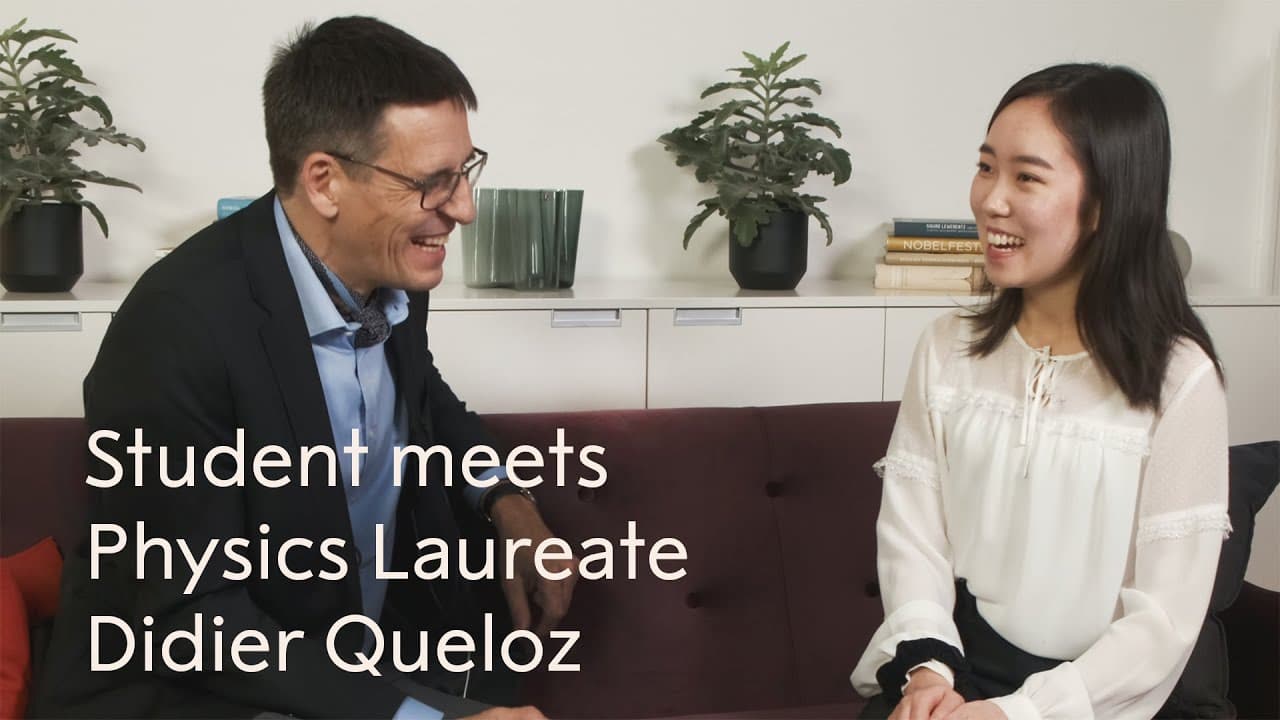
Choose a scientific path that genuinely interests you, keep your options open, and avoid planning every stage too rigidly. Didier Queloz argues that curiosity, resilience after failure, and willingness to investigate data that contradicts accepted theory are central to discovery. Young researchers can contribute major ideas because they may explore unconventional paths without being constrained by established expectations.
Transcript
I'm very pleased and honored to be talking to you today I want to start off by introducing myself my name is Jen and I'm 18 years old and I'm currently studying the natural science program in Sweden at a gymnasium called International a tennis game nausea and sorry mum this year I will choose between a few programs at university level and I'm think... Read More
Key Insights
- Curiosity is the enduring source of energy behind scientific work. Queloz says researchers should listen to the interests that pull them toward particular questions, allow investigation to develop freely, and resist excessive planning that can restrict unexpected discoveries.
- Failure is a normal part of meaningful scientific investigation. Most attempts do not immediately produce significant results, so successful researchers must learn to tolerate disappointment, become stronger through difficulty, and use unsuccessful work as a foundation for later progress.
- Young scientists can generate important ideas because they are often willing to explore unconventional paths. Queloz notes that many laureates performed the foundational work behind their prizes while young, even though they were considerably older when they eventually received recognition.
- Contradictory data can initiate major advances in scientific understanding. Queloz's detected planet did not fit existing theory or resemble the solar system's large planets, so the evidence required the scientific community to digest an unfamiliar result and reconsider its explanations.
- Careful analysis is essential when an observation appears strange. Queloz initially worried that his equipment, procedure, or data contained a mistake, but continued testing the result rationally until he became convinced that the unexpected signal was real.
- Flexible education can preserve future opportunities. Queloz chose physics partly because he believed it would leave many later possibilities open, and he advises students to pursue subjects they enjoy without treating early decisions as permanent commitments.
- Scientific curiosity benefits from crossing disciplinary boundaries. Queloz's growing interest in life in the universe led him to recognize that he needed to relearn chemistry, while his broader interests also include biology, scientific history, geography, and people.
- Childhood curiosity can develop into useful scientific work when society provides supportive conditions. Queloz remembers dismantling objects to discover how they worked, and credits Switzerland's wealth and accessible education with helping his curiosity mature into a scientific career.
Install to Summarize YouTube Videos and Get Transcripts
Explore YouTube Video Summarizer or Get YouTube Transcript Extractor
Questions & Answers
Q: How should students choose between different science careers?
Students should choose subjects they genuinely enjoy while avoiding the assumption that one early decision determines their entire lives. Queloz selected physics because he liked mathematics and physics and believed the field would preserve many future possibilities. He recommends building a good educational background, remaining curious, and accepting that people can change direction as new interests and opportunities emerge.
Q: Why is failure important in scientific research?
Failure is important because difficult questions rarely yield significant answers on every attempt. Queloz says researchers must learn how to face unsuccessful experiments, delayed answers, and work that appears to lead nowhere. These experiences strengthen resilience and support future progress. In his view, a successful scientist is distinguished less by constant success than by an ability to cope with failure and build upon it.
Q: How can young researchers make important scientific discoveries?
Young researchers can make important discoveries by using their intense training, fresh ideas, and willingness to investigate paths that more experienced scientists might avoid. Queloz argues that there is no minimum age for being clever. He also observes that laureates often completed the foundational work behind their eventual prizes when they were young, particularly during demanding periods near their doctoral research.
Q: What should scientists do when data contradicts accepted theory?
Scientists should examine the data rationally, test possible errors, and remain open to changing the theory if the evidence holds. Queloz initially suspected a mistake when he encountered a strange planetary signal. After careful analysis convinced him that the result was real, the mismatch became scientifically valuable because the detected planet did not fit existing expectations or have a counterpart in the solar system.
Q: Why does Didier Queloz advise against overplanning research?
Queloz advises against overplanning because scientific discovery depends on curiosity, unexpected observations, and freedom to follow promising questions. A rigid plan can discourage researchers from looking beyond established expectations or exploring unusual results. He recommends listening to one's internal interests, allowing science to develop somewhat freely, and giving curious people room to investigate whatever they believe deserves closer examination.
Q: What motivated Didier Queloz during uncertain research?
Curiosity, optimism, and excitement about new equipment sustained Queloz even when he did not expect to find anything. He enjoyed conducting the work because the process itself was interesting. When an unusual result appeared, concern about possible mistakes gave way to careful reasoning. His training helped him evaluate the data rationally and recognize that the strange observation might represent a genuine discovery.
Q: How does curiosity develop into a scientific career?
Queloz describes curiosity as an inborn quality that can persist throughout life, but social norms may sometimes restrict its freedom. As a child, he dismantled objects such as radios to understand how they worked, even when he could not rebuild them. He believes supportive living conditions and broad access to good education helped transform that energetic curiosity into something useful to society through science.
Q: What is the future direction of research on life in the universe?
Queloz regards the science of life in the universe as a field that is only beginning. He expects researchers to find interesting evidence related to life on Mars and possibly something related to Venus. Progress on these difficult questions requires interdisciplinary learning, which is why his own movement toward the subject has prompted him to study chemistry again after forgetting much of what he learned earlier.
Summary
In this video, a young scientist named Jen interviews a Nobel Prize laureate about his experiences in the field of science. They discuss topics such as the significance of receiving the Nobel Prize, the importance of curiosity and failure in science, and the future of scientific research.
Questions & Answers
Q: How does it feel to have a Nobel Prize medal?
Receiving the Nobel Prize is an immense honor and also a big responsibility. It is still sinking in for me, but I see it as a magical element that will help me to do even better in my scientific pursuits.
Q: Where do you store your Nobel Prize medal?
Since gold can attract attention, I have to keep it safe. It may end up in a bank for protection.
Q: What led you to choose physics and engineering as your career paths?
When I was younger, I had a passion for mathematics and physics, and I believed that pursuing physics would open up many possibilities for me in the future. My advice to others is to do what they love and not to overplan, as life is unpredictable and there are always opportunities for change.
Q: How difficult was it to convince the scientific community of your groundbreaking discoveries?
Discovering exoplanets was not an easy task, especially since nobody was doing similar research at the time. The history of searching for exoplanets has been filled with failures, but we were able to provide solid evidence. However, the fact that the planets we detected did not fit into existing theories made it challenging to gain acceptance.
Q: What was it like to experience the contradiction between data and theory?
It was an extraordinary announcement, as it demonstrated the unpredictability of scientific discoveries. While we learn about the scientific process from textbooks, actually experiencing it is a different game. Having data that contradicts existing theories requires the development of new theories based on new data, which can be a challenging yet rewarding experience.
Q: How did you find the motivation to keep researching a project that appeared to have little promise of success?
The key was to cultivate curiosity and embrace failure. Being curious and accepting that most attempts will not lead to significant results is crucial in science. Failure is part of success, and learning to cope with failure and build on it is what makes a scientist successful in their research.
Q: Was it surprising to achieve such success at a young age?
There is no age limit for being clever and successful. In fact, being young can be an advantage because there is a willingness to explore new ideas that may not fit into conventional wisdom. Many Nobel Prize laureates achieved their groundbreaking work at a young age, which shows the importance of youthful curiosity and boldness in science.
Q: Are you interested in other fields of science besides astrophysics?
I am interested in various fields of science, including biology and chemistry. However, due to time constraints, I focus primarily on exploring questions about life in the universe. To make progress in this area, I am learning more about chemistry to better understand the complexities of life.
Q: Were you always a curious person since childhood?
Yes, curiosity is innate, and I have always been very curious. As a child, I had an interest in dismantling objects and understanding how they worked. While this led to some destruction, it also fueled my curiosity and energy. Curiosity is a common trait in children, but not all have the opportunity or conditions to nurture it fully.
Q: What do you think the future holds for your field of science?
I believe we are at the beginning of a new science, specifically the study of life in the universe. Exploring the possibility of life on Mars and other planets, such as Venus, is an exciting project. The future holds many discoveries in this field, and I hope to live long enough to witness some of them.
Takeaways
This video interview with a Nobel Prize laureate highlights the importance of curiosity, failure, and embracing change in the field of science. The laureate's journey, from a young scientist to receiving the highest honor in science, showcases the significance of pursuing one's passions and being open to new ideas. The future of scientific research, especially in the study of life in the universe, holds great promise and excitement.
Summary & Key Takeaways
-
After receiving his 2019 Nobel medal, Didier Queloz describes it as both an immense honor and a major responsibility. He hopes its symbolic value will help him continue conducting and promoting science. Reflecting on career choices, he recommends studying what feels interesting, maintaining a strong background, and remembering that future paths can change.
-
Queloz recalls working in a field where almost nobody pursued the same planetary research and where earlier searches had repeatedly failed. His evidence indicated a large planet unlike anything in the solar system, contradicting prevailing theory. The experience demonstrated how unexpected data can force scientists to reconsider explanations and develop new theories.
-
Curiosity powered Queloz through uncertainty, while optimism and careful analysis helped him investigate strange results instead of dismissing them. He defines scientific success as the ability to cope with failure and build upon it. Looking ahead, he sees the study of life in the universe as an emerging field requiring knowledge across disciplines.
-
Key Insights safely wrapped for JSON compatibility
Read in Other Languages (beta)
Share This Summary 📚
Summarize YouTube Videos and Get Video Transcripts with 1-Click
Try YouTube Summary with ChatGPT & Claude or YouTube Transcript Generator
Explore More Summaries from Nobel Prize 📚


Summarize YouTube Videos and Get Video Transcripts with 1-Click
Try YouTube Summary with ChatGPT & Claude or YouTube Transcript Generator