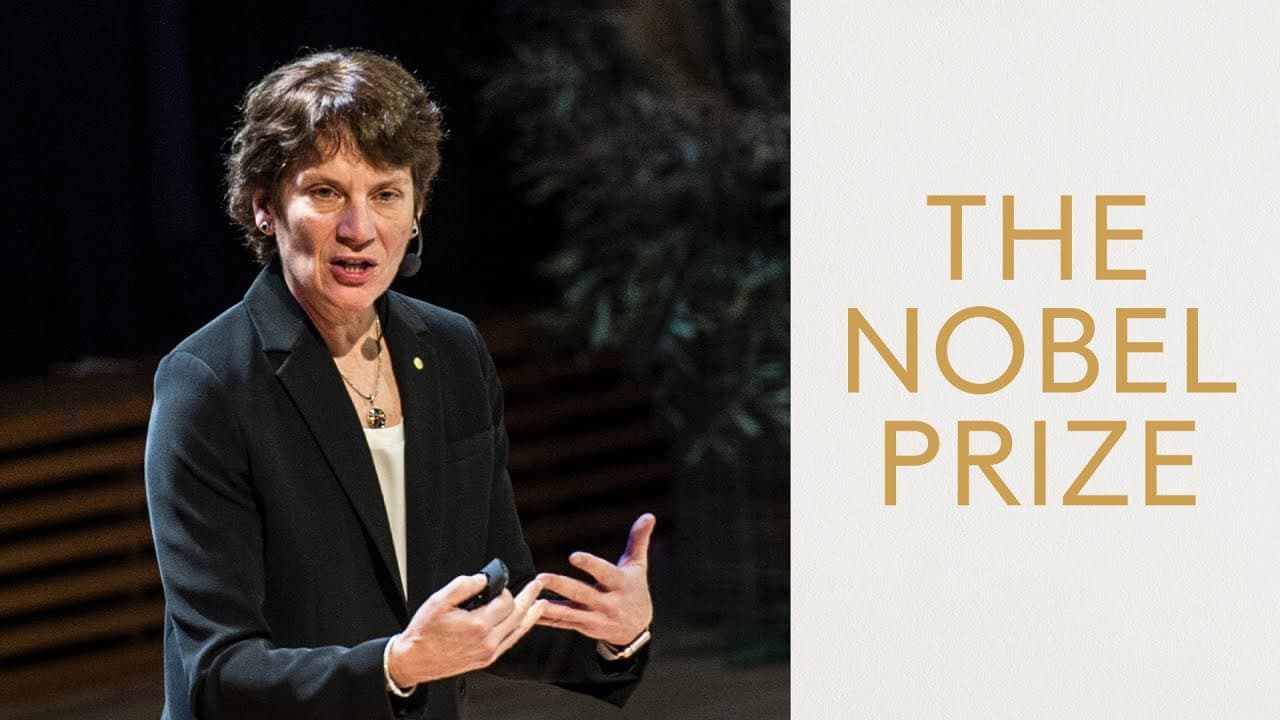
Nobel Prize lecture: Carolyn Bertozzi, Nobel Prize in Chemistry 2022
TL;DR
Bioorthogonal chemistry uses chemical components that react selectively with each other without interacting with or disrupting living systems. Bertozzi’s team developed the Staudinger ligation to attach imaging probes to modified sugars on cell surfaces, enabling researchers to observe glycosylation in native biological environments and supporting applications ranging from cultured cells and zebrafish to drug delivery studies in human cancer patients.
Transcript
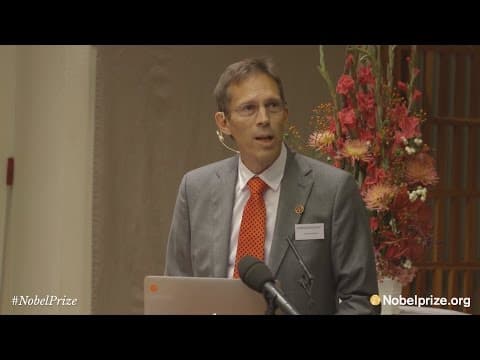
Carolyn bertozi was born 1966 in Boston Massachusetts USA she was awarded a PhD PhD in from the University of California at Berkeley in 1993 and is now active as the anti and Robert M bass professor at Stanford University where she's also an investigator of the house use Howard Hughes Medical Institute so by that please welcome me in welcome and pl... Read More
Key Insights
- Bioorthogonal reactions are chemical reactions between components that neither interact with nor interfere with a biological system. Their functional groups occupy a reactivity space outside ordinary biological chemistry while remaining capable of reacting selectively within cells, organisms, and other water-based living environments.
- Living organisms are exceptionally complex reaction vessels because chemists cannot control all the parameters as they can in a round-bottom flask. A useful reaction must tolerate water and numerous biological functionalities while attaching probes or other molecules without damaging the surrounding system.
- Cell-surface glycans are complex carbohydrates whose patterns can change when cells transform from one state to another. Cancerous transformation can involve altered glycosylation, including overproduction of sialic acid, making these sugars potential targets for profiling and molecular imaging.
- Metabolic labeling works by feeding cells a chemically altered sugar precursor that their enzymes can still process. The precursor is converted into a modified sialic acid and incorporated into complex carbohydrates, carrying an introduced chemical group to the cell surface.
- The imaging strategy uses two sequential steps: cellular metabolism first installs a reactive group within a cell-surface sugar, then a complementary group on an imaging probe reacts with it. This bond attaches the probe directly to the sugar in its native environment.
- Azides and phosphines were suitable starting components because they do not exist naturally in biological systems and react selectively with each other. However, the product of the classic Staudinger reaction is unstable in water, which made the original chemistry unsuitable for living systems.
- The Staudinger ligation solves water instability by adding a methyl ester to triphenylphosphine. After the phosphine reacts with an azide, an intramolecular reaction forms an amide bond that keeps the ligation product connected when water hydrolyzes the phosphorus–nitrogen bond.
- The Staudinger ligation was demonstrated on cultured cells without harming them. After establishing this reaction, Bertozzi’s team showed that azides could be introduced into multiple cell-surface sugars, including through a modified precursor used to produce labeled sialic acid.
Install to Summarize YouTube Videos and Get Transcripts
Explore YouTube Video Summarizer or Get YouTube Transcript Extractor
Questions & Answers
Q: What is bioorthogonal chemistry?
Bioorthogonal chemistry is chemistry performed with components that neither interact with nor interfere with a biological system. The reacting functional groups are absent from ordinary biological chemistry, yet they selectively recognize each other while surrounded by biological molecules. This allows reactions to occur in complex, water-based environments such as cultured cells, animals, and potentially human patients without disrupting normal biological processes.
Q: Why was bioorthogonal chemistry developed?
Bioorthogonal chemistry was developed to address unmet needs in biology, particularly the need to study molecules inside their native living environments. Bertozzi’s laboratory wanted to attach imaging probes to cell-surface sugars, but no suitable technology existed. Achieving that goal required a reaction that could proceed selectively inside cells or organisms despite water, biological functional groups, and the inability to control every reaction parameter.
Q: How can bioorthogonal chemistry image cell-surface sugars?
The approach begins by feeding a cell or organism a chemically altered sugar precursor containing a reactive functional group. Cellular enzymes metabolize that precursor and incorporate the modified product into complex carbohydrates on the cell surface. An imaging probe bearing a complementary functional group is then introduced. The two groups react selectively, forming a bond that attaches the probe to the surface sugar.
Q: Why are cell-surface glycans important for cancer research?
Cell-surface glycans are complex carbohydrates whose patterns can change when cells undergo a transformation of state. Literature available when Bertozzi began this research showed that healthy cells becoming cancerous could display altered surface glycosylation, often including increased production of sialic acid. A method for profiling and imaging these changes could therefore help researchers study differences between healthy cells and cancer cells.
Q: What observation inspired the metabolic labeling strategy?
At a conference in Southampton, Bertozzi heard Werner Reuter describe how cells could metabolize chemically altered versions of N-acetylmannosamine, a precursor of sialic acid. Conservative extensions to one side chain were tolerated by cellular enzymes. The cells converted those precursors into altered sialic acids and incorporated them into surface carbohydrates, suggesting that a reactive chemical group might be transported there in the same way.
Q: What problem affected the classic Staudinger reaction in living systems?
The classic Staudinger reaction joins triphenylphosphine and an azide to produce an aza-ylide adduct. Although phosphines and azides are absent from biological systems and react selectively, the resulting product is unstable in water. Because water is the unavoidable solvent for reactions in living systems, this hydrolytic sensitivity prevented the unmodified reaction from producing a stable labeling connection.
Q: How does the Staudinger ligation create a stable product?
Eliana Saxon modified triphenylphosphine by introducing a methyl ester. When the phosphine reacts with an azide, the resulting nucleophilic nitrogen attacks that ester through a rapid intramolecular reaction, forming a cyclic intermediate. Water later hydrolyzes the phosphorus–nitrogen bond, but the amide bond formed during the intramolecular step keeps the two reaction partners connected as a stable ligation product.
Q: Where can bioorthogonal reactions be performed?
Bioorthogonal reactions were designed for environments ranging from cultured cells to whole living organisms. Bertozzi describes applications involving live cells in culture dishes, laboratory mice, and zebrafish used as a model for vertebrate development. She also states that bioorthogonal chemistry is being tested in human cancer patients for drug delivery, representing a particularly high level of biological complexity.
Summary
Dr. Bertozzi, a pioneer in the field of chemical biology, shares her journey in developing bioorthogonal chemistry and its applications in imaging cell surface glycans. She explains how bioorthogonal reactions are critical for performing chemistry in living systems like cells, animals, and even humans. The first bioorthogonal reaction she developed was the staudinger ligation, which enabled the attachment of imaging probes to sugars on cell surfaces. Later, she and her team discovered the copper-free click chemistry, using strained cyclooctins and azides, which accelerated the reaction rate. This breakthrough allowed for the imaging of various biological molecules, such as proteins, nucleic acids, and lipids, in living systems. The applications of bioorthogonal chemistry have expanded into drug development and diagnostics for human diseases. Dr. Bertozzi emphasizes the importance of curiosity-driven basic science in driving innovations and applications in the field.
Questions & Answers
Q: What is bioorthogonal chemistry and why was it developed?
Bioorthogonal chemistry refers to reactions among components that do not interact with or interfere with biological systems. It was developed to enable chemical reactions in living systems, where traditional chemical reactions control every parameter, are not feasible. The goal was to perform chemistry in complex reaction vessels like live cells, organisms, or even humans.
Q: How did Dr. Bertozzi and her team develop the staudinger ligation?
The staudinger ligation was developed by modifying the classic staudinger reaction, which reacts triphenylphosphine with azides. To overcome the hydrolytic sensitivity of the resulting azaleid product, a methyl ester group was introduced to the triphenylphosphine. This modification allowed the formation of a stable phosphorus-nitrogen bond through intramolecular reaction, making the staudinger ligation a viable bioorthogonal reaction.
Q: What was the significance of introducing the azide into cell surface sugars?
Introducing the azide into cell surface sugars allowed the attachment of imaging probes to sugars in their native habitats. This enabled the study of changes in cell surface glycans, which are associated with various biological states and diseases. For example, studying the overproduction of cyalic acid in cancer cells compared to healthy cells provided insights into cancer development and progression.
Q: How did Dr. Bertozzi and her team expand the applications of bioorthogonal chemistry?
Dr. Bertozzi's team demonstrated that bioorthogonal chemistry could be used to label and image various other biological molecules beyond sugars. They developed methods to introduce azides into amino acids, nucleosides, and lipids, allowing for the imaging of proteins, nucleic acids, and lipids in living systems. This expansion of applications sparked the interest of researchers and led to further advancements in the field.
Q: How did the development of copper-free click chemistry accelerate the reaction rate?
Copper-free click chemistry, inspired by the discovery of copper-catalyzed azide-alkyne cycloaddition, utilized strained cyclooctins and azides to achieve a fast reaction rate. The incorporation of two fluorine atoms near the triple bond of the cyclooctin greatly increased its reactivity, allowing the cycloaddition to occur rapidly at room temperature without the need for toxic metal catalysts like copper.
Q: How did Dr. Bertozzi and her team apply bioorthogonal chemistry to image sugars in living animals?
In collaboration with other researchers, Dr. Bertozzi's team used bioorthogonal chemistry to label and image sugars in living zebrafish embryos. They fed the embryos azido sugars, which were metabolized and appeared on the cell surfaces. Then, through copper-free click chemistry, they attached fluorescent dyes to the azido sugars in a live animal, enabling the visualization and mapping of sugar distribution during development.
Q: What other applications have emerged from bioorthogonal chemistry?
Bioorthogonal chemistry has found applications in various fields. One significant application is in the development of antibody drug conjugates, where bioorthogonal chemistry is used to attach drugs to specific antibodies for targeted cancer treatment. It is also being used to create vaccine conjugates and targeted degraders of extracellular molecules. The versatility and potential for new applications make bioorthogonal chemistry an exciting field of study.
Q: How does curiosity-driven basic science contribute to innovations and applications?
Dr. Bertozzi emphasizes the importance of curiosity-driven basic science in catalyzing innovations and applications. The foundational knowledge built by earlier chemists who made curious observations about exotic molecules provided the basis for bioorthogonal chemistry. These chemists could not have foreseen the current applications of their work, but their curiosity-driven research set the stage for advancements in techniques like bioorthogonal chemistry, which now has significant implications for human health and medicine.
Q: What support and funding sources have enabled Dr. Bertozzi's research?
Dr. Bertozzi acknowledges the support and funding provided by the Royal Swedish Academy of Sciences, the Nobel Foundation, her institution UC Berkeley, and her current institution Stanford. She also mentions the financial support from the National Institutes of Health and the Howard Hughes Medical Institute from the beginning of her research. These organizations and institutions played a crucial role in facilitating her groundbreaking work in bioorthogonal chemistry.
Q: Who are the key contributors to Dr. Bertozzi's research?
Dr. Bertozzi acknowledges her students, postdocs, and colleagues as the key contributors to her research. She expresses gratitude for their dedication and fearlessness in pushing the boundaries of bioorthogonal chemistry. She also recognizes the institutions, funding agencies, and her family for their support throughout her career.
Q: How has bioorthogonal chemistry impacted medicine and diagnostics?
Bioorthogonal chemistry has made significant contributions to medicine and diagnostics. It has been utilized in the development of antibody drug conjugates, vaccine conjugates, and targeted degraders of extracellular molecules for cancer treatment. The ability to image and track biological molecules using bioorthogonal chemistry has also improved diagnostics and understanding of diseases. This chemistry holds great promise for advancing healthcare and finding new therapeutic strategies.
Takeaways
Dr. Bertozzi's groundbreaking work in bioorthogonal chemistry has revolutionized the field of chemical biology. The development of the staudinger ligation and copper-free click chemistry enabled the imaging of sugars and various other biological molecules in living systems. This versatile chemistry has found applications ranging from basic research to drug development and diagnostics. Dr. Bertozzi highlights the importance of curiosity-driven basic science in driving innovations and applications. The foundational knowledge established by previous researchers played a fundamental role in the advancements made in bioorthogonal chemistry. The impact of bioorthogonal chemistry in medicine and diagnostics signals a bright future for this field, with ongoing exploration and the need for new innovations and reactions.
Summary & Key Takeaways
-
Bioorthogonal chemistry arose from the need to perform controlled chemical reactions inside complex living environments. Unlike laboratory flasks, cells and organisms do not allow chemists to control every reaction parameter. The required components must therefore react selectively with each other while neither interacting with nor interfering with surrounding biological chemistry.
-
Bertozzi sought to image changes in cell-surface glycosylation, particularly the overproduction of sialic acid associated with cancerous transformation. Inspired by Werner Reuter’s research, she proposed feeding cells a modified metabolic precursor. Cellular enzymes would process it and display a reactive chemical group within sugars on the cell surface.
-
The first successful reaction was the Staudinger ligation, developed by modifying the classic reaction between phosphines and azides. Eliana Saxon added a methyl ester that enabled intramolecular bond formation and preserved the ligation product after hydrolysis in water. The reaction worked on cultured cells without harming them.
Read in Other Languages (beta)
Share This Summary 📚
Summarize YouTube Videos and Get Video Transcripts with 1-Click
Try YouTube Summary with ChatGPT & Claude or YouTube Transcript Generator
Explore More Summaries from Nobel Prize 📚

Summarize YouTube Videos and Get Video Transcripts with 1-Click
Try YouTube Summary with ChatGPT & Claude or YouTube Transcript Generator