How to Turn Books Into Expert AI Advisors
TL;DR
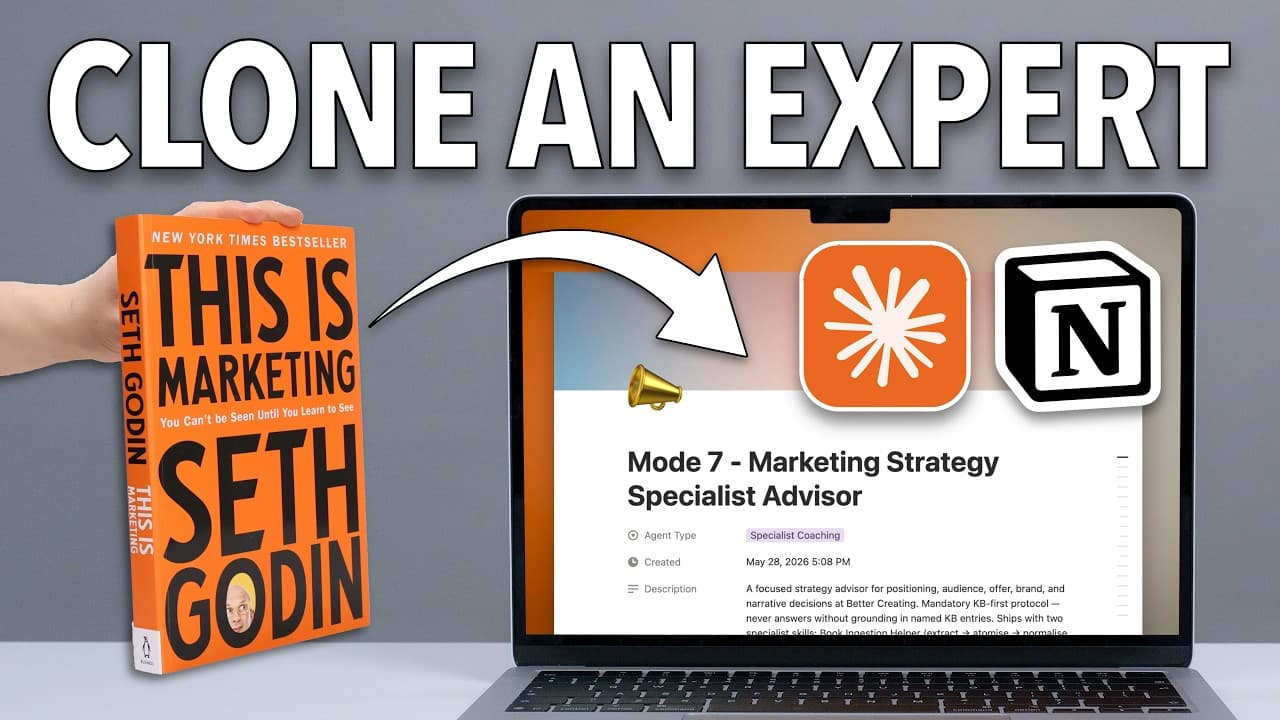
Build an expert AI advisor by combining clear agent instructions, reusable skills, and a dedicated knowledge base created from books or other trusted sources. In Notion, the knowledge base supplies curated principles, examples, application guidance, confidence levels, and citations, helping the personal AI agent provide grounded business advice instead of relying only on generic training data.
Transcript
What if I told you you can take any book, any body of research, any expert's entire framework and turn it into an AI advisor that actually thinks only from that knowledge, not a chatbot that makes things up, a specialist collaborator backed by sources you choose that can advise you on demand around your specific work and business. That's exactly wh... Read More
Key Insights
- A specialist AI advisor is built from agent instructions, reusable skills, and a dedicated knowledge base. Instructions establish identity and behavior, skills define repeatable actions, and the knowledge base supplies the curated ideas and principles that guide decisions.
- Agent instructions are the equivalent of a job description for an AI specialist. They define who the agent is, how it should behave, its primary mission, and which source of truth it should consult when answering questions or supporting business work.
- Skills are reusable playbooks that describe processes and actions step by step. They can cover simple work, such as preparing an executive meeting summary, or more complex workflows, such as reviewing an inbox and proposing answers across multiple messages.
- A knowledge base is the decision-making brain of the advisor. It holds trusted frameworks, principles, case studies, examples, application guidance, confidence levels, and sources, allowing the agent to ground its recommendations in material deliberately curated by the user.
- Books can be converted into structured knowledge by extracting important ideas from each chapter and separating them into individual principles. Related ideas from other trusted sources can then be linked, giving the advisor a connected body of material for analysis and recommendations.
- Grounded advice depends on curation rather than generic model knowledge alone. The demonstrated system uses selected sources to make the agent's guidance more specific and consistent, while a skills-only setup can still produce generic advice despite following a clearly defined process.
- Notion provides a model-agnostic workspace for the system because Notion AI can run on different underlying models. The instructions, skills, and knowledge databases remain organized in one visual environment rather than being tied entirely to a single model provider.
- Personal agent chat is the recommended interface for iterative AI consultancy. Custom agents are intended for specific jobs that can run across a team and use credits, although they can still consult the same linked knowledge bases and skills when appropriate.
Install to Summarize YouTube Videos and Get Transcripts
Explore YouTube Video Summarizer or Get YouTube Transcript Extractor
Questions & Answers
Q: How do you turn a book into an expert AI advisor?
Start by extracting the book's important frameworks and breaking chapter material into distinct principles. Store each principle in a structured knowledge base with fields such as topic, category, key insight, when to apply, confidence level, and source. Then create specialist instructions defining the advisor's role and behavior, plus reusable skills for the actions it should perform. Link all three components so its recommendations are grounded in the selected book.
Q: What components does a specialist AI advisor need?
A specialist AI advisor needs three connected components. Agent instructions define its identity, behavior, mission, and source of truth. Skills provide reusable, step-by-step processes for tasks it can perform. A dedicated knowledge base contains the frameworks, principles, case studies, examples, and sources that inform its decisions. Together, these components give the advisor both a defined role and trusted material for producing relevant guidance.
Q: What should an AI advisor knowledge base contain?
The demonstrated knowledge base includes a topic, category, key insight, guidance about when the idea should be applied, a confidence level, and the original source. It can also contain frameworks, strategies, models, principles, case studies, and examples. Organizing material this way helps the advisor retrieve ideas in context, apply them to appropriate situations, and show which curated source supports its recommendations.
Q: What is the difference between AI skills and a knowledge base?
A skill defines a process or set of actions that the AI should follow, such as drafting a consulting pitch, preparing an executive summary, or reviewing an inbox. A knowledge base supplies the principles and ideas that influence the AI's judgment while performing those actions. Skills determine how work is completed, while the knowledge base determines which trusted frameworks and evidence should shape the resulting advice.
Q: Why does curated knowledge improve AI business advice?
Curated knowledge gives the advisor a specific body of trusted frameworks instead of leaving it to rely only on generic training data. The creator found that an AI with a clear process but no dedicated knowledge base could still give generic guidance. Adding selected principles, examples, application conditions, and sources makes its recommendations more grounded, consistent, and aligned with the approaches the business owner actually trusts.
Q: How can a meta agent help build a specialist advisor?
A meta agent can plan the specialist's structure and help create its knowledge base, agent instructions, and supporting skills. In the demonstration, it first proposes a build order: confirm the scope, create the knowledge base, write the specialist instructions, and build the skills. It also consults its own prompt-engineering knowledge base, showing how a grounded advisor can use curated principles while helping construct another agent.
Q: Should AI business advisors use Notion personal or custom agents?
The creator recommends the personal agent chat for consultancy-style collaboration because useful advisory work requires iterative thinking and conversation. Notion custom agents are better suited to specific jobs that operate for a whole team, such as briefing tasks, and they consume credits. Custom agents can still access the same skills and knowledge bases, but the personal interface is presented as the better fit for ongoing specialist advice.
Q: Can several trusted experts be combined in one AI knowledge base?
Yes. The demonstrated system can summarize principles from one book and connect them with similar ideas from other trusted authors or sources. For example, an idea derived from one author's chapter can be linked to a related idea from another author. These relationships create a broader knowledge base while keeping the underlying sources visible, allowing the advisor to compare and apply multiple curated frameworks rather than relying on one isolated text.
Summary & Key Takeaways
-
An effective specialist AI advisor has three connected components: agent instructions that define its role and behavior, skills that provide repeatable action processes, and a curated knowledge base that informs its decisions. The advisor can then support marketing, content, consulting, or other business work using frameworks selected by its owner.
-
The demonstrated Notion knowledge base organizes material into properties such as topic, category, key insight, when to apply, confidence level, and source. Books can be broken down chapter by chapter and principle by principle. Related ideas from multiple trusted authors can also be linked, creating a richer body of grounded guidance.
-
The creator recommends using Notion's personal agent chat for iterative advisory conversations because consultancy work benefits from back-and-forth thinking. Custom agents can access the same knowledge bases and skills, but they are designed for specific team-wide jobs and consume credits. A meta agent can accelerate planning, instruction writing, knowledge-base construction, and skill creation.
Read in Other Languages (beta)
Share This Summary 📚
Summarize YouTube Videos and Get Video Transcripts with 1-Click
Try YouTube Summary with ChatGPT & Claude or YouTube Transcript Generator
Explore More Summaries from Systems Made Better 📚
Summarize YouTube Videos and Get Video Transcripts with 1-Click
Try YouTube Summary with ChatGPT & Claude or YouTube Transcript Generator