How Long Should You Rest Between Workout Sets?
TL;DR
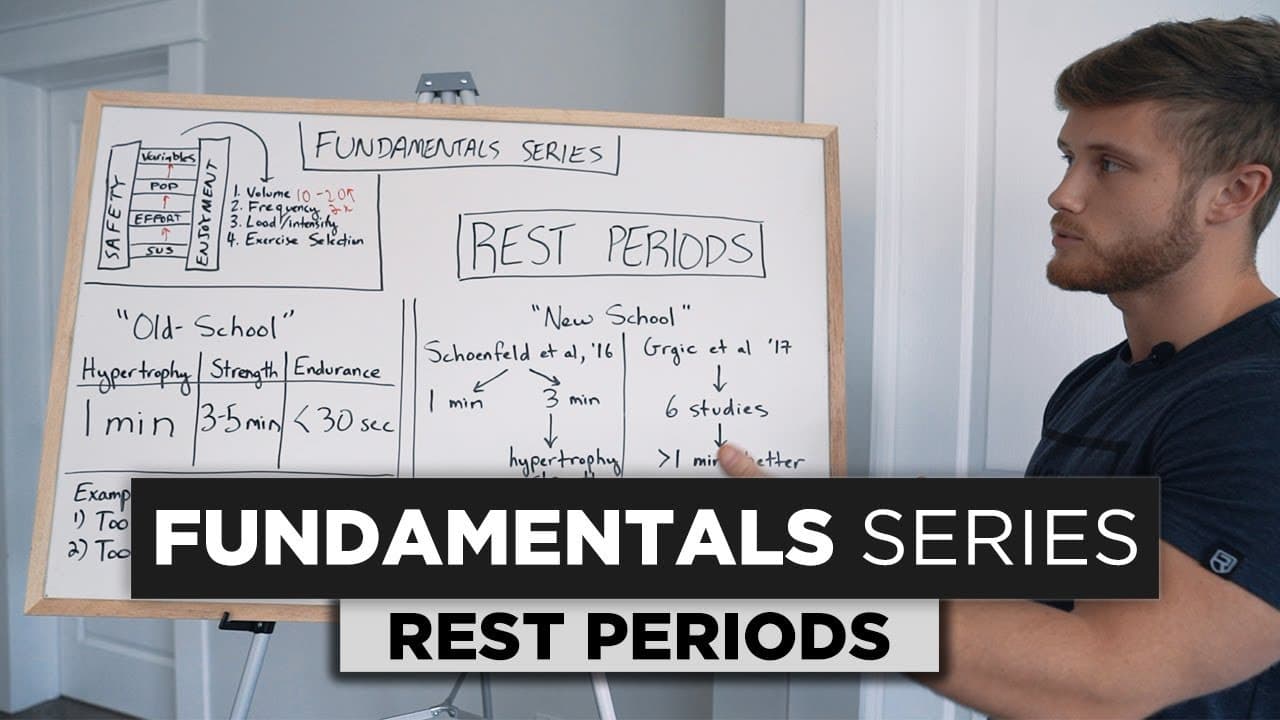
Rest 3–5 minutes between heavy compound sets and 1–2 minutes between isolation sets. Longer recovery can preserve repetitions, weight, and total training volume, while excessively long breaks can make workouts inefficient. The appropriate interval depends on the exercise, load, effort, recovery demands, and available training time, with rests under one minute rarely recommended.
Transcript
all right welcome everyone to a new episode of the fundamentals series it's been a while since I've had the whiteboard out so Before we jump into everything to do with rest periods I'm just gonna do a super quick recap of everything we've talked about so far and if you'd like to skip that recap that you can just jump to this time stamp over here bu... Read More
Key Insights
- Rest periods are a lower training priority than safety, enjoyment, sustainability, effort, progressive overload, prioritization, volume, frequency, load, and exercise selection. They still matter because inadequate recovery can interfere with higher-priority goals, particularly the ability to maintain productive training volume across successive sets.
- The two main functions of rest periods are recovery and time management. A useful interval restores enough performance for the next set without unnecessarily extending the workout, reducing energy, encouraging distraction, or causing the overall session to lose its productive pace.
- Heavy compound exercises generally require 3–5 minutes of rest because they involve more muscle mass and carry higher recovery costs. The precise interval depends on the movement and load, with barbell rows potentially requiring about three minutes and heavy squats requiring closer to five.
- Isolation exercises generally require 1–2 minutes of rest because they use smaller muscles and have lower recovery costs. A one-minute interval supports a faster workout, while two minutes may be appropriate when time is available and fuller recovery is preferred.
- Short rest periods can reduce total training volume by limiting performance on subsequent sets. In the example provided, completing five bench press repetitions with 300 pounds would not likely be repeatable after only one minute, potentially reducing the second set to two or three repetitions.
- Three-minute rest periods produced better outcomes than one-minute rests in the cited eight-week full-body study. The longer-rest group achieved better quadriceps and triceps hypertrophy, greater bench press and squat one-repetition maximum strength, and no disadvantage in muscular endurance.
- Rest periods longer than one minute performed better than shorter intervals in the cited 2017 meta-analysis of six studies. The main rationale was that greater recovery allowed participants to complete more total volume, although the appropriate interval also depended on exercise selection and exertion.
- Separated supersets can make shorter transitions practical by alternating antagonistic muscle groups. A lat pulldown paired with a dumbbell fly lets the back recover while the chest works, and vice versa, but this approach is presented mainly as an option for people facing significant time constraints.
Install to Summarize YouTube Videos and Get Transcripts
Explore YouTube Video Summarizer or Get YouTube Transcript Extractor
Questions & Answers
Q: How long should you rest between heavy compound sets?
Rest approximately 3–5 minutes between heavy compound sets. These movements involve substantial muscle mass and generally impose higher recovery costs than isolation exercises. The exact interval should reflect the exercise and load. A barbell row may require about three minutes, while heavy squats, deadlifts, or a very heavy set of three squat repetitions may warrant closer to five minutes.
Q: How long should you rest between isolation exercise sets?
Rest approximately 1–2 minutes between isolation exercise sets. These movements generally involve smaller muscles and have lower recovery costs than heavy compound exercises. Choose closer to one minute when workout efficiency is important, or closer to two minutes when more complete recovery is preferred. Going beyond two minutes may needlessly slow the workout and create opportunities for distraction.
Q: Why can short rest periods reduce muscle-building performance?
Short rest periods can prevent adequate recovery before the next set, reducing the weight, repetitions, or effort that can be sustained. This lowers total training volume, which is treated as a relatively important training variable. For example, after five bench press repetitions with 300 pounds, resting only one minute might reduce the following set to two or three repetitions instead of five.
Q: Are three-minute rests better than one-minute rests for hypertrophy?
The cited eight-week full-body training study found better quadriceps and triceps hypertrophy in the group resting three minutes rather than one minute. The three-minute group also improved bench press and squat one-repetition maximum strength more, while muscular endurance did not differ between groups. These findings challenge the older recommendation that hypertrophy training should generally use approximately one-minute rests.
Q: Should rest periods be timed exactly during a workout?
Rest periods do not need to be timed exactly if they remain roughly within the recommended ranges and are monitored carefully. The practical targets are 3–5 minutes for heavy compound exercises and 1–2 minutes for isolation exercises. Individual discretion is appropriate because recovery needs vary with the movement, the weight being used, the exertion required, and the desired pace of the workout.
Q: Why should rest periods not be excessively long?
Excessively long rests can make a workout feel drawn out and may cause energy or momentum to decline as the session becomes longer. They can also encourage distraction, including spending too much time on a phone. Rest should be long enough to restore useful performance, but not so long that it needlessly reduces training efficiency or disrupts the workout's productive pace.
Q: When are rest periods under one minute appropriate?
Rest periods under one minute are rarely recommended because they often provide insufficient recovery for productive subsequent sets. One possible exception involves separated supersets using antagonistic muscle groups, such as pairing a lat pulldown with a dumbbell fly. While one muscle group works, the opposing group recovers, making the arrangement potentially useful when someone is particularly constrained by time.
Q: What factors determine the ideal rest period between sets?
The ideal rest period depends on the exercise, load, effort, recovery cost, and desired workout pace. Squats and deadlifts generally demand more recovery than barbell rows, while a heavy triple may require more rest than speed work. Time availability also matters. Longer rests preserve performance, while shorter rests improve efficiency, provided they do not substantially reduce repetitions, weight, or total volume.
Summary & Key Takeaways
-
Rest periods serve two main functions: allowing sufficient recovery between sets and managing workout duration. Breaks that are too short can reduce repetitions, weight, effort, and total work on later sets. Breaks that are unnecessarily long can slow the session, encourage distraction, and make the workout feel drawn out.
-
Heavy compound exercises generally warrant 3–5 minutes of rest because they involve substantial muscle mass and have greater recovery costs. Heavy squats or triples may require at least five minutes, while a barbell row may require about three. Isolation exercises generally need only 1–2 minutes between sets.
-
Research discussed in the episode challenges the traditional recommendation of approximately one-minute rests for hypertrophy. An eight-week study favored three-minute rests for quadriceps and triceps growth, squat and bench press strength, while a six-study meta-analysis found that rests longer than one minute supported better results by enabling more total volume.
Read in Other Languages (beta)
Share This Summary 📚
Summarize YouTube Videos and Get Video Transcripts with 1-Click
Try YouTube Summary with ChatGPT & Claude or YouTube Transcript Generator
Explore More Summaries from Jeff Nippard 📚

Summarize YouTube Videos and Get Video Transcripts with 1-Click
Try YouTube Summary with ChatGPT & Claude or YouTube Transcript Generator