Best and Worst Glute Exercises According to Science
TL;DR
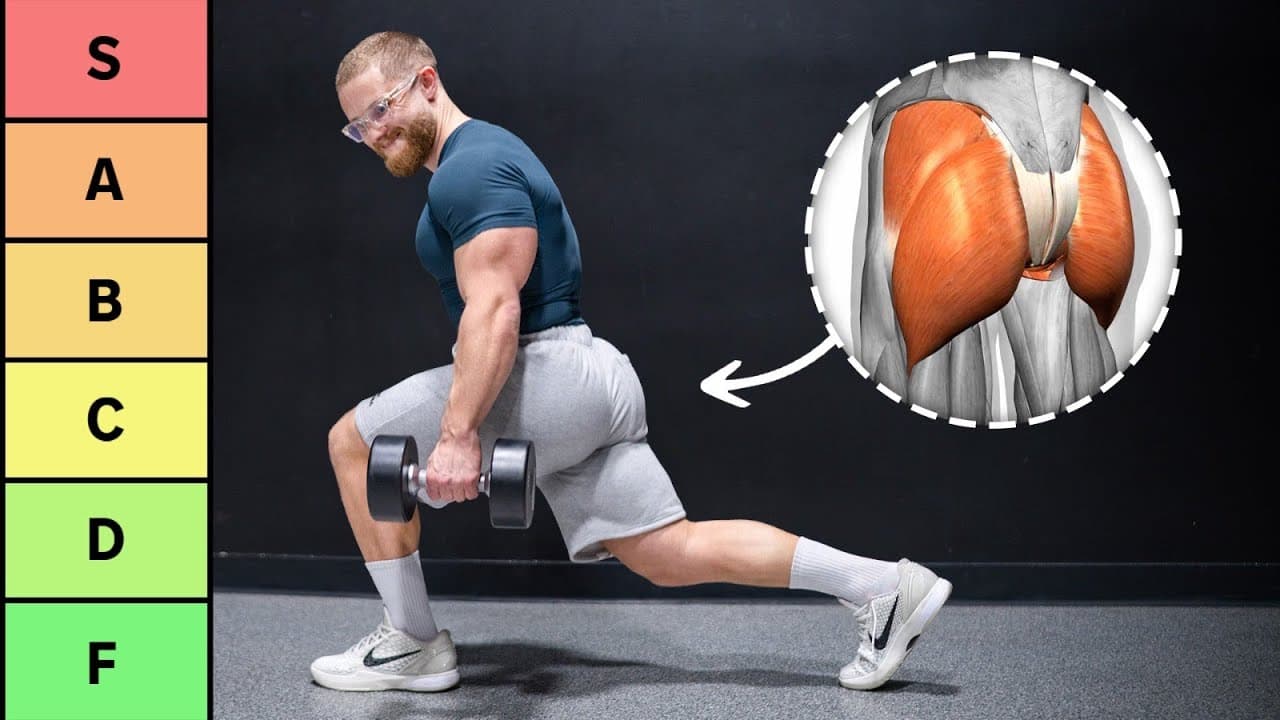
The single-leg dumbbell hip thrust, Bulgarian split squat, and machine hip abduction rank highest for glute growth because they combine high tension, a good stretch, and easy progressive overload. Donkey kicks and fire hydrants rank lowest since they generate little tension in the stretched position and are hard to overload. Combine stretch-focused moves like squats with shortened-position moves like hip thrusts.
Transcript
the glutes are one of the single most important muscles for building an impressive physique they're also one of the largest muscles in the body so regardless of whether you're a man or you're a woman building this one muscle will make it immediately obvious that you lift from the side and the rear so in this video I'm ranking the best and worst glu... Read More
Key Insights
- The glutes are actually three distinct muscles: the large glute maximus that extends and externally rotates the hip, the glute medius (about a third the size, with muscle mass similar to the delts), and the smaller glute minimus, both of which stabilize and build the upper glutes.
- The criteria for an S-tier glute exercise are high tension especially in the stretched position, feeling good with no knee, hip, or low back pain, and having a clear way to progressively overload over time.
- The barbell hip thrust activates the entire glute but mainly the middle portion, and it is excellent for progressive overload; if your glutes get stronger in the 5 to 15 rep range they are also getting bigger. It ranks high B tier.
- The machine hip thrust solves the barbell version's pinching and setup problems with a comfortable belt and a stable base, earning high A tier and the number one pick for the middle glutes.
- Squats are an underrated glute builder that stretch the glutes and hit all regions, though they also heavily involve the quads; squatting deeper and breaking parallel is important for glute growth. The barbell squat ranks A tier.
- The Bulgarian split squat gets a deeper glute stretch than a standard squat and, being single-leg, involves the upper glutes more, ranking high A tier but held back by being hard to overload and exhausting.
- Donkey kicks and fire hydrants both rank low D tier as glute builders because they provide very little tension in the stretched position and are hard to progressively overload, though they work as warm-up, activation, mobility, or rehab drills.
- Machine hip abductions are fantastic for the upper glutes because they directly challenge the glute medius and minimus through hip abduction; leaning forward about 30 degrees improves the line of pull and deepens the stretch.
Install to Summarize YouTube Videos and Get Transcripts
Explore YouTube Video Summarizer or Get YouTube Transcript Extractor
Questions & Answers
Q: What are the three muscles that make up the glutes?
The glutes are technically three distinct muscles. The glute maximus is the very large powerhouse of the lower body that extends the hips like in a deadlift and externally rotates the leg. The glute medius is about a third the size of the maximus but still has roughly the same muscle mass as your delts and sits on the upper glutes. The glute minimus is about half the size of the medius and plays a key stabilization role while adding size to the upper glutes.
Q: What makes a glute exercise S tier according to the video?
To reach S tier, an exercise must meet three criteria. First, it needs to provide high tension, especially in the stretched position. Second, it should feel good, meaning it does not cause knee, hip, or low back pain. Third, there must be some way of progressing the exercise over time through progressive overload, which is ultimately what keeps the glutes growing. An exercise can be S tier for one specific glute region without being S tier for the entire glutes.
Q: Is the barbell hip thrust good for glute growth?
Yes, the barbell hip thrust is one of the more studied movements in exercise science and a pile of studies show it is very effective at growing the glutes. It activates the entire glute but mainly targets the middle portion because it isolates hip extension, and it is great for progressive overload. Downsides include the barbell pinching the hips, awkward and slow setup, and only reaching about 90 degrees of hip flexion rather than a deep stretch, so it ranks high B tier.
Q: Why is the machine hip thrust ranked higher than the barbell version?
The machine hip thrust, such as the Nautilus Glute Drive, solves several problems of the barbell version. The belt is much more comfortable than a barbell, you do not need to set anything up, and because the machine is very stable you do not need to use balance and can focus on engaging your glutes better. Its only real downside is the lack of a really deep stretch. It earns high A tier and is picked as the number one option for the middle aspect of the glutes.
Q: How do you make squats more glute-dominant?
Squats activate all regions of the glutes, especially the middle, but also give a huge quad stimulus. To make the movement more glute dominant, you can place the bar a few inches lower on your back, lean further forward, and focus on really driving through your hips. Research also shows that squatting deeper is important for glute growth, so you should try to at least break parallel. With these adjustments the barbell squat ranks A tier for glute growth.
Q: Why do donkey kicks and fire hydrants rank so low for glute growth?
Donkey kicks probably do not grow the glutes very well because they are really hard to overload, even with a band you get very little tension while the glutes are stretched, and progressively overloading with a band is difficult. Fire hydrants have similar issues and just do not get high tension on the glutes. Both go in low D tier as glute builders, though donkey kicks work as a warm-up activation drill and fire hydrants work for mobility or rehab.
Q: What is the best way to train the upper glutes?
The upper glutes respond to exercises combining hip extension and hip abduction, since the upper glute fibers perform both. Kickbacks work well if you kick up and out diagonally and are very stable when braced. Step-ups target the upper glutes because doing one leg at a time engages the glute medius and minimus, especially with the box at or above knee level. Machine hip abductions are fantastic because they directly challenge the glute medius and minimus, and leaning forward about 30 degrees improves the line of pull.
Q: How should glute training be structured across stretched and shortened positions?
Like other muscles, the glutes likely grow best from a combination of exercises that challenge them in a more stretched position, such as the squat, plus exercises that challenge them in a more shortened position, such as the hip thrust. One nine-week study with untrained subjects found the hip thrust just as effective as the squat despite the squat stretching the glutes more, but other research suggests the glutes respond well to deeper training, so combining both approaches is the recommended strategy.
Summary & Key Takeaways
-
The glutes are three muscles: the powerhouse glute maximus that extends and externally rotates the hip, the glute medius with delt-sized muscle mass, and the smaller glute minimus. All are worth training, and exercises are ranked from S tier down to F tier for muscle-building potential.
-
Hip-extension moves like the barbell hip thrust, machine hip thrust, squats, and Bulgarian split squats build the glutes well through high tension and progressive overload. The machine hip thrust earns high A tier and is picked as the number one option for the middle glutes.
-
Donkey kicks and fire hydrants land in low D tier because they deliver little tension in the stretch and resist overload. Upper-glute work such as kickbacks, step-ups, and machine hip abduction targets the glute medius and minimus through hip extension plus abduction.
Read in Other Languages (beta)
Share This Summary 📚
Summarize YouTube Videos and Get Video Transcripts with 1-Click
Try YouTube Summary with ChatGPT & Claude or YouTube Transcript Generator
Explore More Summaries from Jeff Nippard 📚


Summarize YouTube Videos and Get Video Transcripts with 1-Click
Try YouTube Summary with ChatGPT & Claude or YouTube Transcript Generator