How to Use Claude Fable 5.1 Without Overspending
TL;DR
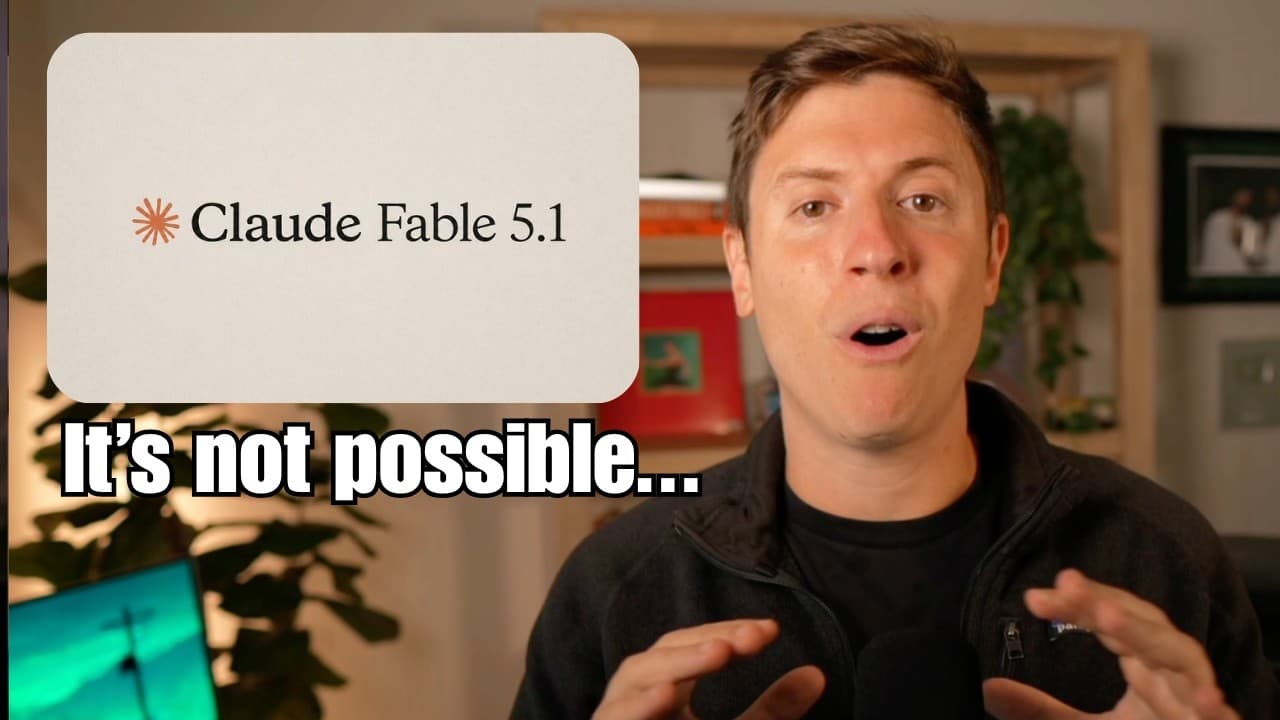
Use Claude Fable 5.1 for research, agent audits, repeated brainstorming, and custom benchmark testing, where its efficiency and ability to generate novel ideas provide the clearest advantages. Although its per-token price matches Fable 5, the presenter reports that it completes tasks with fewer tokens and can reduce task costs by roughly 25 to 40%.
Transcript
Claude Fable 5.1 just released and what it's capable of is mindblowing. It is a clear step up in every single way from Fable 5. But here's the thing. If you don't use it the right way, you're going to waste tons of money. In this video, I'm going to cover all of the changes implemented into Fable 5.1. I'm going to cover all the ways it got better. ... Read More
Key Insights
- Claude Fable 5.1 is described as substantially more efficient than Fable 5, completing equivalent tasks with fewer tokens while retaining the same per-token price. According to the presenter, this can lower the total cost of a task by roughly 25 to 40%.
- Scientific research is presented as Claude Fable 5.1’s largest area of improvement. The presenter connects this strength to breaking subjects into first principles, developing novel concepts, and examining existing ideas or systems from perspectives that earlier brainstorming sessions may have missed.
- Content filtering is described as less disruptive in Claude Fable 5.1 than in Fable 5. The newer model completed the presenter’s relic-hunt test, which required searching files for hidden items, while Fable 5 consistently refused that task during the presenter’s previous tests.
- The custom debugging test showed Claude Fable 5.1 finding all identified bugs in a randomly selected GitHub repository with significantly fewer tool calls than GPT56 Soul. The presenter interprets this as evidence that the model can combine strong results with more efficient tool use.
- The 3D roller coaster test showed Claude Fable 5.1 producing a more detailed simulation than GPT56 Soul. The presenter highlighted richer buildings, trees, grass, tracks, clouds, colors, and sky details, while describing the competing result as functional but visually less complete.
- The website recreation test showed Claude Fable 5.1 generating a more recognizable imitation of Apple’s homepage than Fable 5. Its representations of devices and people remained imperfect, but the presenter found their general forms easier to identify than those in the earlier model’s output.
- An AI agent audit is recommended as an immediate Claude Fable 5.1 use case. The proposed workflow is to export a detailed markdown description of an agent system, including its skills and sub-agents, then ask the model to identify improvements and propose new approaches.
- A personal benchmark harness is presented as more useful than relying only on public benchmark scores. The presenter recommends designing tests around recurring daily tasks so users can directly measure model quality, efficiency, filtering behavior, and suitability for their individual workflows.
- More videos from this channel:
- More from this channel: Alex Finn
Install to Summarize YouTube Videos and Get Transcripts
Explore YouTube Video Summarizer or Get YouTube Transcript Extractor
Questions & Answers
Q: How should you start using Claude Fable 5.1?
Start with work that benefits from research, first-principles analysis, or novel ideas. The presenter recommends auditing an existing AI agent setup, rerunning promising brainstorming sessions previously completed with Fable 5, and building a personal benchmark harness. These tasks help reveal whether the model produces better ideas, uses fewer tools or tokens, and fits your actual workflow.
Q: How can Claude Fable 5.1 reduce task costs?
Claude Fable 5.1 reportedly has the same per-token price as Fable 5, but it can finish tasks with fewer tokens. The presenter estimates that this greater efficiency reduces the total cost of a task by approximately 25 to 40%. The savings therefore come from needing less model usage to achieve the result, not from a lower stated token price.
Q: How do you audit an AI agent setup with Claude Fable 5.1?
Ask the main orchestrator in your current agent system to create a detailed markdown file describing the full setup, including its skills, sub-agents, and related components. Download that file, provide it to Claude Fable 5.1, and request an audit. The goal is to identify weaknesses, suggest improvements, and generate fresh approaches that can then be implemented in the system.
Q: Why should old brainstorming sessions be rerun in Claude Fable 5.1?
Rerunning earlier brainstorming prompts can reveal angles and concepts that Fable 5 did not produce. The presenter reports generating substantially new ideas by submitting the same prompts to Fable 5.1. He attributes this difference to the newer model’s research focus and its ability to reason from first principles, especially when a problem requires original approaches rather than routine execution.
Q: What did Claude Fable 5.1 achieve in the coding benchmarks?
In the presenter’s tests, Claude Fable 5.1 produced a more detailed 3D roller coaster simulator, found all bugs in a random GitHub repository with fewer tool calls than GPT56 Soul, and performed slightly better on an agentic file-search gauntlet. It also outscored Fable 5 overall and completed a relic-hunt task that the earlier model had refused.
Q: How is Claude Fable 5.1 filtering different from Fable 5?
The presenter found that Claude Fable 5.1 was willing to answer or execute more legitimate requests without unnecessarily triggering content restrictions. The clearest example was the relic-hunt benchmark, which asked the model to inspect files and locate hidden items. Fable 5 repeatedly refused that task in the presenter’s tests, while Fable 5.1 completed it successfully.
Q: Why is Claude Fable 5.1 described as a research intern?
Claude Fable 5.1 is described as a research intern because its strongest reported gains appear in scientific research and novel idea generation. The presenter says research involves reducing subjects to first principles and building new concepts from them. He recommends assigning the model open-ended challenges, including designing engines and improving existing systems, where original reasoning is more important than repeating established solutions.
Q: How do you build a useful benchmark for Claude Fable 5.1?
Create a test harness based on tasks you perform regularly instead of relying exclusively on generalized public benchmarks. The presenter’s examples include interface recreation, repository debugging, 3D simulation, file-based searches, and multi-file agentic work. Comparing models on personally relevant tasks can expose differences in output quality, tool-call efficiency, filtering behavior, token usage, and successful task completion.
Summary & Key Takeaways
-
Claude Fable 5.1 is presented as a broad improvement over Fable 5, with especially large gains in scientific research. The presenter says it is smarter, more willing to complete legitimate tasks, and more efficient, even though both versions have the same stated price per token.
-
The presenter’s custom tests cover a 3D roller coaster simulator, repository debugging, an agentic file-search gauntlet, a relic hunt, and an Apple website recreation. Fable 5.1 reportedly produced richer visuals, found every bug with fewer tool calls, completed tasks that Fable 5 refused, and achieved higher overall scores.
-
The recommended first uses are auditing an existing AI agent system, rerunning earlier brainstorming sessions, and creating a personalized benchmark harness. The presenter argues that Fable 5.1 is best treated as a research intern that can examine existing systems from first principles and propose fresh concepts, approaches, and implementation ideas.
Read in Other Languages (beta)
Share This Summary 📚
Summarize YouTube Videos and Get Video Transcripts with 1-Click
Try YouTube Summary with ChatGPT & Claude or YouTube Transcript Generator
Explore More Summaries from Alex Finn 📚



Summarize YouTube Videos and Get Video Transcripts with 1-Click
Try YouTube Summary with ChatGPT & Claude or YouTube Transcript Generator