Is OpenClaw 2.0 Better Than Hermes Agent?
TL;DR
OpenClaw 2.0 improves subagent orchestration, project tracking, conversation forking, credential handling, and its web interface, but persistent update failures undermine its reliability. Its strongest features are largely desktop web app features, while multiplayer access and restored Claude subscriptions may offer limited value to individual users.
Transcript
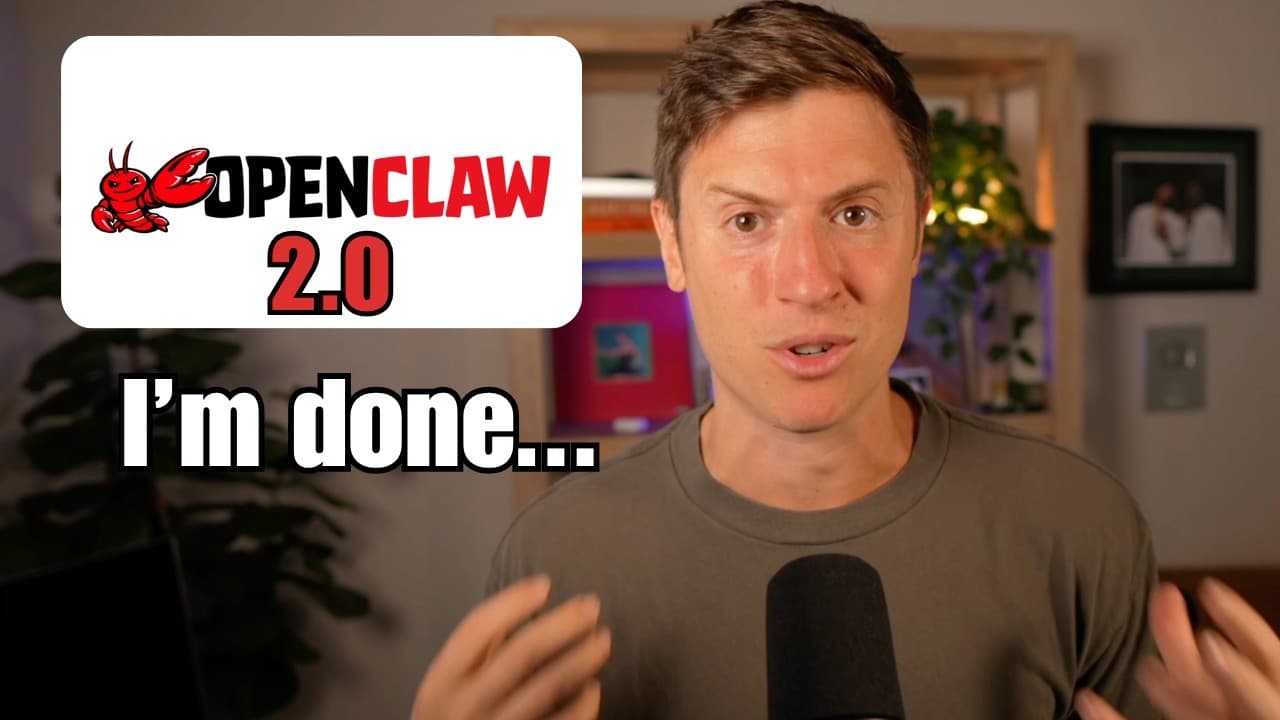
OpenClaw is back from the dead. After not shipping a single update in seven weeks, which is about three decades in AI time, they are back with OpenClaw 2.0. This is their biggest update ever. But does it make them better than Hermes Agent and Grockbot? Should you make the switch? I think the answer is going to surprise you. Let's lock in and get in... Read More
Key Insights
- OpenClaw's reliability remains its central weakness because the reviewer says more than 70% of attempted updates broke the installation, despite minimal customization. The OpenClaw 2.0 upgrade also caused the existing agent to stop responding, forcing the evaluation onto a fresh laptop installation.
- OpenClaw 2.0 introduces multiplayer AI access through group chats on Discord and Slack. New permissions can restrict what other participants do, including preventing password changes, but the reviewer avoids the feature because sharing a personal agent still feels unnecessary and risky.
- Claude subscriptions are supported again in OpenClaw 2.0, restoring an option that had previously been useful to the reviewer. He now considers it less important because he believes GPT-5.6 Soul and Grok perform as well as Claude Opus for agent-based work.
- The OpenClaw web app is required for much of the update's functionality, including detailed subagent orchestration and chat widgets. These features are not fully available through Telegram or the mobile app, creating a disadvantage for users who regularly work away from a desktop computer.
- The redesigned web app can pull projects and chats from Codex into OpenClaw. This integration lets users view OpenClaw agents beside existing coding projects and conversations, creating a consolidated workspace for agent tasks and software development activity.
- OpenClaw's orchestration system can transform a detailed prompt into a goal and several subtasks automatically. It can also create a project, start separate chats for specialized agents, and assign focused roles such as marketing analyst or pricing analyst without requiring those individual prompts from the user.
- OpenClaw's subagent interface provides separate visibility into each agent's work. The reviewer regards this tracking experience and its task-progress display as cleaner than Hermes Agent's corresponding interface, although the demonstration itself appeared to stop making progress before completing the assigned project.
- Conversation forking allows users to rewind from the middle of a discussion and pursue different approaches from that point. OpenClaw 2.0 also adds chat widgets, automatic skill improvement, and credential masking that prevents entered passwords from being passed directly to the models.
- More videos from this channel:
- More from this channel: Alex Finn
Install to Summarize YouTube Videos and Get Transcripts
Explore YouTube Video Summarizer or Get YouTube Transcript Extractor
Questions & Answers
Q: Should I switch to OpenClaw 2.0 from Hermes Agent?
OpenClaw 2.0 offers a stronger subagent interface than Hermes Agent in the reviewer's assessment, especially for tracking separate workers, goals, and task progress. However, the reviewer previously switched to Hermes because OpenClaw updates repeatedly broke, while Hermes did not produce the same problem. A switch therefore depends on whether the improved web experience outweighs OpenClaw's demonstrated reliability issues.
Q: What are the main new features in OpenClaw 2.0?
OpenClaw 2.0 adds multiplayer agent access for Discord and Slack group chats, restored Claude subscriptions, automatic skill improvement, improved subagent orchestration, conversation forking, chat widgets, and masked credential handling. Its web app can also display imported Codex projects and chats, automatically establish goals, divide complex prompts into subtasks, and create separate sessions for specialized agents.
Q: Why did the OpenClaw 2.0 upgrade fail for the reviewer?
The reviewer asked an existing OpenClaw agent to upgrade itself using a link, which was the same process he used successfully with other open-source tools. OpenClaw began the update and then stopped responding entirely. He emphasizes that the installation had barely been used and was not heavily customized, so he does not attribute the failure to unusual modifications or merge conflicts.
Q: How does OpenClaw 2.0 handle complex multi-agent tasks?
OpenClaw 2.0 can interpret a long prompt, create an overall goal, and divide that goal into distinct subtasks. It can then establish a project and open a separate chat for each subagent. An orchestrator assigns specialized instructions, such as marketing or pricing analysis, while the interface lets the user inspect the individual sessions and follow task progress.
Q: Does OpenClaw 2.0 work well on mobile devices?
Many of OpenClaw 2.0's notable additions are presented through the desktop web app rather than its mobile channels. The reviewer says Telegram does not show much of the subagent orchestration or widget functionality, and the mobile app still needs substantial updates. Users who complete much of their work on mobile may therefore miss the release's most useful interface improvements.
Q: Is OpenClaw 2.0's multiplayer AI feature safe to use?
OpenClaw 2.0 provides permission controls for group-chat access, including rules that can prevent participants from performing sensitive actions such as changing passwords. The reviewer nevertheless declines to test it because he does not want other people accessing his personal agent. The feature may suit enterprises or larger teams, but he sees little practical value for an individual workflow.
Q: How does the OpenClaw 2.0 web app integrate with Codex?
The updated OpenClaw web app can pull in projects and chat sessions from Codex. In the demonstration, projects previously used on the reviewer's laptop appeared inside OpenClaw, allowing coding work and OpenClaw agent sessions to be accessed from one interface. The goal and task-progress views also closely resemble the corresponding Codex interface, according to the reviewer.
Q: What is OpenClaw 2.0's biggest strength and weakness?
OpenClaw 2.0's clearest strength is its web-based subagent experience, which automatically creates goals, projects, specialized sessions, and visible task tracking. Its largest weakness is reliability. The reviewer reports that more than 70% of his updates broke, the 2.0 upgrade stopped his existing agent from responding, and the demonstrated complex task appeared stuck after 27 minutes.
Summary & Key Takeaways
-
OpenClaw 2.0 introduces multiplayer group-chat access, restored Claude subscriptions, automatic skill improvement, improved subagent orchestration, conversation forking, chat widgets, and masked credentials. The reviewer considers this the product's largest update, but reports that upgrading an existing installation caused the agent to stop responding, continuing a long pattern of failed updates.
-
A fresh OpenClaw installation revealed a redesigned web app that can import projects and chats from Codex. For complex prompts, the system can automatically define a goal, divide the work into subtasks, create a project, open separate chats for specialized subagents, and provide an interface for monitoring their individual assignments and progress.
-
The reviewer sees OpenClaw's subagent interface as a step above Hermes Agent because each worker can be tracked separately, but the demonstrated task appeared stuck after 27 minutes. Many new capabilities are unavailable through Telegram and need the desktop web app, limiting their usefulness for someone who performs substantial work on mobile.
Read in Other Languages (beta)
Share This Summary 📚
Summarize YouTube Videos and Get Video Transcripts with 1-Click
Try YouTube Summary with ChatGPT & Claude or YouTube Transcript Generator
Explore More Summaries from Alex Finn 📚



Summarize YouTube Videos and Get Video Transcripts with 1-Click
Try YouTube Summary with ChatGPT & Claude or YouTube Transcript Generator