How to Build an Autonomous AI Coding Loop
TL;DR
Build an autonomous coding loop around three reusable skills: spec, build, and review. The spec skill interviews you and converts your idea into detailed issues with acceptance criteria, while the other skills repeatedly implement, test, and review those issues, allowing projects to advance even when you are away from your computer.
Transcript
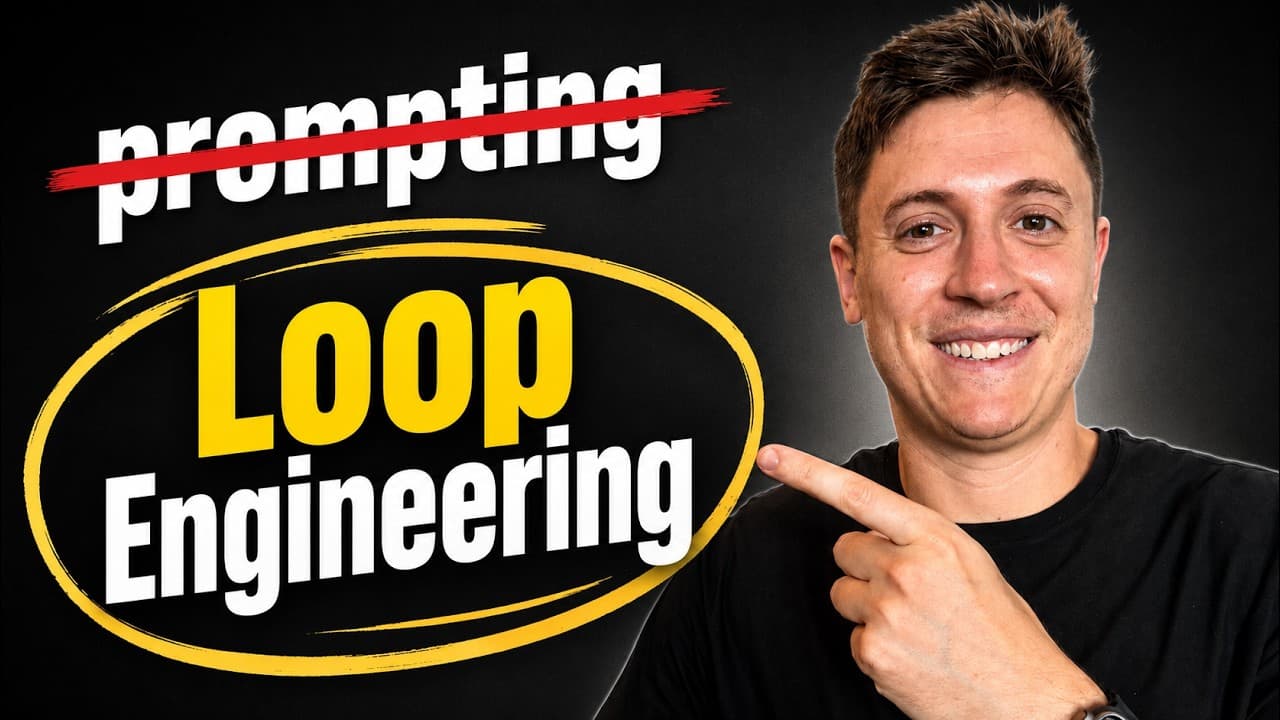
Everyone and their mothers has been talking about vibe coding loops lately, aka loop engineering. I mean, take a look here. Everyone from Peter Steinberg has been saying, "Hey, don't prompt your agents anymore. You should be building your loops." Even Boris from Claude Code, the guy who invented Claude Code, all he's talking about is loops. I don't... Read More
Key Insights
- • Traditional vibe coding is a manual cycle in which a person requests a feature, waits for the coding agent, tests the result, and submits the next prompt. Development therefore stops whenever that person is unavailable to direct or verify the work.
- • Loop engineering is an approach that gives a coding agent a recurring process for building, reviewing, and testing work. The loop keeps projects advancing without requiring the user to remain at the computer and issue instructions throughout the day.
- • The Finn Loop is organized around three custom skills called spec, build, and review. Together, these skills capture the user's intent, implement defined tasks, inspect the output, run tests, and prepare completed work for a final human merge.
- • The spec skill is an interview process that begins with a high-level idea and asks questions until the agent understands the requested feature in detail. This concentrates the user's manual involvement at the beginning instead of spreading it across the entire implementation cycle.
- • A well-formed issue is a detailed task containing acceptance criteria, scope, non-goals, notes, and testing expectations. These elements tell the coding agent what to build, what to avoid, and how to determine whether its implementation satisfies the request.
- • Linear is used as a free project management tool and persistent task tracker for the loop. It acts as a second brain by recording each issue and its current state, allowing coding agents to resume work when the user returns or launches another agent.
- • The build and review skills are the automated portion of the workflow. After the user approves the generated issues, the agent repeatedly builds, reviews, and tests the requested features instead of waiting for separate prompts and manual tests at every stage.
- • The loop is designed to work with coding tools such as Claude Code and Codex, provided the selected tool supports custom skills. The accompanying Finn Loop repository supplies the skills and prompts, while optional messaging integrations can be added separately.
Install to Summarize YouTube Videos and Get Transcripts
Explore YouTube Video Summarizer or Get YouTube Transcript Extractor
Questions & Answers
Q: How do you build an autonomous AI coding loop?
Build the workflow around three custom skills: spec, build, and review. Use the spec skill to interview you about a high-level idea and convert the answers into detailed issues. After approving those issues, let the build and review skills repeatedly implement, test, and inspect the work. You then return to review the completed changes and merge them.
Q: What is loop engineering for AI coding agents?
Loop engineering is a method of replacing repeated manual prompting with a recurring agent workflow. Instead of asking for one change, waiting, testing it, and issuing another request, the user supplies ideas at the beginning. The agent then cycles through implementation, review, and testing, allowing the project to keep progressing while the user is away.
Q: Why is manual vibe coding considered a bottleneck?
Manual vibe coding depends on the user at every stage. The user submits a request, waits for the implementation, tests the result, and then writes the next prompt. If the user is not at the computer, the project does not advance. This limitation becomes more significant when one person is trying to manage several projects simultaneously.
Q: What does the spec skill do in the Finn Loop?
The spec skill captures and expands the user's idea before implementation begins. The user gives it a high-level feature or project concept, and the agent asks a series of questions until it understands the request in detail. It then turns that information into multiple issues that can be passed into the automated build, review, and testing cycle.
Q: What information should an AI coding issue contain?
An issue should give the coding agent enough detail to implement and verify a specific task. In the demonstrated workflow, each issue includes the task description, acceptance criteria, scope, non-goals, relevant notes, and expectations for testing. The non-goals are particularly useful because they state what the agent should not change while completing the assigned work.
Q: How does Linear support an AI coding loop?
Linear stores and tracks the issues produced by the spec skill. It functions as a second brain for the coding agent by preserving each task and its current state. When the user returns or starts another agent, the agent can consult those records, understand what is being built, and resume from the existing project state.
Q: Can the Finn Loop work with Codex and Claude Code?
The workflow is presented as compatible with Codex, Claude Code, and other coding agents that support custom skills. The core requirement is the ability to define the spec, build, and review skills used by the loop. The Finn Loop repository linked in the description provides the skills and prompts needed to reproduce the demonstrated setup.
Q: What work remains for the user after starting the loop?
The user provides high-level ideas, answers the spec skill's questions, and approves the resulting issues. The coding agent then handles the recurring build, review, and testing work. After the loop finishes, the user returns, clicks through the completed results, and merges them. The repository keeps this final stage simple by providing a link to each pull request.
Summary & Key Takeaways
-
Traditional vibe coding requires the user to prompt an agent, wait for implementation, test the result manually, and then submit another prompt. Because progress stops whenever the user steps away, the human remains the bottleneck, especially when trying to advance several software projects at the same time.
-
The proposed Finn Loop uses three custom skills called spec, build, and review. The spec skill interviews the user about a high-level idea, develops the necessary details, and creates issues containing scope, acceptance criteria, non-goals, notes, and testing expectations for the autonomous implementation process.
-
After the issues are approved, the build and review skills repeatedly implement, test, and inspect the work. Linear stores and tracks the issues as a second brain for coding agents, enabling new or returning agents to resume from the recorded state before the user reviews and merges the completed work.
Read in Other Languages (beta)
Share This Summary 📚
Summarize YouTube Videos and Get Video Transcripts with 1-Click
Try YouTube Summary with ChatGPT & Claude or YouTube Transcript Generator
Explore More Summaries from Alex Finn 📚


Summarize YouTube Videos and Get Video Transcripts with 1-Click
Try YouTube Summary with ChatGPT & Claude or YouTube Transcript Generator