How Do AI Agent Skills Add Procedural Knowledge?
TL;DR
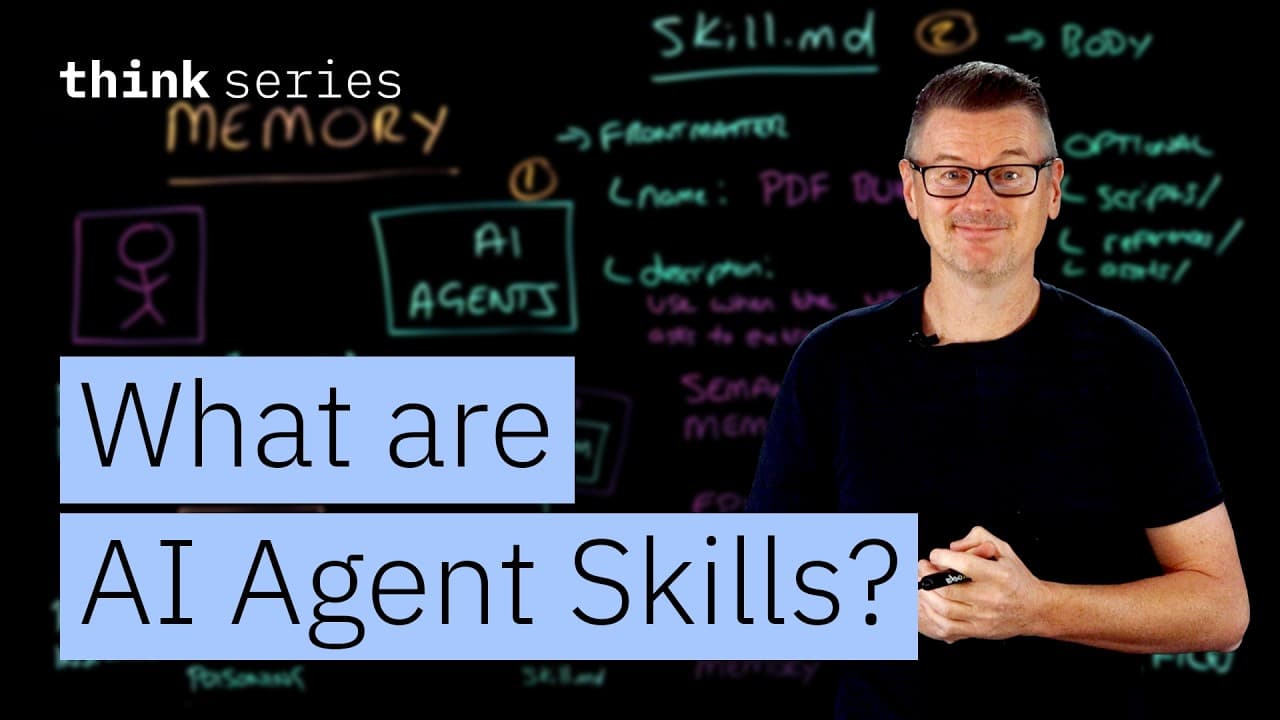
AI agent skills provide procedural knowledge by storing repeatable workflows, rules, examples, and supporting resources in portable folders centered on a SKILL.md file. Agents load skill metadata first, retrieve full instructions only when a request matches, and access scripts, references, or assets when needed, preserving context space while supplying task-specific guidance.
Transcript
What are AI agent skills and why have they become an open standard adopted by practically every major AI coding platform? Well, because skills address a specific problem with agents. Now AI agents, they're pretty good reasoners and LLMs or large language models already know a lot of facts. They can tell you about Kubernetes architecture or... Read More
Key Insights
- AI agent skills are a form of procedural knowledge that teaches agents how to perform repeatable jobs in a defined order and with appropriate judgment. They address workflows that cannot be handled reliably through factual knowledge or general reasoning alone.
- A skill is organized around a SKILL.md file inside a folder. The file combines YAML front matter with plain Markdown instructions covering workflows, rules, examples, expected inputs, expected outputs, and any other guidance required to complete the job.
- The name and description are mandatory skill metadata fields. The name identifies the capability, while the description explains what it does and when it should activate, making the description the trigger condition used by the model during task matching.
- Progressive disclosure loads skill information in three tiers. Agents first receive metadata, then load full SKILL.md instructions after identifying a relevant request, and finally retrieve scripts, references, or assets only when those supporting resources are needed.
- MCP provides access to external APIs and services, while skills supply judgment about when and how to use those capabilities. The two mechanisms complement each other because tool availability alone does not define the workflow an agent should follow.
- RAG supplies factual reference material by retrieving relevant knowledge chunks at runtime, but skills teach procedures. Fine-tuning embeds knowledge permanently in model weights, while skills remain editable files that can be updated, version controlled, and transferred between supporting platforms.
- The agent skills format is an open standard published through agent skills.io under an Apache 2.0 license. Platforms including Claude Code and OpenAI Codex have adopted it, allowing a skill created for one supporting platform to work on another.
- Executable skill scripts create security risks because they may access local files, environment variables, and API keys. Public skills can contain prompt injection, tool poisoning, or hidden malware, so teams should review them like software dependencies before installation and execution.
- More videos from this channel:
- More from this channel: IBM Technology
Install to Summarize YouTube Videos and Get Transcripts
Explore YouTube Video Summarizer or Get YouTube Transcript Extractor
Questions & Answers
Q: What are AI agent skills?
AI agent skills are files and supporting resources that give an agent procedural knowledge for a specific job. They define how to complete a task, in what order steps should occur, and where judgment is required. A skill can include workflows, rules, examples, scripts, reference documents, templates, and data files, allowing repeatable work to be performed without restating every instruction each time.
Q: Why do AI agents need skills if language models already know many facts?
Language models may know factual information and reason effectively, yet still lack the specialized procedures used in real work. A complex workflow, such as the cited 47-step process for producing a compliant financial report, requires more than facts. Skills supply those steps and decision rules, reducing the need for users to repeat detailed prompts and reducing the likelihood that an agent will simply guess.
Q: What does a SKILL.md file contain?
A SKILL.md file begins with YAML front matter containing at least a name and description. The name identifies the skill, while the description states what the skill does and when it should be used. Below the front matter, plain Markdown provides the actual instructions, including step-by-step workflows, operating rules, examples, and descriptions of expected inputs or outputs.
Q: How does progressive disclosure work for AI agent skills?
Progressive disclosure separates skill loading into three tiers. At startup, the agent sees only each skill's name and description, creating a lightweight index. When a request matches a description, the full SKILL.md instructions enter the context. If the task then requires supporting scripts, references, or assets, those resources are retrieved at the point of need rather than loaded in advance.
Q: Why is an AI skill description important?
A skill description acts as its trigger condition. The language model reasons about the user's request and compares it with the available skill descriptions to decide whether a particular skill applies. A clear description therefore helps the agent select the right procedure at the right time. A vague description can make relevant skills harder to identify or cause inappropriate activation.
Q: How are AI agent skills different from MCP and RAG?
Skills provide procedural knowledge, meaning instructions about how to perform work and apply judgment. MCP provides access to external APIs and services, defining what an agent can reach without necessarily explaining when or how to use it. RAG retrieves relevant factual material at runtime, helping an agent look something up without teaching the ordered process required to complete a task.
Q: How are agent skills different from fine-tuning?
Fine-tuning places knowledge directly into a model's weights, making the change persistent but expensive and requiring the work to be repeated when the model changes. Skills are ordinary files that remain separate from model weights. They can be updated, placed under version control, and moved between platforms that support the specification, making procedures easier to maintain and distribute.
Q: Are downloadable AI agent skills safe to install?
Downloadable skills require the same caution as other software dependencies. Their scripts may execute commands locally and access file systems, environment variables, or API keys. Audits cited in the transcript found that public skills can contain prompt injection, tool poisoning, and hidden malware. Users and teams should review a skill, understand its behavior, and evaluate its resources before running it.
Summary & Key Takeaways
-
AI agents can reason and recall many facts, but they may lack the procedural knowledge required for specialized work. Skills address this limitation by providing explicit workflows, rules, examples, and judgment. Without them, users must repeatedly supply every step, or agents must guess how a complex task should be completed.
-
A skill is a folder centered on a SKILL.md file containing YAML front matter and Markdown instructions. Its mandatory name and description identify the skill and define when it applies. Optional scripts, references, and assets extend the workflow with executable code, supporting documentation, templates, data files, and other task-specific resources.
-
Progressive disclosure keeps large skill collections efficient. Agents initially load only names and descriptions, then retrieve complete instructions when a request matches, and finally access supporting resources when required. Skills complement MCP tool access and RAG reference material, remain portable across supporting platforms, and should be reviewed carefully before installation.
Read in Other Languages (beta)
Share This Summary 📚
Summarize YouTube Videos and Get Video Transcripts with 1-Click
Try YouTube Summary with ChatGPT & Claude or YouTube Transcript Generator
Explore More Summaries from IBM Technology 📚
Summarize YouTube Videos and Get Video Transcripts with 1-Click
Try YouTube Summary with ChatGPT & Claude or YouTube Transcript Generator