What is a CNN in deep learning and how does it work?
TL;DR
A CNN uses small pattern detectors called filters that slide across an image to detect features. As data passes through multiple layers, filters become more abstract, enabling object recognition and tasks like OCR. Pooling consolidates information, helping the network handle variation and scale for robust image understanding.
Transcript
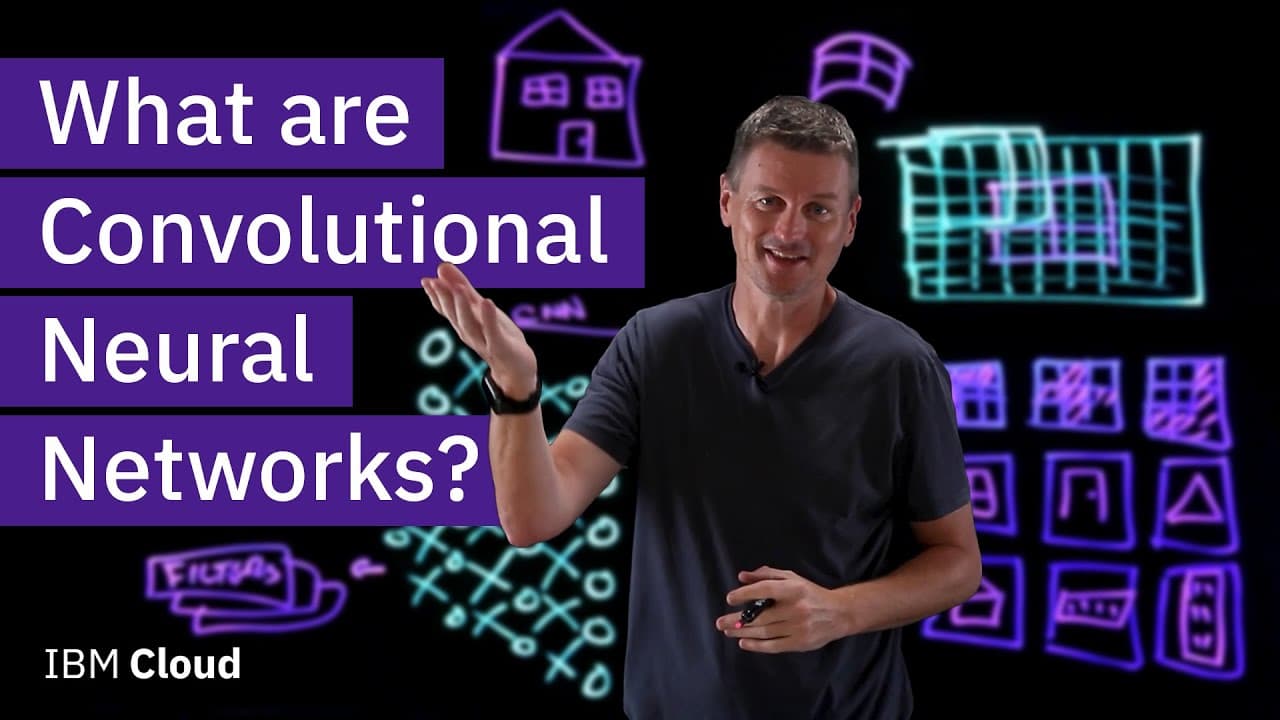
OK, pop quiz. What am I drawing? I'm going to make three predictions here. Firstly. You think at your house, you'd be right? Secondly, that that just came pretty easily to you, it was effortless. And thirdly, you're thinking that I'm not much of an artist and you'd be right on all counts there. But how can we look at this set of geometric shapes an... Read More
Key Insights
- A CNN uses a standard neural network structure where layers transform inputs into outputs
- A filter is a small pattern detector, typically a 3x3 block, applied across image regions
- The convolution operation scores similarity between the filter and image blocks
- Multiple filters capture different shapes and textures, producing a set of score maps
- Pooling combines multiple filter outputs to reduce dimensionality and highlight important features
- Early layers detect simple features like edges and corners, later layers detect complex objects
- Deeper layers perform more abstract tasks such as distinguishing between house types or different objects
- CNNs have broad business applications including OCR, facial detection, and medical imaging
- More videos from this channel:
- More from this channel: IBM Technology
Install to Summarize YouTube Videos and Get Transcripts
Explore YouTube Video Summarizer or Get YouTube Transcript Extractor
Questions & Answers
Q: What is a convolutional neural network and what problem does it solve?
A convolutional neural network is a type of deep learning model designed for pattern recognition in images and other structured data. It solves the problem of how to enable a computer to identify objects or patterns by learning from data to detect features at different levels of abstraction. The network uses layers and filters to transform inputs into meaningful representations.
Q: How do filters work in a CNN?
Filters are small matrices, typically three by three, that slide over the input image to measure how closely local pixel patterns match a predefined shape. Each position produces a numeric score indicating similarity to the filter pattern. Applying many filters yields multiple score maps that summarize the presence of different features across the image.
Q: What is the role of pooling in a CNN?
Pooling combines information from the numerous filter outputs to reduce the spatial dimensions of the data. This creates a compact representation that preserves the most important features, helps the network generalize across translations and distortions, and reduces computation for subsequent layers.
Q: Why do CNNs become more abstract as you go deeper?
As data passes through successive layers, the filters learn to represent increasingly complex structures. Early layers detect basic patterns like edges, while deeper layers recognize parts and whole objects. This hierarchical feature extraction enables the network to distinguish between high level concepts such as different building types or scenes.
Q: What are typical applications of CNNs mentioned in the material?
CNNs are applied to optical character recognition for handwritten text, visual recognition and facial detection for identifying people or objects, visual search for retrieving similar images, and medical imaging to analyze scans. These applications leverage CNNs ability to interpret rich, high dimensional image data.
Q: How does a CNN determine if a window or roof is present in a house image?
A CNN uses filters trained to recognize shapes associated with windows or roofs. By sliding across the image and pooling results, the network builds a representation that signals where these features are likely present. Deeper layers then combine these signals to confirm the object, such as a window or roof.
Q: What does the term feature abstraction mean in the context of CNNs?
Feature abstraction refers to the progressive transformation of raw pixel data into higher level representations. Each layer abstracts the input more, moving from simple patterns like edges to complex concepts like a door or a house type. This abstraction enables robust recognition across variations in appearance and viewpoint.
Q: What makes CNNs particularly suited for image related tasks?
CNNs are designed to exploit spatial structure in images by applying localized filters that detect patterns and reduce redundancy through pooling. This leads to efficient learning of hierarchical features, improved translation invariance, and scalable performance on large image datasets, making them well suited for vision tasks.
Summary & Key Takeaways
-
CNNs detect patterns with small filters and learn hierarchical features from edges to objects, enabling image understanding and OCR.
-
The network uses multiple layers and pooling to transform raw pixels into concise feature representations, improving recognition accuracy.
-
Applications include visual recognition, facial detection, medical imagery, and visual search, with increasing abstraction in deeper layers.
Read in Other Languages (beta)
Share This Summary 📚
Summarize YouTube Videos and Get Video Transcripts with 1-Click
Try YouTube Summary with ChatGPT & Claude or YouTube Transcript Generator
Explore More Summaries from IBM Technology 📚






Summarize YouTube Videos and Get Video Transcripts with 1-Click
Try YouTube Summary with ChatGPT & Claude or YouTube Transcript Generator