How to Power Internal AI Apps Without API Fees
TL;DR
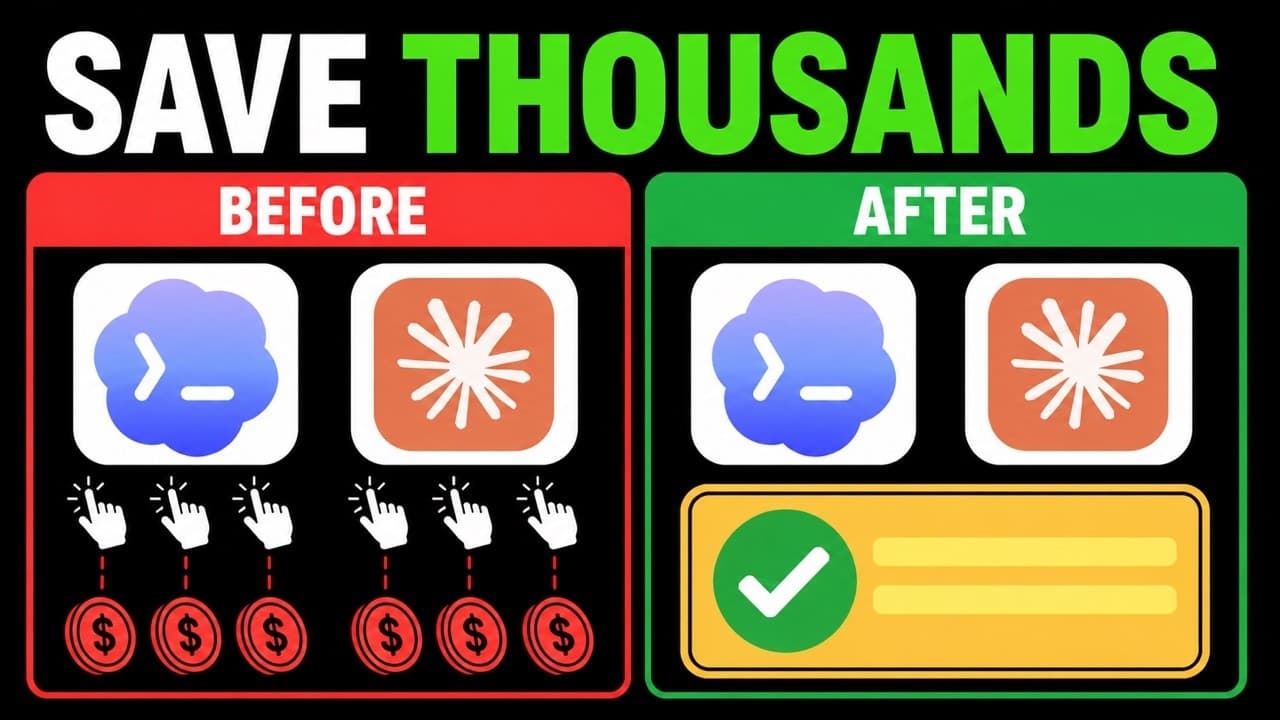
Use the Codex SDK as a bridge between a personal or internal application and an existing Codex subscription, allowing requests to run through a headless worker instead of a separately billed API key. The approach can support text analysis, research, file sorting, email triage, and image generation, but it is intended only for personal or internal use under the provider's terms.
Transcript
If you've ever built your own internal tool, whether that's on something like Claude, Codeex, or even Lovable, then you know this process. You get an idea, you build the app, and it finally works. But to make it really work, you have to add an API key. So every time you use the tool that you built to replace a subscription, you are continually payi... Read More
Key Insights
- An SDK is the bridge that connects an internal application to an existing AI subscription, replacing the usual API-key component while leaving the application's problem definition, specification, interface, and broader architecture largely unchanged.
- A headless worker is a background Codex session that receives an application's request without requiring interaction through the normal interface. It processes the supplied context and returns the completed result to the requesting application.
- The meeting analyzer sends pasted meeting content through the Codex SDK and returns an analyzed, categorized, and summarized brief within 10 seconds. The demonstration uses the Luna model at medium effort and incurs no separate per-request API charge.
- Subscription-supported capabilities can include multiple models, adjustable effort tiers, text generation, and image generation. The available functions depend on what the selected service provides through the subscription and SDK.
- The thumbnail workflow sends a creative brief from the application through the SDK, starts a headless Codex worker, develops three thumbnail ideas, and returns a generated image after the user requests another thumbnail.
- Internal tools suited to this architecture include brief makers, research tools, file sorters, email-triage systems, meeting analyzers, social-media analytics tools, idea boards, and thumbnail-generation workflows.
- The sample build prompt requires a complete runnable local-first tool named Brief Room, routes every AI call through the SDK using cached ChatGPT authorization, explicitly excludes API keys, and defines the architecture, project skeleton, wrapper, files, and localhost startup process.
- The subscription-based SDK method is restricted to personal or internal use according to the terms described in the presentation. Using rotating consumer subscription accounts to power a public SaaS would violate those stated terms and could create compliance problems.
- More videos from this channel:
- More from this channel: Mark Kashef
Install to Summarize YouTube Videos and Get Transcripts
Explore YouTube Video Summarizer or Get YouTube Transcript Extractor
Questions & Answers
Q: How can an internal AI app work without an API key?
An internal AI app can replace its separately metered API-key layer with the Codex SDK. The SDK acts as a bridge between the application and a cached ChatGPT login associated with an existing subscription. When a user submits a task, the bridge starts a headless Codex worker, supplies the application's context, and returns the generated result without using a separate API balance.
Q: What does headless mode mean for a Codex-powered app?
Headless mode means that a Codex session runs in the background instead of being operated through its usual visible interface. The application sends a request through the SDK, a background worker receives the task and its context, and the completed output comes back to the application. This allows an internal tool to use Codex capabilities as part of its own workflow.
Q: How does the Codex SDK differ from an API key?
An API key normally sends each application request to a separately metered service with its own credit usage and billing. In the demonstrated setup, the Codex SDK replaces that component and connects the application to an existing subscription through cached authorization. The rest of the project still requires a defined problem, a build plan, a specification, an interface, and suitable application architecture.
Q: What internal tools can use a subscription-backed SDK?
The demonstrated pattern can support meeting analyzers, structured brief makers, research tools, file sorters, email-triage workflows, social-media analytics systems, idea boards, and thumbnail tools. It can handle text tasks and, when the subscription service supports it, image generation. Each application sends its task and relevant context through the SDK to a headless worker and receives the finished output.
Q: How was the Brief Room meeting analyzer built?
Brief Room was specified as a complete runnable local-first internal tool that converts pasted text into a structured brief. Its build prompt required all AI calls to pass through the SDK using cached ChatGPT authorization, with no API key anywhere. The prompt also defined the architecture, localhost server, project skeleton, required files, and an SDK wrapper responsible for accessing the subscription-backed worker.
Q: Can the Codex SDK generate images for an internal app?
The demonstrated thumbnail tool uses the SDK workflow for image generation because that capability is available through the selected subscription service. The application creates a thumbnail brief, sends it through the bridge, starts a headless Codex worker, and returns generated output. In the example, the pipeline first develops three thumbnail ideas, then processes another request to produce a finished thumbnail image.
Q: Can a subscription-backed AI tool be shared with a team?
A local internal tool can be shared with selected team members through a private network setup. The example uses Tailscale to make a localhost application available to an agency team through a private mesh server or a link limited to specific people. This sharing configuration is optional and is presented for internal, noncommercial access rather than for offering the tool as a public service.
Q: Can this SDK method power a public SaaS product?
The method is presented for personal tools, internal workflows, and integrations, not for a public SaaS product. According to the terms described in the presentation, developers should not operate a commercial service by cycling through consumer subscription accounts to avoid API charges. Usage limits and the current terms of the selected AI provider still apply, even when the application runs through an SDK.
Summary & Key Takeaways
-
The demonstrated architecture replaces the separately metered API layer in an internal AI application with the Codex SDK. When a user submits a task, the SDK launches a headless Codex worker, passes it the relevant context, and returns the result while drawing on the usage available through an existing subscription.
-
A meeting analyzer demonstrates the workflow by turning pasted meeting text into an analyzed, categorized, and summarized brief within 10 seconds. A thumbnail tool uses the same pattern to prepare three concepts and generate an image, showing that subscription-supported capabilities can extend beyond text when the selected service provides them.
-
The setup is designed for local-first personal tools, internal workflows, and limited team integrations rather than public commercial software. The build prompt specifies a complete project structure, cached ChatGPT authorization, no API key, a localhost server, and an optional Tailscale configuration for privately sharing the application with agency team members.
Read in Other Languages (beta)
Share This Summary 📚
Summarize YouTube Videos and Get Video Transcripts with 1-Click
Try YouTube Summary with ChatGPT & Claude or YouTube Transcript Generator
Explore More Summaries from Mark Kashef 📚




Summarize YouTube Videos and Get Video Transcripts with 1-Click
Try YouTube Summary with ChatGPT & Claude or YouTube Transcript Generator