Why Could AI Consulting Thrive in 2026?
TL;DR
Independent AI consultants can compete with large legacy firms by using AI to research companies, identify genuine business problems, draft solutions, and produce useful assets in days or weeks instead of months. The strongest opportunity lies in combining hands-on tool experience with niche expertise, reusable systems, careful citation checks, employee upskilling, and implementation that produces measurable value.
Transcript
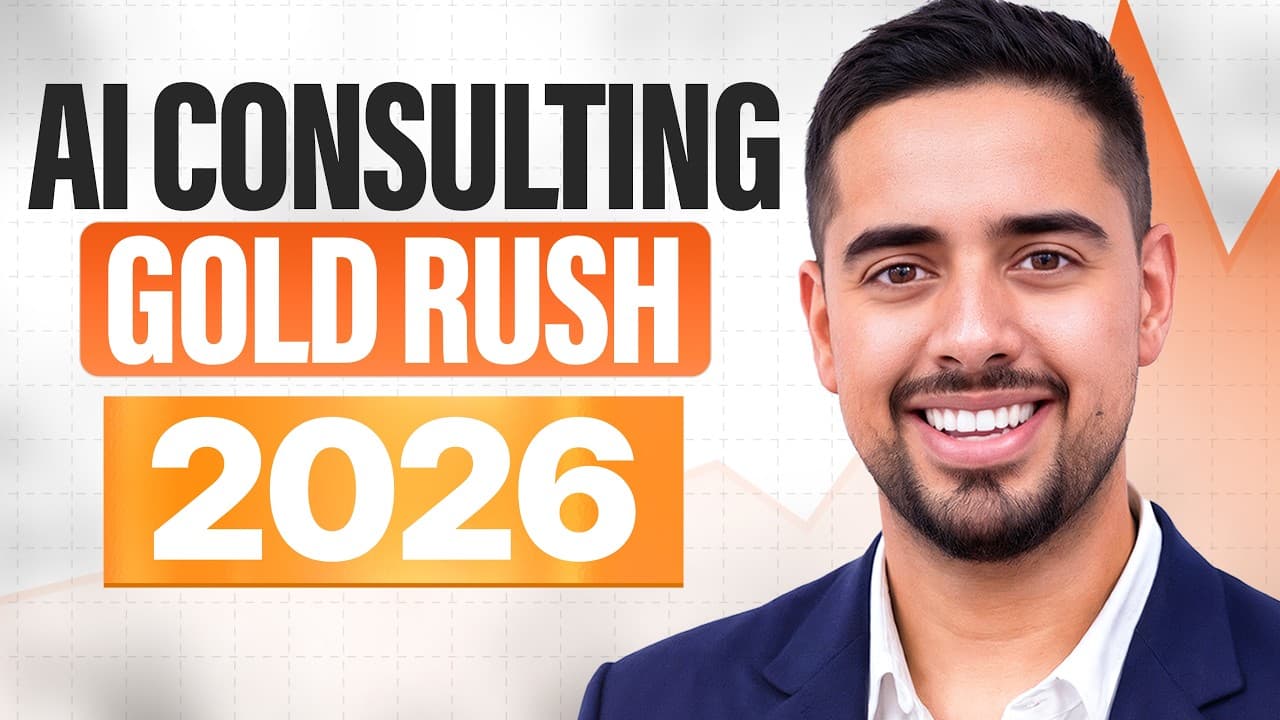
If you want to be able to outpace the big legacy consulting firms and take matters into your own hands and find a way to market yourself as an AI consultant in your particular niche, then this video is for you. I'm going to walk through three different pillars that I personally think will make 2026 the equivalent of the consulting gold rush for sol... Read More
Key Insights
- AI has reduced the knowledge scarcity that supported legacy consulting firms because case studies, educational videos, and language models now make previously difficult-to-acquire knowledge more accessible. Independent practitioners can use these resources to research, advise, and create deliverables without maintaining a large organization.
- Legacy consulting incentives can favor extended billable engagements because firms add margins to subcontracted labor and may treat implementation as an upsell. The transcript argues that this structure contributed to bloated delivery models focused on long contract runways instead of targeted, implemented, ROI-positive value.
- The first responsibility of an AI consultant is to identify the underlying business problem before selecting any technology. AI should not be treated as a solution searching for a problem, and consultants must decide whether a real use case exists and whether AI is suitable for it.
- AI-assisted research can compress early consulting work by helping a practitioner study a company, anticipate likely pain points, and draft potential workflow solutions. The consultant must still tailor prompts, assess usefulness, and double-check citations rather than accepting generated findings without review.
- Hands-on implementation experience is a competitive advantage because clients can benefit from consultants who have already built workflows, written prompts, created AI-generated content, or developed internal tools. Such experience can support faster delivery and more practical recommendations than purely theoretical advice.
- Niche specialization is a viable consulting strategy because practitioners do not need to cover every AI use case. A consultant can focus on content creation, a specific content format, one industry, or another narrow domain while mastering the tools and techniques relevant to that specialty.
- Reusable consulting assets can compound over time because workshops across hedge funds, real estate firms, and marketing agencies may reveal similar employee skill levels and recurring pain points. Those patterns can inform repeatable training materials, workflows, prompts, SOPs, and industry-specific systems.
- An AI-first strategy is centered on employee upskilling rather than preemptive layoffs or forced adoption. When a company encounters a new problem or seeks greater efficiency, it should consider how AI can make existing employees more capable while accounting for the consequences of implementation.
- More videos from this channel:
- More from this channel: Mark Kashef
Install to Summarize YouTube Videos and Get Transcripts
Explore YouTube Video Summarizer or Get YouTube Transcript Extractor
Questions & Answers
Q: Why could independent AI consulting grow in 2026?
Independent AI consulting could grow because the knowledge and production advantages of large firms have weakened. Case studies, educational videos, language models, and research tools give solo practitioners access to information and capabilities that were previously harder to obtain. They can research businesses, anticipate pain points, draft solutions, and create consulting assets in days or weeks, while operating with fewer resources than a large firm.
Q: How can solo AI consultants compete with legacy firms?
Solo AI consultants can compete by combining AI-assisted research with practical implementation experience and specialized industry knowledge. They can investigate a company, identify likely pain points, draft workflows, prepare prompts, generate SOPs, and develop internal-tool concepts before a traditional engagement would finish requirements gathering. Their advantage depends on tailoring the work, verifying citations, and delivering useful outcomes rather than merely producing polished presentations.
Q: What should an AI consultant do before recommending AI?
An AI consultant should first determine whether the business has a genuine problem and clearly define that problem. The next step is deciding whether AI is actually the right tool for solving it. The transcript warns that many organizations treat AI as a solution looking for a problem, so responsible consulting begins with diagnosis, use-case selection, and an assessment of whether implementation can create meaningful value.
Q: What services can an independent AI consultant offer?
An independent consultant can help create an AI strategy and digital transformation road map, deliver tailored workshops, draft automated workflows, develop prompts, generate departmental SOPs, and propose internal tools. The description also identifies workflow automation, prompt engineering, retrieval-augmented generation, and niche specialization as opportunities. These services should be selected according to the client’s actual problems, workforce capabilities, and available technology stack.
Q: How can AI shorten a consulting engagement?
AI can shorten an engagement by accelerating company research, pain-point analysis, workflow ideation, documentation, and presentation preparation. A practitioner can use research tools to study a business and then generate draft workflows, prompts, SOPs, or slide copy from that foundation. Work that previously took weeks, months, or years may be drafted in a weekend, although the consultant must verify citations and usefulness.
Q: Why is niche specialization useful for AI consultants?
Niche specialization allows a consultant to build deep, practical knowledge without becoming an expert in every AI application. A practitioner might focus only on content creation, or narrow that specialty further to video, images, text posts, LinkedIn, or another format. By mastering the relevant tools and recurring client needs, the consultant can deliver faster results and turn repeated experience into a clear market advantage.
Q: How can AI workshops create value for companies?
AI workshops can help employees understand available tools and apply them to recurring business tasks. The transcript notes that workers across hedge funds, real estate firms, and marketing agencies may begin at similar skill levels and experience similar pain points. A consultant can use those patterns to create tailored training that demystifies tools such as ChatGPT, Claude, or Gemini and supports practical employee upskilling.
Q: What does an employee-focused AI-first strategy mean?
An employee-focused AI-first strategy means considering AI when addressing new problems or seeking efficiency, while prioritizing the improvement of existing workers. It does not mean preemptively firing employees, damaging company culture, or forcing customers and staff to use AI without considering the consequences. The objective is to upskill employees and make them more capable, then apply AI where a suitable business use case exists.
Summary & Key Takeaways
-
AI has weakened the knowledge advantage traditionally held by large consulting firms. Independent practitioners can now access case studies, educational content, language models, and research tools that help them investigate companies, anticipate pain points, prepare recommendations, and create polished consulting assets with fewer resources and much shorter delivery timelines.
-
Effective AI consulting begins with diagnosing the business problem before proposing technology. Consultants must determine whether a genuine problem exists and whether AI is appropriate for solving it. Workshops, strategy road maps, workflow drafts, prompts, internal tools, SOPs, and implementation support can then be tailored to the client’s actual needs.
-
Specialization gives independent consultants a practical route into the market. A practitioner can focus on one industry, workflow, or content format, master the relevant tools and techniques, and convert repeated experience into reusable systems. The proposed AI-first approach emphasizes employee upskilling and improved efficiency instead of preemptive layoffs or forced adoption.
Read in Other Languages (beta)
Share This Summary 📚
Summarize YouTube Videos and Get Video Transcripts with 1-Click
Try YouTube Summary with ChatGPT & Claude or YouTube Transcript Generator
Explore More Summaries from Mark Kashef 📚


Summarize YouTube Videos and Get Video Transcripts with 1-Click
Try YouTube Summary with ChatGPT & Claude or YouTube Transcript Generator