Which GPT-6 Astra Effort Level Works Best?
TL;DR
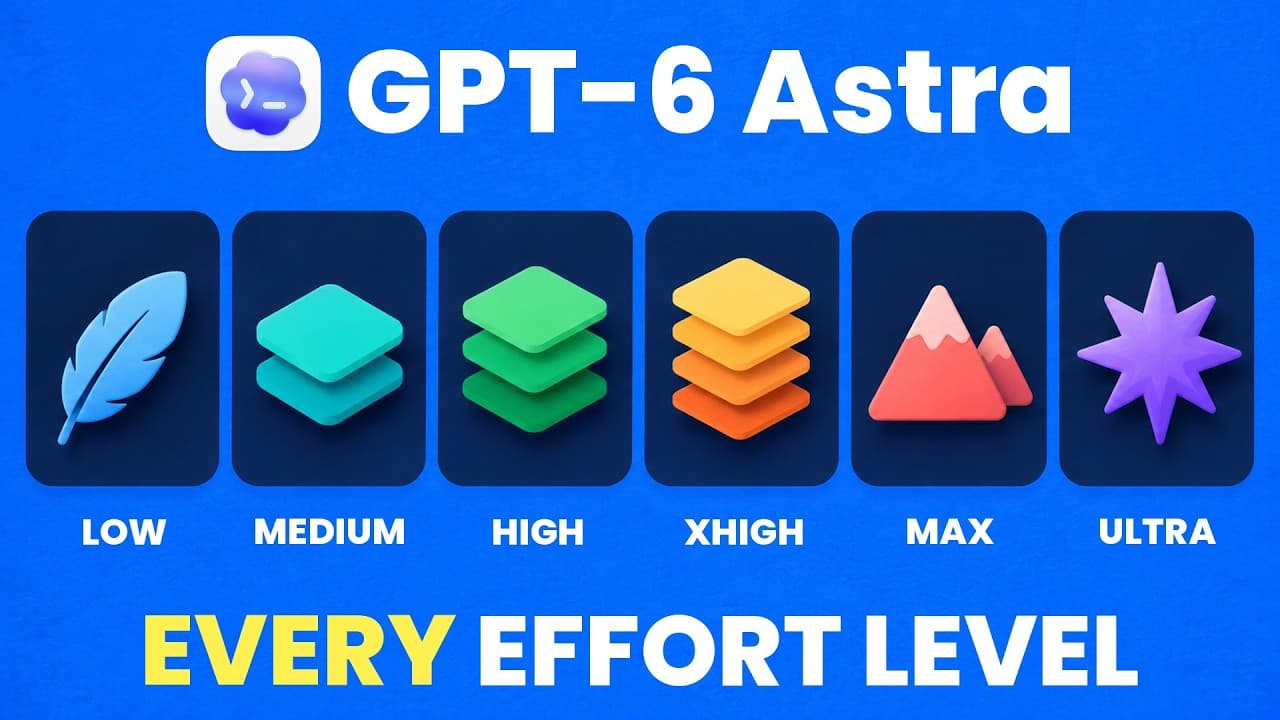
Astra Medium produced a broader, cleaner analysis than Low while finishing faster and processing fewer tokens in the reported test. High delivered the clearest product concept and most detailed canvas among the first three settings, but required more time and tokens, suggesting that a refined prompt or follow-up at Medium may offer better everyday value.
Transcript
So, GBT6 Astra has been out for a bit now, and one of the biggest points of contention on both YouTube and X is the following question. What's the right effort level to get the most value or bang for your buck from this model? I've also seen people say that this model is inherently lazy. It does what you tell it to do, but nothing more, and sometim... Read More
Key Insights
- Reasoning effort is not a reliable proxy for resource efficiency. In the reported runs, Low processed almost 15 million tokens, Medium processed 10 million, and High processed close to 14 million, so increasing the setting did not produce a simple upward progression in token use.
- Astra Medium offered the strongest efficiency result among the first three settings. It finished in 30 minutes with 10 million processed tokens, compared with 37 minutes and almost 15 million tokens for Low, while producing a cleaner and more varied analysis.
- Astra High produced the clearest product concept among the first three runs. Its proposed software would reassign residential cleaning visits when a crew cannot work, helping owners cover appointments that might otherwise become cancellations and unrealized revenue.
- Astra Low completed the core assignment but did not exceed its explicit instructions. It researched eight Reddit threads, found no evidence from X, created 161 canvas elements, and proposed software for tracking missed commercial cleaning tasks through correction and rechecking.
- Astra Medium proposed software for pricing extra commercial cleaning work and recording client acceptance. Its proposed moat was a growing record of accurate scopes and estimates improved by actual jobs, although the presenter questioned whether that constituted a strong moat.
- The experiment controlled six variables to improve comparability. The runs used the same context, tool access, MCPs, skills, build scope, and conditions, while Ultra was separated because it often creates multiple subagents during its work.
- The assignment treated rapidly reproducible software as a competitive constraint. Every run was told to assume that customers and competitors could use Astra to create competent software quickly, pushing the model to seek an opportunity with more defensibility than a weekend build.
- Parallel Codex threads can support effort-level comparisons at scale. A user can request separate named threads, assign each one a different effort setting, place them in a chosen folder, run the same prompt simultaneously, and monitor their progress independently.
- More videos from this channel:
- More from this channel: Mark Kashef
Install to Summarize YouTube Videos and Get Transcripts
Explore YouTube Video Summarizer or Get YouTube Transcript Extractor
Questions & Answers
Q: Which Astra effort level offered the best everyday value?
Astra Medium showed the best balance among the fully described Low, Medium, and High runs. It finished in 30 minutes and processed 10 million tokens, yet produced a cleaner and more varied analysis than Low. High created a clearer concept and more detailed canvas, but it required nearly 40 minutes and close to 14 million tokens.
Q: Does higher Astra effort always produce better results?
Higher effort did not produce a simple, consistent improvement in efficiency or resource use. Low processed almost 15 million tokens, Medium processed 10 million, and High processed close to 14 million. Output quality improved in some respects at High, especially concept clarity and canvas detail, but Medium outperformed Low while using less time and fewer processed tokens.
Q: How was the Astra effort-level experiment controlled?
The experiment kept the same context, access to tools, MCPs, skills, project scope, and operating conditions across the runs. Each thread received the same research and build assignment, and the evaluator recorded completion time and processed tokens. Ultra was separated because that setting often creates several subagents, which could make direct comparisons less straightforward.
Q: What assignment did each Astra effort level receive?
Each run had to research problems faced by owners of small service businesses with 2–20 employees, consider three SaaS opportunities, and select one. It also had to investigate repeated frustrations, workarounds, spending signals, counterevidence, and three existing alternatives, then create an editable Excalidraw plan, a polished website, and a working software prototype.
Q: What did Astra Low produce in the test?
Astra Low proposed software that tracks missed commercial cleaning tasks through correction and rechecking for owners managing recurring office sites. Its proposed moat combined client-specific standards with a history of successful fixes. The run took 37 minutes, processed almost 15 million tokens, examined eight Reddit threads, created 161 canvas elements, and used no evidence from X.
Q: What did Astra Medium produce in the test?
Astra Medium proposed software that prices extra commercial cleaning work and records client acceptance for owners operating under written service agreements. Its suggested moat was a record of accurate scopes and estimates improved by completed jobs. The run took 30 minutes, processed 10 million tokens, reviewed six Reddit threads, and presented a cleaner, broader analysis than Low.
Q: What did Astra High produce in the test?
Astra High proposed software that reassigns residential cleaning visits when a crew cannot work, helping owners cover scheduled appointments and reduce unrealized revenue from cancellations. It took close to 40 minutes, processed close to 14 million tokens, used Reddit plus one set of posts on X, and created the most detailed canvas among the first three settings.
Q: How can users compare multiple Astra effort settings in Codex?
Users can ask Codex to create separate physical threads for the same prompt, rename each thread according to its effort setting, assign Low, Medium, and High or other levels, and place them in a designated folder. The threads can run simultaneously and be monitored individually, making it possible to compare outputs, completion time, processed tokens, and follow-through under matching conditions.
Summary & Key Takeaways
-
The experiment tested Astra Low, Medium, High, Extra High, Max, and Ultra on the same Codex research and build assignment, with GPT-5.6 Sol on High included for comparison. Every run received the same context, tools, skills, scope, and conditions, while time and processed-token totals were recorded.
-
Each run researched problems faced by owners of service businesses with 2–20 employees, considered three SaaS opportunities, selected one, investigated customer feedback and existing alternatives, and assessed defensibility. The assignment also required an editable Excalidraw plan, a polished explanatory website, and a working prototype of the proposed product.
-
Low consumed nearly 15 million tokens over 37 minutes, while Medium used 10 million over 30 minutes and produced a cleaner, more varied analysis. High used close to 14 million tokens over nearly 40 minutes and delivered the clearest concept and most detailed canvas among those three settings.
Read in Other Languages (beta)
Share This Summary 📚
Summarize YouTube Videos and Get Video Transcripts with 1-Click
Try YouTube Summary with ChatGPT & Claude or YouTube Transcript Generator
Explore More Summaries from Mark Kashef 📚






Summarize YouTube Videos and Get Video Transcripts with 1-Click
Try YouTube Summary with ChatGPT & Claude or YouTube Transcript Generator