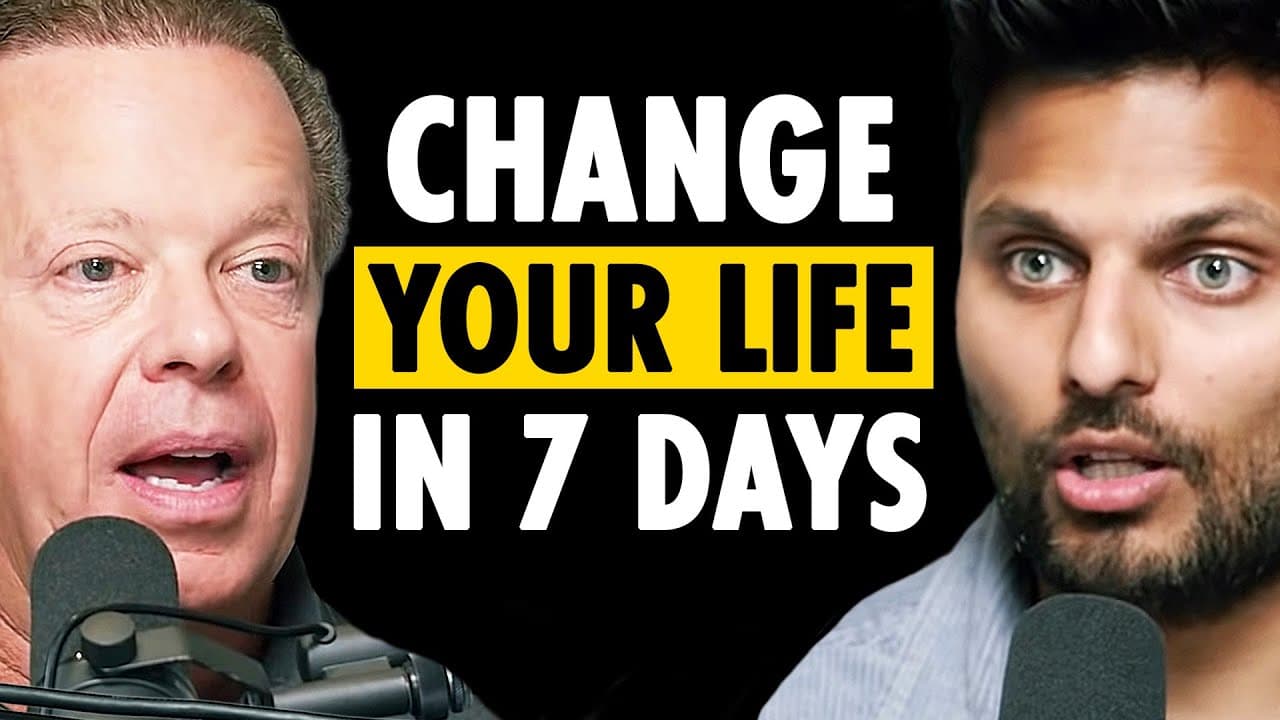
TRY THIS For 7 Days To Completely CHANGE YOUR LIFE In 2022! | Dr. Joe Dispenza & Jay Shetty
TL;DR
You can begin changing your life by noticing automatic thoughts, emotions, and behaviors before they dictate your response. Dr. Joe Dispenza explains that thoughts produce chemical responses and that repeated feelings can keep the mind anchored to past problems. Returning attention to the present creates room for unfamiliar, deliberate choices instead of predictable routines. Read on for practical ways to interrupt the loop.
Transcript
you realize that it never came from anything out there it didn't come from the wardrobe or the facelift or sports car or whatever it came from within you and so you stopped looking out there for it and now the love affair begins and you never want to miss a date because it's just too good hey everyone welcome back to on purpose the number one healt... Read More
Key Insights
- Victim consciousness is the pattern of allowing an external person, condition, or circumstance to control how you think and feel. Strong emotional reactions direct more attention and energy toward that circumstance, which can reinforce the sense that your inner state depends on something outside you.
- Thoughts create chemical responses that contribute to feelings in the body. Dispenza describes thoughts as the language of the brain and feelings as the language of the body, with their repeated interaction forming a person's state of being.
- Morning thoughts about personal problems can immediately orient the mind toward the past. Problems are connected to remembered people, objects, times, and places, and recalling them can reproduce emotions such as fear, anxiety, unhappiness, or suffering before anything new has happened.
- The body can respond to an emotion created by thought as though the associated event were happening in the present. In Dispenza's account, repeatedly reproducing stress-related emotions keeps the body reacting to remembered or imagined threats rather than current conditions.
- A habit is a repeated set of automatic thoughts, behaviors, and emotions acquired through repetition. When the body knows a routine better than the conscious mind, daily life can run on autopilot and reproduce a predictable future based on past choices.
- The present moment is where freedom from the familiar past and predictable future becomes possible. Dispenza calls it the place where the unknown exists because the mind and body are temporarily less governed by remembered conditions and rehearsed routines.
- The conditioned body resists change by prompting familiar judgments, complaints, blame, excuses, and emotional reactions. Accepting these thoughts without examining them can restore the same choices, experiences, and feelings that a person intended to leave behind.
- Not reacting emotionally can change how a difficult situation is addressed. The broader practice is to notice the body's demand for a familiar feeling, pause before surrendering to it, and choose a response that is not dictated by the old emotional program.
- Related book: Think Like a Monk
- Export your Kindle highlights to Glasp: How to Download Highlights and Notes from Kindle
Install to Summarize YouTube Videos and Get Transcripts
Explore YouTube Video Summarizer or Get YouTube Transcript Extractor
Questions & Answers
Q: How can you break a stress loop and change your life?
Notice when thoughts about a problem recreate familiar emotions such as anxiety, fear, unhappiness, or suffering. Pause before those feelings generate more matching thoughts or automatic reactions. Staying present creates space to choose a response that is not dictated by the old emotional pattern.
Q: What is victim consciousness according to Dr. Joe Dispenza?
Victim consciousness means allowing an external person, condition, or circumstance to control how you think and feel. Dispenza says stronger emotional reactions direct more attention and energy toward the circumstance. He responded to the global pandemic by treating it as an opportunity for self-reflection and personal work.
Q: Why do thoughts about problems recreate negative emotions?
Problems are memories connected to particular people, objects, things, times, and places. Recalling them can reproduce emotions such as fear, anxiety, unhappiness, or suffering before anything new happens. Those feelings can then generate matching thoughts, reinforcing the same past-oriented state.
Q: How do thoughts and feelings create a state of being?
Dispenza describes thoughts as the language of the brain and feelings as the language of the body. A thought produces chemical messengers that contribute to a bodily feeling, and that feeling can influence subsequent thoughts. Their repeated interaction creates a person's state of being.
Q: How do repeated routines create a predictable future?
A habit is a repeated set of automatic thoughts, behaviors, and emotions acquired through repetition. When the body knows the routine better than the conscious mind, daily life operates on autopilot. Repeating the same choices and reactions then produces a future based on past programs.
Q: Why is changing an emotional habit difficult?
The conditioned body is accustomed to familiar emotional reactions and may resist unfamiliar choices. It can prompt judgment, blame, complaint, excuses, or suffering to restore its established state. Accepting those prompts without examining them leads back to the same choices, experiences, and feelings.
Q: How does the present moment help break old patterns?
The present moment creates distance from the familiar past and the predictable future. Dispenza describes it as the place where the unknown exists because remembered conditions and rehearsed routines exert less control. Observing thoughts and bodily emotions without automatically following them makes a different choice possible.
Q: What practical actions supported Dr. Joe Dispenza during uncertainty?
Dispenza used the pandemic period for self-reflection, personal work, improving his website and brand, and connecting more with his staff. He also cooked his own meals, worked out, used his body, and practiced walking meditations on the beach. These actions reflected his decision not to let external circumstances determine his internal state.
Summary
In this video, Dr. Joe Dispenza discusses the importance of looking within ourselves for love and fulfillment, rather than seeking it externally. He shares his insights on how our thoughts and emotions affect our state of being, and how we can overcome challenges and create positive change in our lives. Dr. Joe emphasizes the power of consciousness and the need to step out of unconscious patterns in order to manifest our desires.
Questions & Answers
Q: How did Dr. Joe approach the global pandemic and refuse to be a victim?
Dr. Joe refused to let external circumstances control how he felt and thought. He recognized that being a victim would mean allowing something in his outer environment to dictate his inner state. Instead, he saw the pandemic as an opportunity for self-reflection and personal growth. He used this time to connect with himself, his staff, and to make positive changes in his life.
Q: What is victim consciousness and how does it affect us?
Victim consciousness is when we allow something in our outer environment to control how we feel and think. When we blame circumstances or other people for our negative emotions, we are effectively giving away our power. The more we focus on and give energy to these negative emotions, the more we reinforce our victimhood. By shifting our mindset and taking responsibility for our own thoughts and emotions, we can break free from victim consciousness and regain our power.
Q: How do our thoughts and emotions influence our state of being?
Every thought we have creates a chemical response in our body. Thoughts of limitation and negativity produce stress hormones that can weaken the body. On the other hand, thoughts of abundance and positivity can make us feel resilient and empowered. Our feelings are the body's response to our thoughts, and they shape our state of being. By becoming aware of our thoughts and choosing more positive ones, we can create a healthier and more fulfilling state of being.
Q: Why is it important to overcome challenging thoughts and emotions?
Challenging thoughts and emotions, such as fear, doubt, and self-depreciation, can have a detrimental effect on our well-being. When we allow these thoughts and emotions to dominate our minds, we reinforce negative patterns and limit our potential for growth. Overcoming these challenges involves recognizing the thoughts and emotions that hold us back and actively choosing new thoughts and emotions that align with our goals and desires.
Q: How can we break free from habitual thought patterns and behaviors?
Breaking free from habitual thought patterns and behaviors requires conscious effort and awareness. We need to step outside of our automatic, unconscious reactions and become the observer of our thoughts and emotions. By noticing how we think, speak, and act, we can begin to make conscious choices that align with our desired state of being. It may be uncomfortable at first, but with practice and persistence, we can create new neural pathways and change our habitual patterns.
Q: What role does the unknown play in personal growth and transformation?
The unknown is the realm of possibilities and growth. Stepping into the unknown means letting go of our familiar past and predictable future. It requires embracing uncertainty and discomfort, but it is in this space that we can tap into our creativity, intuition, and potential. To become comfortable in the unknown, we can practice meditation and learn to quiet the mind and be present. By cultivating awareness and staying conscious, we can navigate the unknown with courage and adaptability.
Q: How can we effectively process and handle problems in our lives?
To effectively handle problems, we need to approach them from a higher level of consciousness than the one that created them. We can start by acknowledging that problems are actually opportunities for growth and change. Instead of reacting to problems with negative emotions and limited thinking, we can shift our perspective and explore new possibilities. By seeking knowledge, learning from others who have faced similar challenges, and finding solutions, we can overcome problems and evolve as individuals.
Q: Why do we tend to remember painful experiences more vividly than joyful ones?
Our memory is often biased towards negative experiences because they trigger stronger emotional responses. Painful experiences leave a deeper imprint on our memory because they are associated with survival instincts and the need to avoid similar situations in the future. On the other hand, joyful experiences may not evoke the same level of emotional intensity and therefore do not leave as strong of an impression. However, by consciously focusing on and appreciating positive experiences, we can counterbalance this bias and cultivate a more positive and grateful mindset.
Q: How can we create lasting change in our lives and overcome limitations?
Creating lasting change involves consistently challenging and transforming our thoughts, emotions, and patterns of behavior. It requires a commitment to self-reflection, learning, and personal growth. By taking responsibility for our own experiences and actively choosing new thoughts and behaviors that align with our desires, we can overcome limitations and manifest positive change. It is a continuous process of evolving and expanding our consciousness.
Q: Why is it important to believe in ourselves and our potential?
Believing in ourselves and our potential is crucial for personal growth and fulfilling our desires. Our thoughts, beliefs, and emotions are powerful energetic signals that shape our reality. When we doubt ourselves or lack faith in our abilities, we limit our potential and attract more of the same. However, when we truly believe in ourselves, our dreams, and our capacity to create, we tap into the boundless energy and possibilities of the universe. By aligning our thoughts, emotions, and actions with our highest potential, we can experience profound transformations and achieve what seemed impossible.
Q: How can we shift our focus from the past to the present moment and create a brighter future?
Shifting our focus from the past to the present moment involves consciously choosing to let go of old patterns, thoughts, and emotions. It requires practicing being fully present and aware of our thoughts, feelings, and actions. By bringing our attention to the present moment, we can start reshaping our experiences from a place of consciousness and intention. In this present moment, we have the power to imagine and create a future that resonates with our true desires and aspirations.
Summary & Key Takeaways
-
Dispenza defines victim consciousness as allowing an external person, condition, or circumstance to control how you think and feel. He describes the global pandemic as an opportunity for self-reflection, personal work, healthier routines, stronger staff connections, cooking, exercise, and walking meditations instead of treating circumstances as the sole cause of his internal state.
-
Thoughts produce chemical responses, while feelings communicate the body's condition and can influence further thinking. Repeatedly recalling problems can recreate associated emotions such as anxiety, fear, or unhappiness. This creates a feedback loop in which familiar feelings generate matching thoughts, keeping attention anchored to past experiences and reinforcing the same state of being.
-
Changing a habitual state requires recognizing automatic thoughts, behaviors, and emotions before acting on them. The conditioned body may resist unfamiliar choices and push the mind toward judgment, blame, complaint, or suffering. Remaining present without accepting those prompts creates space to respond differently, enter uncertainty, and move beyond a predictable future based on past routines.
Read in Other Languages (beta)
Share This Summary 📚
Summarize YouTube Videos and Get Video Transcripts with 1-Click
Try YouTube Summary with ChatGPT & Claude or YouTube Transcript Generator
Explore More Summaries from Health Experts 📚


Summarize YouTube Videos and Get Video Transcripts with 1-Click
Try YouTube Summary with ChatGPT & Claude or YouTube Transcript Generator