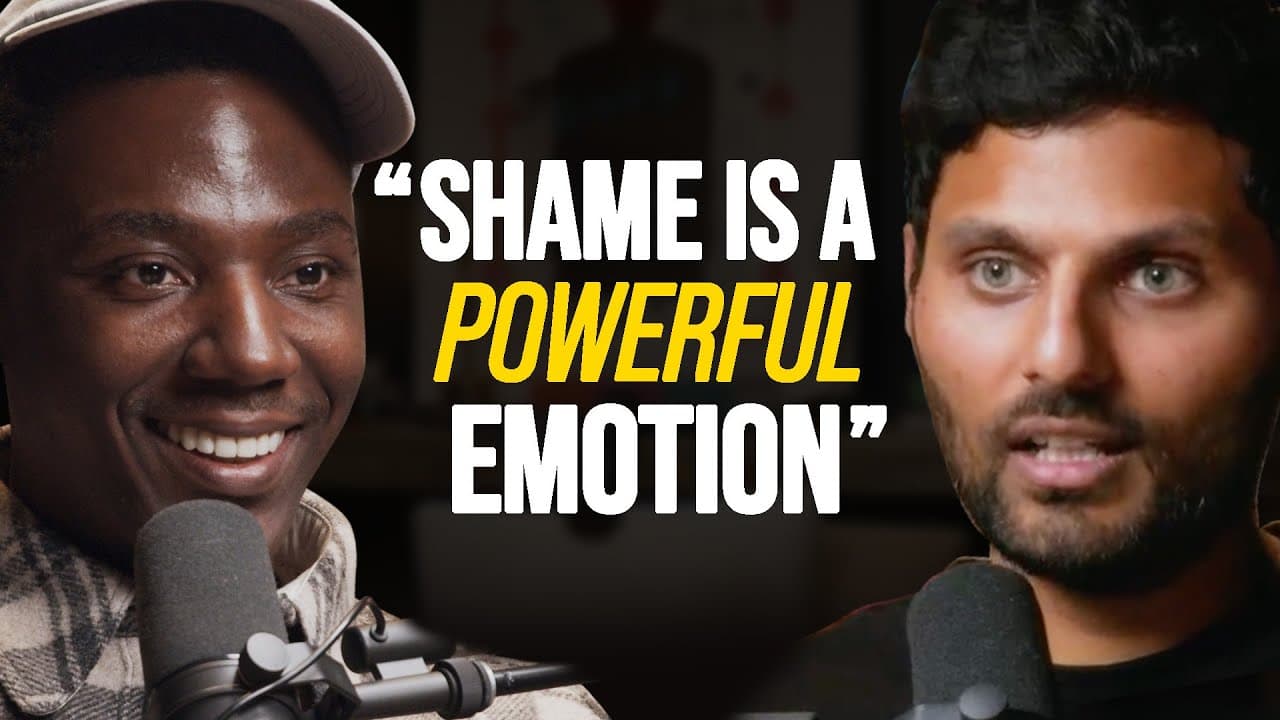
Jerrod Carmichael ON: How To Reframe Shame Into Self Growth
TL;DR
Facing your scariest conversations rarely leads to devastation, only a moment of discomfort or cringe, and that risk is worth it. Jerrod Carmichael found that refusing to lie and dealing with shame head-on made him a better storyteller, a funnier performer, and more comfortable being truthful both on stage and in life.
Transcript
the biggest conversations in my life the scariest ones won't even lead to like Devastation it just could potentially lead to like a moment of discomfort discomfort of cringe or whatever and it's worth it the best-selling author and host the number one Health and Wellness podcast on purpose with Jay Shetty when I look at you you're very private on s... Read More
Key Insights
- The scariest conversations in life rarely lead to devastation. As Jerrod Carmichael puts it, the worst likely outcome is 'a moment of discomfort, discomfort of cringe or whatever, and it's worth it,' which reframes fear as a small, survivable cost.
- Refusing to lie is a creative driver. Carmichael says his recent drive 'to not lie' made him a storyteller, because telling scary things about his own life turned out to be funnier and more powerful than protecting his words.
- Not performing can make a performer better. Carmichael describes himself as 'a performer who's trying to remain non-performance,' and says he has become funnier on stage 'by being truthful' rather than presentational.
- Asking for people's attention is precious. Carmichael respects that ticket buyers spend money, drive to a venue, wait, and then listen, so he treats an audience's time and attention as something owed real care and effort.
- Shame is one of the most powerful emotions shaping behavior. Carmichael notes there are 'plenty of books about just how it can dictate the course of your life,' and says much of who we are is an attempt to hide a hidden piece of ourselves.
- Everyone hides something. Carmichael tells friends he thinks 'everybody's in the closet about something,' framing shame and secrecy as a near-universal human experience rather than an isolated personal flaw.
- Creative work often starts from anger or frustration. Carmichael says a project can begin as 'a spark of something,' often anger, and his last special came fast from frustration 'with secrets' and feeling too old to keep them.
- Most of creating is invisible failure. Carmichael explains that making something is 'a bunch of trying and failing that no one sees,' failing in his own writing and head repeatedly before a show takes shape.
Install to Summarize YouTube Videos and Get Transcripts
Explore YouTube Video Summarizer or Get YouTube Transcript Extractor
Questions & Answers
Q: How can you reframe shame into self-growth?
Carmichael reframes shame by confronting it head on rather than hiding it. He describes trying to have conversations he had never had, dealing with shame, and even restructuring his relationship with God. He notes the scariest conversations won't lead to devastation, only 'a moment of discomfort, discomfort of cringe,' and that discomfort is worth it. By turning secrets and frustration into art, like his stand-up specials, he transforms shame into truthful, funnier work and personal growth.
Q: Why does Jerrod Carmichael avoid social media?
Carmichael keeps a private, verified Instagram that his publicist set up to post about shows, but he is uncomfortable with it because he does not want attention unless he asks for it. He says he would not want to present a false or presentational version of himself, so he closed it off to stay truthful and non-performing. He would rather channel all his energy into comedy, specials, television, and movies than into a curated online performance.
Q: How does not performing make a comedian funnier?
Carmichael calls himself 'a performer who's trying to remain non-performance' and says he has become funnier on stage by being truthful rather than presentational. Instead of protecting his words or projecting a false self, he tells scary, honest stories about his own life, which he found is funnier for the work. Being around people he doesn't have to guard his words with is more comforting, and this honesty produces what he considers a better version of himself.
Q: What is the biggest risk of having a difficult conversation?
According to Carmichael, the biggest and scariest conversations in life won't even lead to devastation. The realistic worst outcome is just 'a moment of discomfort, discomfort of cringe or whatever,' and he argues that risk is worth taking. This reframing shrinks the fear that keeps people silent: the imagined catastrophe rarely happens, so the small, survivable cost of momentary awkwardness should not stop you from being honest and having the conversation.
Q: How does Jerrod Carmichael start his creative process?
Carmichael says a project begins with 'a spark of something,' frequently anger. He starts by performing in clubs, then solo shows, then prepares the material for television, working backward from stand-up because he believes his attention reads best in that medium. His last special came fast, driven by frustration with secrets and feeling too old to keep them, which created urgency to resolve those feelings through art by making a special.
Q: Why does Carmichael treat his audience's attention as precious?
Carmichael believes asking for people's attention is precious because it asks a lot of them. When he does a show, people spend money for tickets, drive out to the venue, sit, wait, and then listen to him, which he sees as a serious request for their time. This respect, which he says has grown in him since childhood, raises his creative standards and makes him want all his energy and thoughts to go into the work he presents.
Q: What role does shame play in shaping who we are?
Carmichael describes shame as a powerful, strong emotion that can dictate the course of your life, your actions, and your behavior, noting there are plenty of books about it. He argues that much of who we are is just our attempts to hide a little piece of ourselves that can never be seen. He tells friends that 'everybody's in the closet about something,' framing shame and hidden secrets as a common human experience rather than a rare personal failing.
Q: When did Jerrod Carmichael discover his passion for performing?
Carmichael discovered performing very early as a child. He asked for a microphone every year at Christmas, was obsessed with microphones, and sang in the choir. Even around age three, when his mother was an usher, he would cry after church until she helped him up to the mic. He says his whole life he has always performed, filmed, and written, though he fought against it for a period before a friend's encouragement pushed him to move to LA and pursue it.
Summary
In this video, Gerard Carmichael discusses his personal journey in the entertainment industry and shares insights into his creative process. He emphasizes the importance of being truthful and authentic in his work, and how exploring personal fears and shame has shaped his comedy. He also reflects on his relationship with God and the power of prayer in his life.
Questions & Answers
Q: Was it intentional for you to be private on social media?
Yes, it was intentional. Gerard prefers to keep a private Instagram account and avoids posting frequently. He believes in presenting a truthful version of himself and avoids being performative on social media.
Q: How has being non-performative on social media affected your comedy?
Gerard believes that being truthful and authentic in his comedy has made him funnier on stage. By not trying to perform or present a false version of himself, he has been able to connect with audiences in a more genuine way.
Q: What has been the biggest impact on who you are today?
It is a complex question, influenced by various factors such as the time period, being American, and the performers Gerard has admired. Recently, he has been influenced by the drive to not lie and be a storyteller.
Q: What was the environment like for you growing up and when did you discover your passion for comedy?
Gerard grew up in North Carolina and had a strong inclination towards performing from an early age. He always felt a connection with microphones and loved the power of amplifying his voice. He started pursuing comedy seriously after a friend encouraged him to make the leap and move to LA.
Q: How do you start the creative process for your specials or TV shows?
Gerard's creative process starts with a spark, often fueled by anger or frustration. He begins by performing in clubs and solo shows, then expands it into a television show or special. He believes stand-up comedy is his core strength and loves the audience connection it provides.
Q: How did it feel to confront fears and shame in your last special?
It was a combination of excitement and fear. Gerard focused on personal exploration and shared deeply personal aspects of his life, including coming out publicly and contending with his parents' experiences. The special allowed him to confront his fears head-on and present a more truthful version of himself.
Q: How do you handle shame and guilt in your creative process?
Gerard believes in running towards the things that scare him and contending with them truthfully. He acknowledges the blocks and anxieties rooted in shame that he still needs to work through in order to have healthier relationships. Good friends have played a crucial role in helping him navigate these challenges.
Q: How do you define authenticity as a comedian?
Gerard believes authenticity in comedy comes from sharing personal experiences and feelings. Audiences respond with empathy and compassion when he talks about himself, even if he sometimes says wild things. He aims to create art that reflects his current emotions and intentions.
Q: You mentioned reframing your relationship with God. Can you explain what prayer means to you?
Gerard believes in his own divinity and sees himself as God manifesting himself as his own unique self. He views prayer as affirmations and requests for what he already possesses. He no longer sees God as an external force who punishes or rewards but as a source of potential and strength.
Q: What advice do you have for others in confronting their own fears and shame?
Gerard recommends running towards the things that scare you in a truthful manner. He emphasizes the importance of having good friends who can provide support during this process. Communicating honestly and being aware of one's own blocks and anxieties is crucial to personal growth and understanding.
Summary & Key Takeaways
-
Jerrod Carmichael keeps a private Instagram set up by his publicist and avoids social media because he does not want attention unless he asks for it, and he refuses to present a false, performed version of himself. He would rather stay truthful and non-performative than turn his real life into spectacle.
-
Carmichael performed from early childhood, asking for a microphone every Christmas and crying to be lifted to the mic after church, and later moved to LA at a friend's urging. He treats an audience's money, time, and attention as precious, which raises the stakes of his creative effort.
-
His creative process often begins with anger or frustration, such as frustration with secrets and feeling too old to keep them, and consists mostly of unseen trying and failing. Recently he has confronted shame directly, having new conversations and restructuring his relationship with God to deal with it head on.
Read in Other Languages (beta)
Share This Summary 📚
Summarize YouTube Videos and Get Video Transcripts with 1-Click
Try YouTube Summary with ChatGPT & Claude or YouTube Transcript Generator
Explore More Summaries from Building Confidence & Overcoming Fears 📚





Summarize YouTube Videos and Get Video Transcripts with 1-Click
Try YouTube Summary with ChatGPT & Claude or YouTube Transcript Generator