How to make AI automations production-ready?
TL;DR
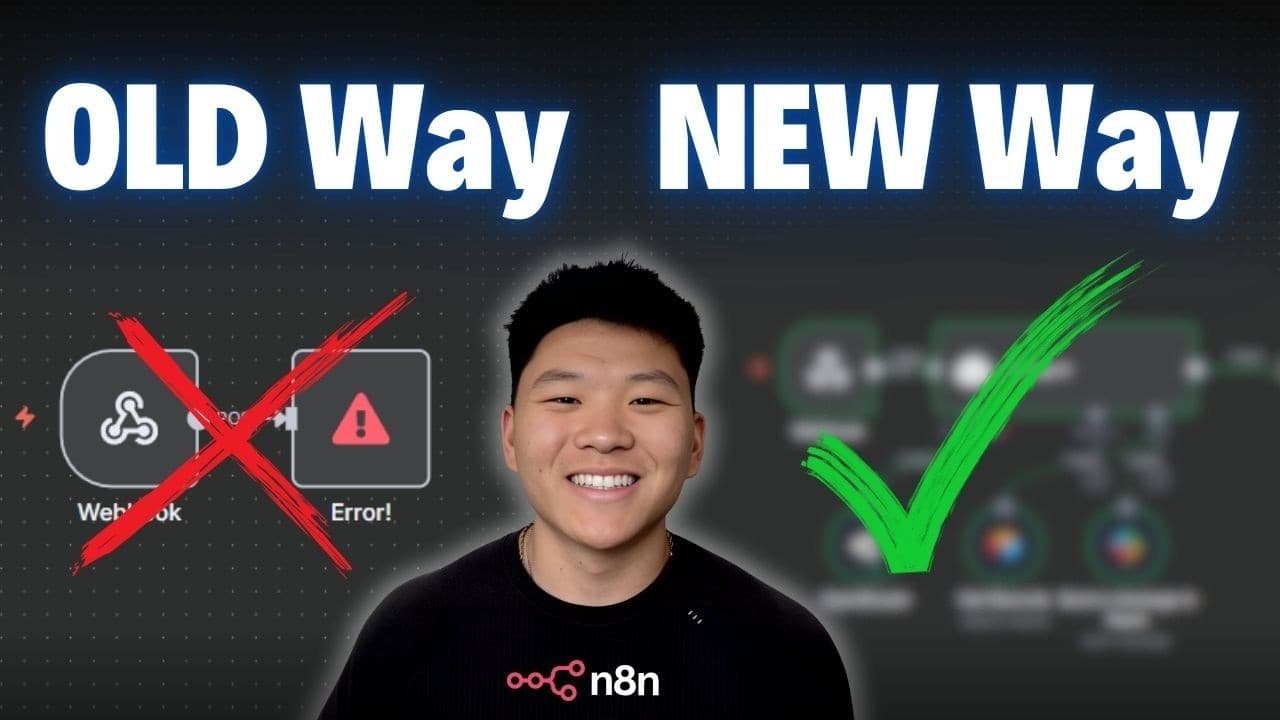
Error handling makes automation reliable by catching failures early and guiding actions. Use error workflows to route issues, enable retries for temporary outages, add fallback models, allow processing to continue on error, and implement polling to detect edge cases. These patterns build guardrails for scalable operations.
Transcript
Today I'm going to be talking about five error handling techniques that you need to master if you want to push your workflows into production. It depends on the use case, but sometimes a workflow needs elements of all five of these techniques in order for you to actually be able to set it and forget it and have peace of mind that it's going to run ... Read More
Key Insights
- Error workflows are the simplest, foundational pattern where an active workflow notifies a separate error workflow to log and handle any failure, enabling faster debugging and clear ownership of error events.
- Retry on failure is a configurable feature across nodes that allows automatic reattempts after a delay, which helps tolerate transient outages and intermittent bugs without human intervention.
- Fallback LLM provides a secondary model path that activates when the main model fails, ensuring the automation still produces usable results.
- Continue on error lets a loop or batch keep processing subsequent items even if one item fails, preventing a single failure from halting the entire run.
- Polling is introduced as a more advanced technique to detect and manage changes or delays in external systems, aiding guard rails and timely responses to issues.
- Guardrail mindset emphasizes predicting edge cases and logging all errors to identify patterns that inform robust safety nets and production-ready design.
- The error workflow concept is described as a minimal yet critical step that every workflow should implement to surface and address failures promptly.
- The video promises a practical demonstration of the techniques with real examples and points to a full video for setup details.
- More videos from this channel:
- More from this channel: Nate Herk | AI Automation
Install to Summarize YouTube Videos and Get Transcripts
Explore YouTube Video Summarizer or Get YouTube Transcript Extractor
Questions & Answers
Q: A real search query question about the video (e.g. 'How to...', 'What is...', 'Why does...', 'When should...'). Question 1
An error workflow is a separate workflow that starts when another workflow errors, allowing you to log the error, notify the right people, and define how to handle the failure. This pattern helps you debug quickly, correlate errors to specific triggers, and prevents silent failures in production.
Q: Question 2
Retry on failure is a setting across nodes that automatically re-executes a failed step after a delay. You can configure the maximum number of tries and the wait time between attempts, which helps absorb transient outages without human intervention.
Q: Question 3
Fallback LLM is a strategy where a secondary model is connected to take over if the primary model fails. This ensures continued output generation, maintains service continuity, and reduces the impact of external API downtimes on your automation.
Q: Question 4
Continue on error allows a loop or batch to proceed with the remaining items even if one item fails. This avoids stopping the entire process due to a single bad input and helps identify all problematic cases in one run.
Q: Question 5
Polling is described as a more advanced technique related to error handling, used to detect changes or delays in external systems. It supports guard rails by providing timely data about system state and potential failure windows.
Q: Question 6
Guardrail mindset focuses on anticipating edge cases and building patterns that catch and manage failures before they cascade. It relies on error logging and pattern analysis to shape robust, scalable production workflows.
Q: Question 7
What does production ready mean in this context? It means having security, output consistency, and error handling in place so that a workflow can run actively without requiring manual intervention, delivering reliable results and timely notifications when issues occur.
Q: Question 8
How do you use error workflows with external tools like Airtable or Gmail in production? You connect the error workflow to the triggering workflow so that any issue with credentials or API access is captured, logged, and routed to a dedicated resolution path, enabling rapid debugging.
Summary & Key Takeaways
-
Error handling builds trust in automation by routing failures to a dedicated error workflow, enabling quick debugging and parity between test and production. It also creates a clear separation of concerns between normal processing and error management.
-
Retry on failure provides resilience to temporary issues by automatically reattempting failed steps with configurable wait times and max attempts, reducing manual intervention and downtime.
-
Fallback LLM ensures continuity when a primary model is unavailable by switching to an alternative model, preserving output quality and keeping the workflow moving even during external service outages.
Read in Other Languages (beta)
Share This Summary 📚
Summarize YouTube Videos and Get Video Transcripts with 1-Click
Try YouTube Summary with ChatGPT & Claude or YouTube Transcript Generator
Explore More Summaries from Nate Herk | AI Automation 📚






Summarize YouTube Videos and Get Video Transcripts with 1-Click
Try YouTube Summary with ChatGPT & Claude or YouTube Transcript Generator