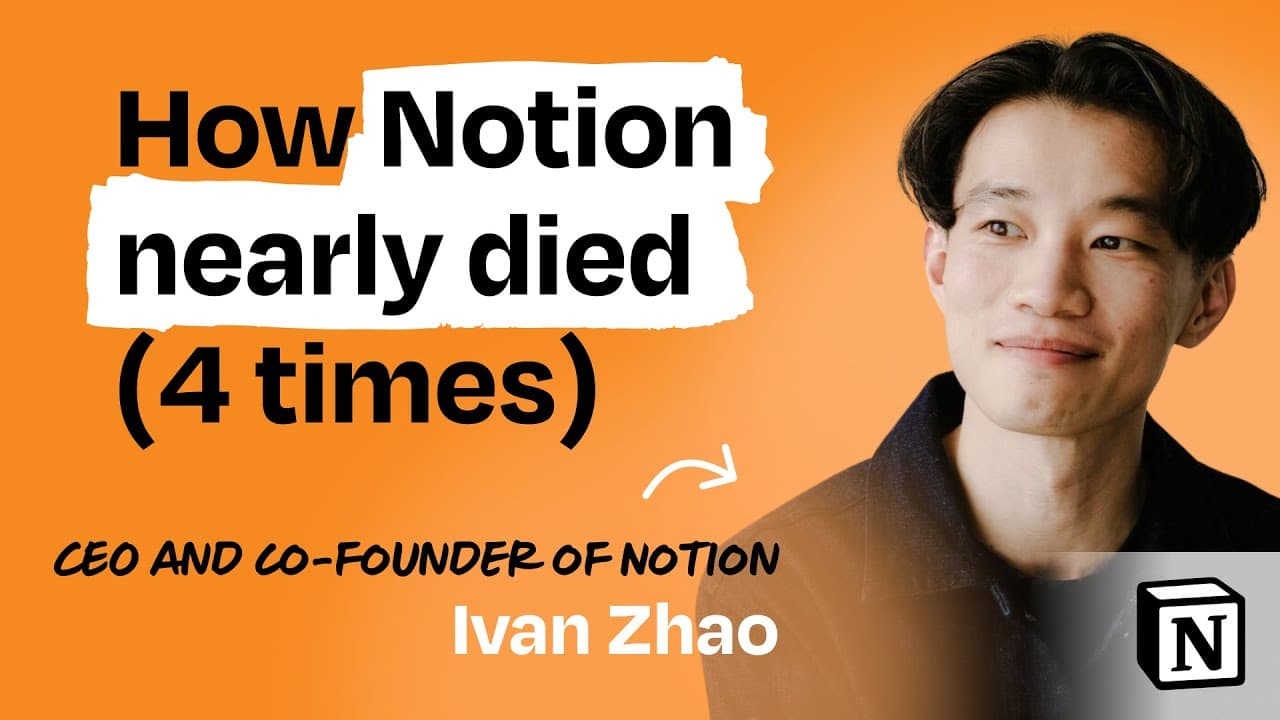
How did Notion start as a lean, horizontal product?
TL;DR
Notion found its footing by hiding its core vision inside a tool people already wanted, a productivity app. The founders kept teams small and focused on craft while balancing business needs, and they endured a near collapse during Covid when a single database nearly ran out of space. The path was iterative, not glamorous, and success came from practical product choices over grand strategy.
Transcript
The way you described the early years of Notion, you described the first three to four years as the lost years. We try many different versions. The first version, okay, everybody can make and create their software, so let's just build a developer tool that's so easy that more people can do that. We tried that a couple of years and learned t... Read More
Key Insights
- Notion pivots from a broad developer tool to a focused productivity tool to meet real user needs.
- The idea of hiding vision behind a sugar coated approach helps align product with user desires.
- Craft and aesthetics are treated as core values that guide product decisions without sacrificing usability.
- Maintaining a small, lean team supports faster iteration and avoids overbuilding.
- A near Covid related data space crisis forced a critical lesson in system design and scalability.
- Horizontal products can succeed when they balance broad applicability with thoughtful design.
- User experience and practical utility trump grand, self driven features in early stages.
- Sustained learning from early failures leads to a durable product roadmap.
- More videos from this channel:
- More from this channel: Lenny's Podcast
Install to Summarize YouTube Videos and Get Transcripts
Explore YouTube Video Summarizer or Get YouTube Transcript Extractor
Questions & Answers
Q: What is the sugar coated broccoli concept and why is it important?
The sugar coated broccoli concept is about hiding the hard core of a product inside something people already want. By providing a familiar, enjoyable surface that delivers the real value underneath, Notion could attract users who might not care about the underlying complexity at first glance. This approach reduces friction, accelerates adoption, and allows the team to iterate on the deeper features later.
Q: How did Notion approach growth with a lean team?
Notion focused on keeping the team small and crafting a product that scales with intent rather than headcount. By prioritizing essential functionality, design, and user feedback, they could iterate quickly without the overhead that comes with large teams. This strategy produced a more agile development cycle and a clearer product direction.
Q: What happened during the Covid period that nearly caused Notion to fail?
During Covid, Notion faced a critical risk where the single database that everything lived in almost ran out of space. This crisis acted as a stress test for the architecture and operations, forcing the team to confront scalability issues and implement robust solutions under time pressure, which ultimately strengthened the product and its resilience.
Q: Why is balance between taste and business important for Notion?
The key is avoiding an overly self driven product or a pure commodity. Notion aims to balance its own aesthetic and taste with real user needs and revenue considerations. This balance prevents the product from becoming too idiosyncratic while ensuring it remains compelling enough to sustain growth and financial viability.
Q: What does it mean that tools are extensions of us, and how does that relate to Notion?
The idea is that tools augment human intellect and problem solving. Notion’s design philosophy treats the product as an environment that users can shape and be shaped by. This mindset encourages building flexible, extensible features that users can adapt to their own workflows, leading to deeper engagement and long term value.
Q: How did Ivan Zhao’s background influence Notion’s development?
Ivan Zhao grew up in a large town in China and moved to Canada, where he learned to code and was drawn to early computing pioneers. His experience of switching contexts and environments fed a belief that software should empower a broad range of people to create, manage, and solve problems in daily life.
Q: What role did historical computing approaches play in Notion’s strategy?
Notion’s approach echoes early computing ideas where there is no strict separation between tool builders and users. The inference is to keep the interface malleable and the environment extensible, which guides Notion toward a flexible platform that users can adapt rather than a fixed application with rigid boundaries.
Q: What does the interview suggest about the relationship between product craft and leadership?
The interview emphasizes craft and aesthetics as foundational to product development while also acknowledging leadership responsibility. Building a high quality product requires attention to detail, an openness to trade offs, and guiding teams with a clear vision that remains grounded in real user needs and sustainable growth.
Summary & Key Takeaways
-
Notion’s founders describe the early years as a lost period where many experiments were tried before hitting a viable product path. They chose a tangible goal that users already care about, then iterated toward it with emphasis on usability. The process was customer-focused and patient.
-
A core philosophy emerged around balancing personal taste with practical user needs, avoiding both excessive self-expression and commodity product features. This middle ground kept Notion distinct while still broadly playable across normal daily tasks.
-
The Covid crisis is highlighted as a dramatic stress test, where space and data constraints threatened product continuity. The team prioritized essential resilience measures, which helped them survive and later thrive, proving the importance of operational foresight in software products.
Read in Other Languages (beta)
Share This Summary 📚
Summarize YouTube Videos and Get Video Transcripts with 1-Click
Try YouTube Summary with ChatGPT & Claude or YouTube Transcript Generator
Explore More Summaries from Lenny's Podcast 📚
Summarize YouTube Videos and Get Video Transcripts with 1-Click
Try YouTube Summary with ChatGPT & Claude or YouTube Transcript Generator