How to Build Strategy Around the Key Challenge
TL;DR
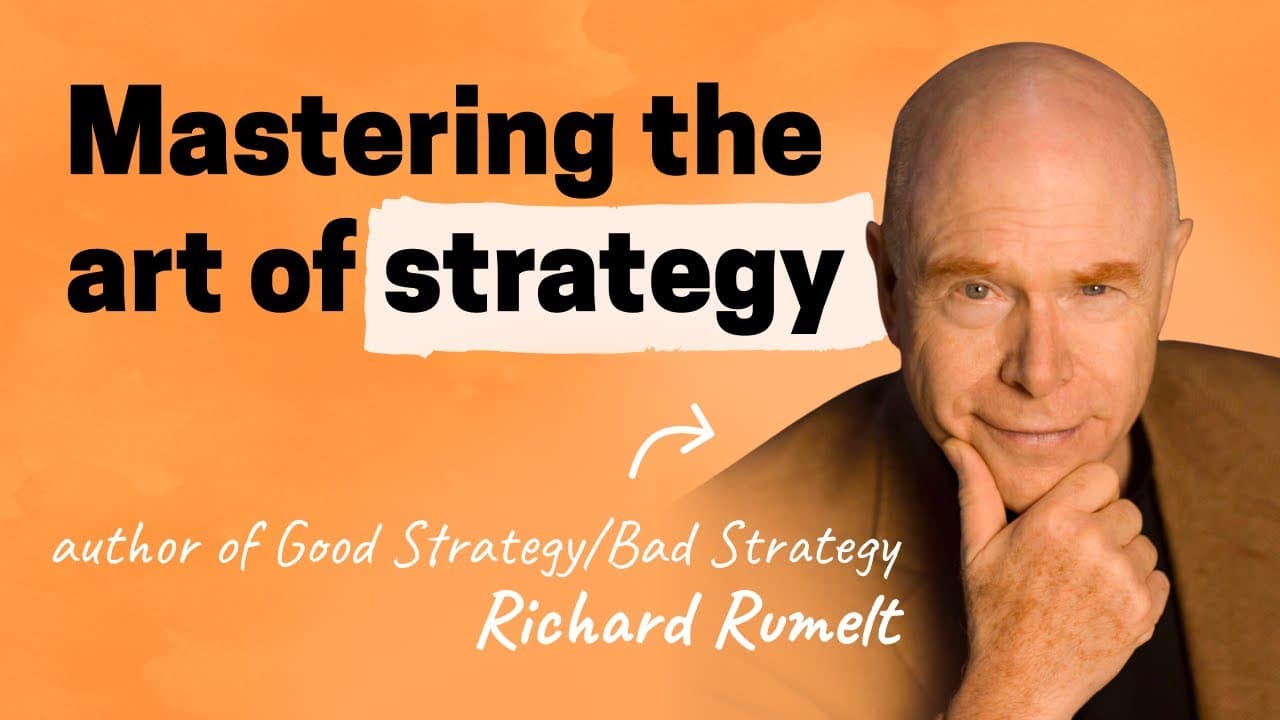
Good strategy begins by identifying one or two high-stakes challenges that can actually be addressed, then choosing a guiding policy and coherent actions to overcome them. Mission, vision, values, long priority lists, and analytical frameworks do not substitute for strategy because they do not specify what matters most, what the organization will do, or what it will deliberately leave undone.
Transcript
Don't call it strategy, call it an action agenda. It's huge numbers of people out there willing to sell you advice on mission and your vision and your values, all these things that have to be in place before you can have strategy. That's not true. Begin to try to identify the one or two key challenges that can actually be addressed and what are... Read More
Key Insights
- Strategy is a design for overcoming a high-stakes challenge through a mixture of policy and action. The challenge can be a valuable opportunity, such as an unexpected discovery, or a serious threat, such as an innovation that is pushing an organization out of its market.
- The foundation of strategic thinking is identifying one or two key challenges that can actually be addressed. Mission, vision, and values do not have to be completed first, because strategy begins with understanding a consequential problem and deciding what to do about it.
- Diagnosis is an interpretation of the situation that determines what deserves attention. Because people cannot understand all of reality, diagnosis necessarily selects important factors and develops one or more hypotheses about what is happening and how the relevant elements connect.
- Analytical frameworks are tools for studying a strategic problem, not strategies in themselves. Matrices, competitive analysis, and similar diagrams may improve comprehension, but a strategy must go further by selecting an approach and connecting that approach to concrete action.
- A guiding policy is the central approach chosen to deal with the diagnosed situation. It states what the organization will do and, just as importantly, what it will not do, providing direction that a broad collection of aspirations cannot supply.
- Priority means identifying what comes first, not labeling every desirable objective as equally important. A list containing market growth, emissions reduction, safety, energy savings, and cost reduction may describe ambitions, but it does not resolve the choices required by strategy.
- Coherent actions are practical steps that work together to carry out the guiding policy. Their coherence matters because strategy is not merely an intention or objective. It is a coordinated agenda for confronting the selected challenge through mutually reinforcing activity.
- An action agenda is a clearer label for strategy because it directs attention toward challenges, choices, and execution. The phrase discourages organizations from treating strategy as ceremonial language and instead asks what they will pursue and which coordinated actions they will take.
- Related book: Good Strategy/Bad Strategy
- Export your Kindle highlights to Glasp: How to Download Highlights and Notes from Kindle
Install to Summarize YouTube Videos and Get Transcripts
Explore YouTube Video Summarizer or Get YouTube Transcript Extractor
Questions & Answers
Q: What is strategy in its simplest form?
Strategy is a design for overcoming a high-stakes challenge. It combines a policy with actions selected to deal with a consequential issue. The challenge may present an upside, such as discovering a valuable resource, or a downside, such as an innovation threatening an organization’s market position. Strategy therefore concerns what must be confronted and how it will be addressed.
Q: How do you build a good strategy?
Begin by identifying one or two important challenges that can realistically be addressed. Diagnose the situation by deciding what deserves attention and forming hypotheses about how the relevant factors connect. Then select a guiding policy that defines the central approach. Finally, specify coherent actions that work together to implement that policy and confront the diagnosed challenge.
Q: What are the essential components of a good strategy?
The essential components described are diagnosis, a guiding policy, and coherent action. Diagnosis interprets the situation and focuses attention on the critical issue. The guiding policy states the basic approach for dealing with it. Coherent actions turn that approach into coordinated steps. Together, these components connect understanding, choice, and execution around a high-stakes challenge.
Q: Why does every good strategy begin with diagnosis?
Diagnosis establishes what is happening and which part of a complicated reality deserves attention. Since people cannot comprehend everything, they must select relevant facts and develop hypotheses about how conditions connect. Without that interpretation, a policy lacks a clear problem to address, and actions can become disconnected activities rather than a coherent response to a defined challenge.
Q: What is a guiding policy in strategy?
A guiding policy is the central approach chosen for handling the diagnosed situation. It answers what the organization is going to do about the challenge and establishes direction for subsequent action. It also requires exclusion, because leaders must determine what they will not pursue. A guiding policy is therefore different from a list of every outcome the organization would like to achieve.
Q: Why are long lists of priorities a sign of bad strategy?
Long lists of priorities avoid the central strategic task of deciding what comes first. Calling many unrelated ambitions priorities produces a collection of wishes, such as gaining market share, reducing emissions, improving safety, saving energy, and cutting costs. Such a list does not establish a guiding policy or explain which actions deserve precedence when objectives compete for attention and resources.
Q: Are analytical frameworks the same as strategy?
Analytical frameworks are not strategies. Tools such as matrices, competitive frameworks, and diagrams can help examine competition, understand a situation, or organize thinking about a problem. They contribute to diagnosis, but they do not decide how the challenge will be handled. Strategy also requires a guiding policy and coherent actions designed to implement the selected approach.
Q: Why call strategy an action agenda?
Calling strategy an action agenda emphasizes what strategic work must produce: a focused response to a key challenge and a set of coherent steps for carrying it out. The term shifts attention away from treating mission, vision, and values as prerequisites. It encourages leaders to specify the challenge, choose what they will pursue, and define the actions needed to address it.
Summary & Key Takeaways
-
Strategy is a design for overcoming a high-stakes challenge through a mixture of policy and action. The challenge may involve capturing an opportunity or responding to a threat. Strategic thinking therefore begins with a concrete issue, not with generic statements about mission, vision, values, or every desirable organizational outcome.
-
Rumelt’s strategy kernel begins with diagnosis, an interpretation of the situation that identifies what deserves attention and offers hypotheses about how important factors connect. Analytical tools, including matrices and competitive frameworks, may assist this work, but they analyze the problem. They do not constitute a strategy by themselves.
-
A guiding policy establishes the central approach to the diagnosed challenge, while coherent actions translate that approach into practical steps. Strategy requires priority, choice, and exclusion. Calling numerous ambitions priorities creates a wish list rather than direction, because a real priority identifies what comes first and clarifies what will not be pursued.
Read in Other Languages (beta)
Share This Summary 📚
Summarize YouTube Videos and Get Video Transcripts with 1-Click
Try YouTube Summary with ChatGPT & Claude or YouTube Transcript Generator
Explore More Summaries from Lenny's Podcast 📚

Summarize YouTube Videos and Get Video Transcripts with 1-Click
Try YouTube Summary with ChatGPT & Claude or YouTube Transcript Generator