How Will AI Agents Change Work and SaaS?
TL;DR
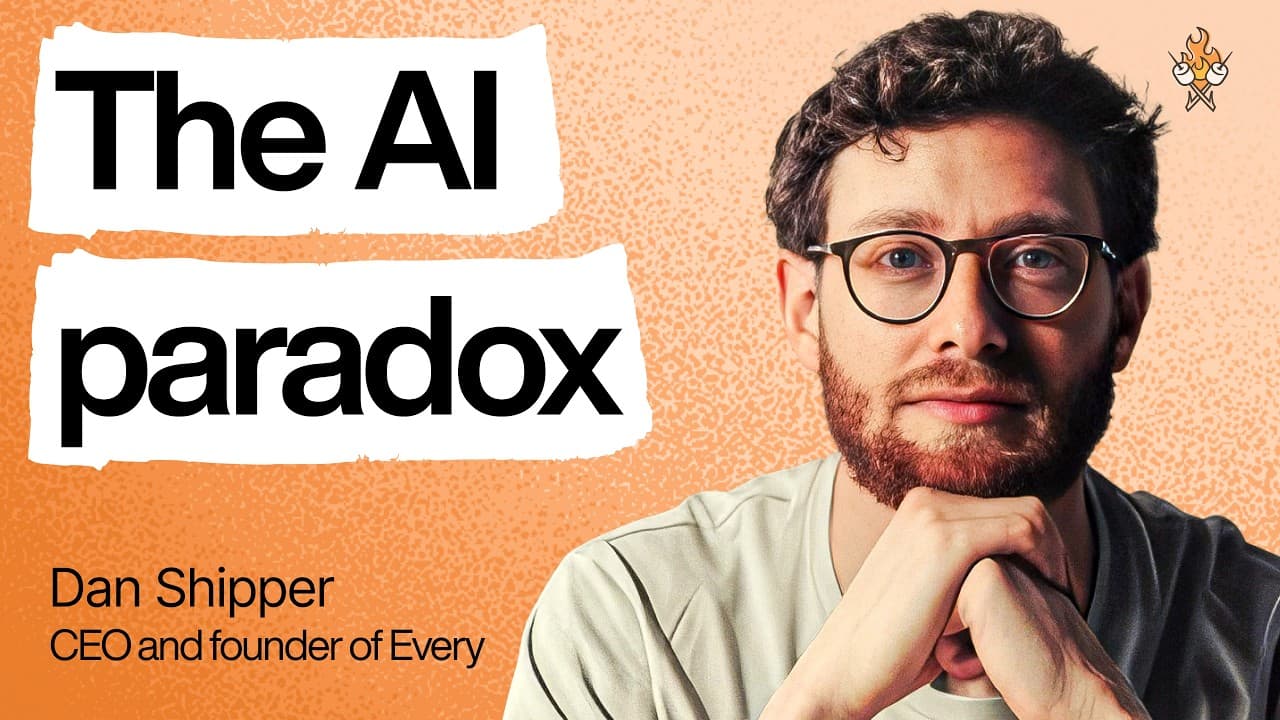
AI is expected to reshape work without eliminating the need for people: employees will delegate tasks to agents while applying creativity and judgment to produce distinctive results. Dan Shipper predicts that work will increasingly happen inside environments such as Codex or Claude Code, SaaS usage will grow rather than collapse, and product managers, full-stack designers, and forward deployed engineers will become especially valuable.
Transcript
The last time you were on this podcast, you had this hot take that people were sleeping on Claude Code. You were so unbelievably right. The premise of this episode is we're going to go through what else you predict will happen. >> The AI job apocalypse is not really a thing. I am super super bullish on PMs and full-stack designers. >> So, you guys ... Read More
Key Insights
- Every functions as a laboratory for AI-enabled work because its roughly 30 employees are early adopters across engineering, design, writing, editing, sales, operations, and customer service. Their daily experimentation lets Shipper form predictions by observing emerging behavior rather than relying only on abstract forecasts.
- AI adoption does not necessarily reduce company headcount. Every grew from about 15 people to almost 30 in a year, even as its employees used AI extensively, illustrating Shipper's argument that greater automation and agent use can coexist with hiring and more human work.
- The future of knowledge work is predicted to center on agent environments such as Codex or Claude Code. Employees will converse with computers in ordinary English, delegate tasks, manipulate files, and operate software without needing to inspect the underlying code or rely primarily on traditional interfaces.
- Every employee is predicted to have at least one agent for offloading work. Shipper also expects companies to operate a shared super-agent inside Slack, giving employees a common conversational route to organizational knowledge, software, and tasks that previously required navigating multiple tools or teams.
- SaaS is predicted to survive and gain users because agents can operate software on behalf of people. Shipper argues that this expanded machine-assisted usage is more likely to increase demand than eliminate applications, and user-supplied AI tokens could also improve the economics and margins of SaaS products.
- Human creativity becomes more valuable when models make yesterday's competence inexpensive. AI can reproduce established patterns and capabilities, but people still decide how to combine that accumulated competence into work that feels new, useful, and distinctive amid growing volumes of routinely generated content.
- Product managers and full-stack designers are predicted to thrive because agent-assisted production increases the value of deciding what to build and shaping the complete experience. Forward deployed engineers also become essential by connecting AI capabilities to specific customers, operational contexts, and practical implementation needs.
- Automation remains dependent on human direction because every agent needs a person. Shipper describes automation as misleading when it implies autonomous completion without supervision, noting that Every has extensive AI and automation while he personally works more, not less, as the range of possible work expands.
Install to Summarize YouTube Videos and Get Transcripts
Explore YouTube Video Summarizer or Get YouTube Transcript Extractor
Questions & Answers
Q: How will AI agents change everyday knowledge work?
AI agents are predicted to become routine collaborators that employees talk to and use for delegated work. Shipper expects most work to move toward computer-based environments such as Codex or Claude Code, where people can communicate in English, manage files, and operate tools. Employees may each have an agent, while companies may also provide a shared super-agent inside Slack for regular organizational use.
Q: Will AI cause a widespread job apocalypse?
Shipper predicts that an AI job apocalypse will not occur in the way many people expect. His own company provides the central example: Every uses AI extensively across technical and nontechnical roles, yet it grew from about 15 employees to almost 30 during the prior year. His position is simultaneously strongly pro-AI and strongly pro-human because agents still require human judgment, direction, and creative choices.
Q: Why does Dan Shipper believe SaaS will survive AI agents?
Shipper argues that agents increase the number of users interacting with SaaS rather than making SaaS unnecessary. Software can be operated by humans and agents together, expanding usage across tasks that people might not have completed manually. He also predicts a change in SaaS economics where users bring their own AI tokens into applications, potentially improving margins instead of forcing providers to absorb every model-related cost.
Q: Which roles are expected to become more valuable in the AI era?
Product managers, full-stack designers, and forward deployed engineers are identified as especially valuable roles. Product managers can determine what should be built as implementation becomes easier, while full-stack designers can shape more of the complete product experience. Forward deployed engineers can apply AI and software directly to customer needs. These roles combine technical leverage with judgment, context, design, and practical coordination.
Q: Why will creativity matter more as AI capabilities improve?
Creativity becomes more valuable because models make established human competence cheaper and more widely available. Shipper describes model capability as frozen competence from yesterday, which can quickly become commoditized. The distinctly human contribution is choosing how to use those capabilities to make something new, interesting, and differentiated. That matters more when large amounts of ordinary content and software can be produced and launched constantly.
Q: How does Every identify emerging AI work trends?
Every creates what Shipper calls a small pocket of the future by hiring curious AI early adopters across engineering, design, writing, editing, sales, and customer service. The team tests new model products, sometimes before public release, and applies them to real work. Shipper then notices which tools people reach for organically and writes about those patterns, making observed behavior the basis for his predictions.
Q: Why does Dan Shipper say automation is a lie?
Shipper uses that phrase to reject the idea that agents remove people from the work process. His claim is that every agent needs a human who directs, evaluates, or builds upon its output. At Every, extensive AI use and automation have not eliminated work. Shipper says he personally works more because these tools expand what can be attempted, creating additional opportunities for judgment, experimentation, and production.
Q: Are command-line interfaces the future of AI-assisted work?
Shipper predicts that command-line interfaces are already passing as the dominant direction, even though many people recently moved toward terminals. He describes the CLI period as something the industry quickly moved through. His broader prediction is that work will happen inside agent environments such as Codex or Claude Code, where conversational interaction and access to software matter more than manually issuing traditional terminal commands.
Summary & Key Takeaways
-
Dan Shipper bases his predictions on Every, a roughly 30-person media and software company where engineers, designers, writers, editors, salespeople, and customer service staff actively experiment with AI. The company doubled its headcount over the prior year, supporting his view that intensive AI adoption can coexist with growing human teams.
-
Shipper predicts that employees will routinely communicate with personal agents and that much of their work will happen inside environments such as Codex or Claude Code. Software will increasingly serve humans and agents together, while a company-wide super-agent in Slack could become a regular interface for knowledge, tools, and delegated work.
-
The predicted winners include product managers, full-stack designers, and forward deployed engineers. Models make established human competence cheaper, so creativity, judgment, experimentation, and the ability to direct agents become more important. Shipper rejects both a near-term job apocalypse and SaaS collapse, arguing that agents can increase software usage while humans remain essential.
-
Key Insights
Read in Other Languages (beta)
Share This Summary 📚
Summarize YouTube Videos and Get Video Transcripts with 1-Click
Try YouTube Summary with ChatGPT & Claude or YouTube Transcript Generator
Explore More Summaries from Lenny's Podcast 📚



Summarize YouTube Videos and Get Video Transcripts with 1-Click
Try YouTube Summary with ChatGPT & Claude or YouTube Transcript Generator