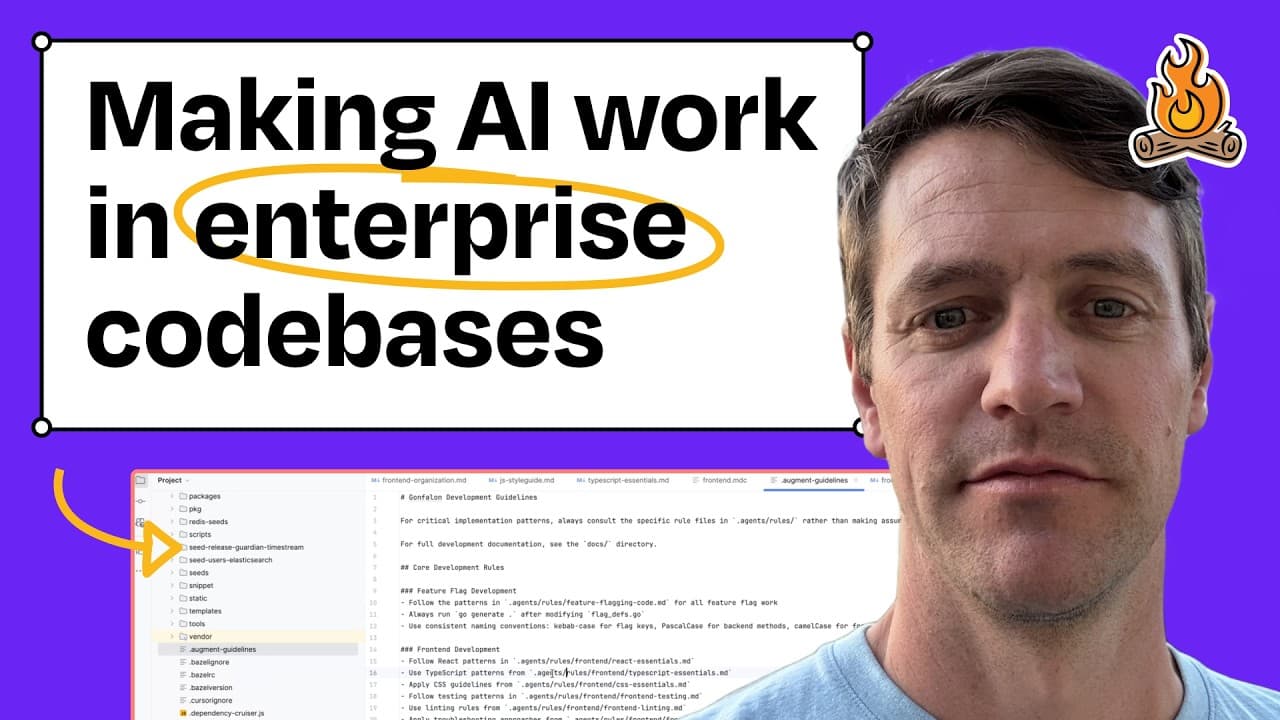
How Can Large Enterprise Engineering Teams Successfully Code with AI? Centralized Rules, Tech Debt Workflows, and More
TL;DR
Large enterprise engineering teams can implement AI effectively by centralizing repository documentation and rules, assigning someone close to the code to drive adoption, and creating structured workflows for technical debt and hiring. At LaunchDarkly, an engineering organization of over 100 people uses tools including Cursor, Devin, and GitHub Copilot while rejecting vibe coding as an enterprise strategy. Read on for practical guidance on scaling these practices.
Transcript
Vibe coding is not an acceptable enterprise development strategy. I love it. I can do a hundred commits a week by myself on my side project on my startup. But when you're working on a codebase in a platform like Launch Darkly that powers trillions and trillions of experiences every day, you can't take the same strategies and tactics that a vibe cod... Read More
Key Insights
- Centralized documentation and rules enhance scalability and efficiency in AI tool use.
- AI agents like Devin and Cursor help in analyzing and reducing test noise in large codebases.
- Leveraging AI tools for documentation extracts knowledge effectively from existing sources.
- Aligning documentation strategies for both humans and LLMs improves accessibility and usability.
- Custom GPT workflows can improve interview feedback quality and coach interviewers effectively.
- Prioritized task lists for tech debt reduction allow collaboration between humans and AI agents.
- Having a dedicated person to drive AI adoption in large teams ensures successful integration.
- Vibe coding is not suitable for enterprise development; structured approaches are necessary.
Install to Summarize YouTube Videos and Get Transcripts
Explore YouTube Video Summarizer or Get YouTube Transcript Extractor
Questions & Answers
Q: How can large enterprise engineering teams implement AI successfully?
Teams should centralize rules and documentation in the repository, use structured workflows, and assign responsibility for driving adoption to someone who works close to the code. LaunchDarkly applies this approach across an engineering organization of over 100 people while using tools such as Cursor and Devin.
Q: Why should AI rules and documentation be centralized in the repository?
Repository-based documentation gives both engineers and LLMs direct access to the same guidance. At LaunchDarkly, that guidance includes front-end organization, accessibility requirements, and a JavaScript style guide, making AI use more scalable.
Q: Why is vibe coding not an acceptable enterprise development strategy?
Vibe coding allows looser practices that may be manageable on a side project, where one developer can make 100 commits a week and recover from quality issues. A platform like LaunchDarkly powers trillions and trillions of experiences every day, so its codebase requires more structured strategies and tactics.
Q: Which AI tools does LaunchDarkly's technology team use?
The team uses Lovable, v0, and Figma Make for design, ChatGPT for product work, and Cursor and Devin heavily for engineering. It also uses Cursor background agents, GitHub Copilot and Cursor for code review, while exploring Windsurf, Augment, and Claude Code.
Q: Why should one person be responsible for driving AI adoption?
A designated person can focus concerted effort on engineering-wide change and determine what works in the actual codebase. Zach Davis says this person should be close to the code and actively trying the tools, whether that person is a manager, director, or another team member.
Q: How can AI agents help reduce technical debt?
AI agents such as Devin and Cursor can analyze test noise and help make large codebases more manageable. Teams can create prioritized task lists so human developers and AI agents can collaborate systematically on technical-debt cleanup.
Q: How can AI improve engineering documentation?
AI tools can extract knowledge from existing sources and help produce documentation for the codebase. Keeping that documentation in the repository makes it accessible to both humans and LLMs and supports a shared understanding of how work should be done.
Q: How can custom GPT workflows support engineering hiring?
Custom GPT workflows can improve the quality and consistency of interview feedback by using structured rubrics and examples. They can also coach interviewers, helping the engineering organization maintain its hiring bar while adopting AI tools.
Summary & Key Takeaways
-
Centralized documentation and rules for AI tools are essential for scalability in large enterprises. By consolidating rules in a single location, both human and AI agents can access necessary information efficiently. This approach reduces redundancy and enhances productivity.
-
AI agents like Devin and Cursor are used to analyze and minimize test noise, making codebases more manageable. By creating prioritized task lists, both human developers and AI agents can collaborate effectively to tackle technical debt.
-
Improving hiring processes with AI involves using custom GPT workflows to enhance interview feedback quality. This ensures consistent and high-quality hiring standards, allowing engineering teams to maintain excellence while integrating AI tools into their workflows.
Read in Other Languages (beta)
Share This Summary 📚
Summarize YouTube Videos and Get Video Transcripts with 1-Click
Try YouTube Summary with ChatGPT & Claude or YouTube Transcript Generator
Explore More Summaries from How I AI 📚



Summarize YouTube Videos and Get Video Transcripts with 1-Click
Try YouTube Summary with ChatGPT & Claude or YouTube Transcript Generator