How to Build Products with AI: Ryan Carson's Workflow
TL;DR
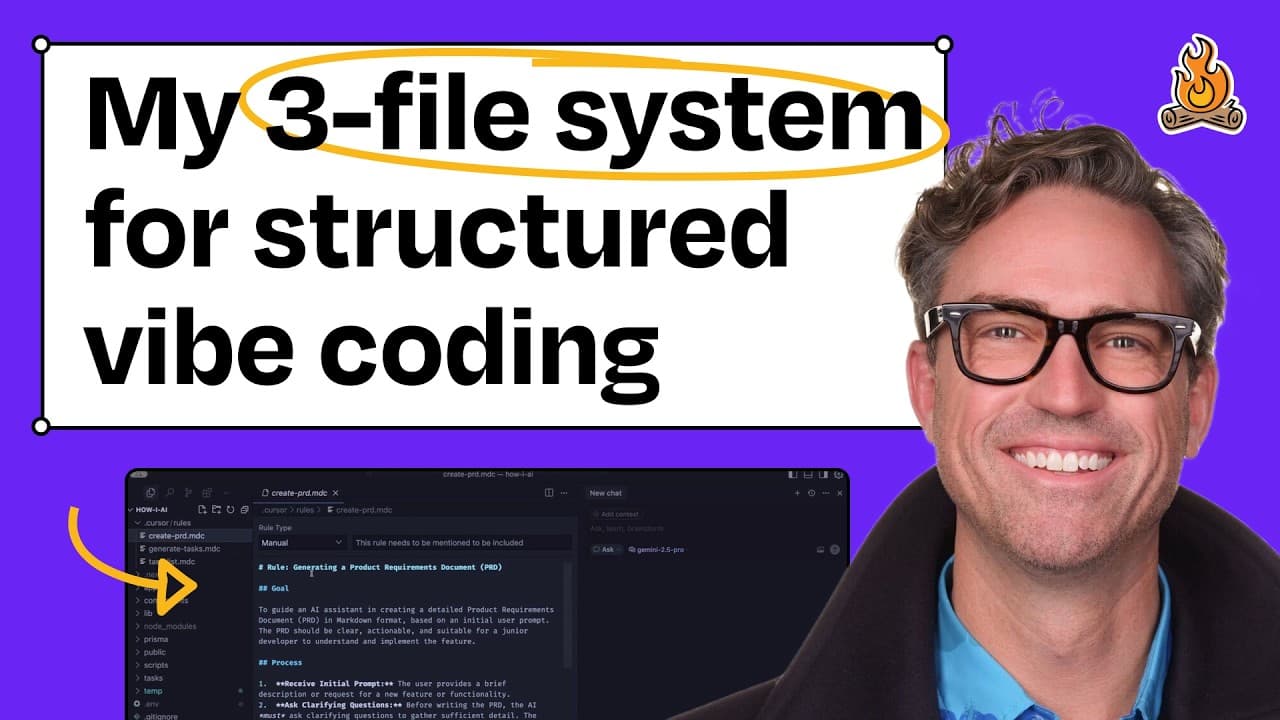
Ryan Carson, a seasoned founder, outlines a three-step AI coding workflow that transforms chaotic coding into a structured process. By using AI-generated PRDs and task lists, founders can build entire companies with minimal engineering teams. Providing proper context to AI models is crucial for accelerating development and achieving reliable results.
Transcript
i think the biggest mistake that I do that everyone does is they try to rush through the context where you just don't have the patience to tell the AI what it actually needs to know to solve your problem and I think if we all just slow down a tiny bit and do these two steps it speeds everything up nobody really knows how to do this stuff the only w... Read More
Key Insights
- AI-generated PRDs and task lists streamline the coding process, making it more structured and reliable.
- Providing AI with proper context is essential to speeding up development and achieving accurate results.
- Cursor, a VS Code fork, is a key tool in Ryan Carson's workflow for building features systematically.
- Model Context Protocols (MCPs) extend AI capabilities beyond coding, aiding in tasks like front-end testing.
- Founders can now build entire companies with minimal engineering teams using AI tools and workflows.
- Ryan Carson uses a three-file system to manage AI coding tasks, ensuring clarity and efficiency.
- AI tools like ChatPRD and Notion are crucial for product management and enhancing productivity.
- Slowing down to provide AI with detailed instructions prevents common mistakes and accelerates coding.
Install to Summarize YouTube Videos and Get Transcripts
Explore YouTube Video Summarizer or Get YouTube Transcript Extractor
Questions & Answers
Q: How can AI-generated PRDs and task lists improve the coding process?
AI-generated PRDs and task lists provide a structured approach to coding, transforming chaotic processes into organized workflows. By clearly defining product requirements and breaking down tasks, these tools ensure clarity and efficiency, enabling founders to build products with minimal engineering resources and preventing common coding mistakes.
Q: What role does context play in AI development?
Context is crucial in AI development as it ensures that AI models understand the problem they are solving. Providing detailed context helps AI generate accurate and relevant results, speeding up the development process and minimizing errors. Proper context is achieved by using tools like Cursor and Model Context Protocols (MCPs).
Q: What is the importance of slowing down in AI coding?
Slowing down in AI coding allows developers to provide detailed instructions and context to AI models, preventing common mistakes and ensuring accurate results. This deliberate approach accelerates development by reducing errors and improving the reliability of AI-generated outputs, ultimately saving time and resources.
Q: How do Model Context Protocols (MCPs) enhance AI capabilities?
Model Context Protocols (MCPs) extend AI capabilities beyond coding by enabling tasks like front-end testing. MCPs allow AI to interact with other applications, providing a seamless integration of AI tools into existing workflows. This enhances productivity and enables more complex tasks to be automated and managed efficiently.
Q: How can founders build companies with minimal engineering teams using AI?
Founders can leverage AI tools and workflows to build companies with minimal engineering teams by automating repetitive tasks and streamlining product development. AI-generated PRDs, task lists, and tools like Cursor and ChatPRD enable founders to focus on strategic decision-making while AI handles the technical execution, reducing the need for large engineering teams.
Q: What tools are essential in Ryan Carson's AI coding workflow?
Key tools in Ryan Carson's AI coding workflow include Cursor, a VS Code fork for systematic feature building, and Model Context Protocols (MCPs) for extending AI capabilities. Additional tools like ChatPRD and Notion support product management and productivity, while AI-generated PRDs and task lists provide structure and clarity to the coding process.
Q: Why is it important to provide AI with detailed instructions?
Providing AI with detailed instructions is important because it ensures that AI models understand the specific tasks they need to perform. This reduces the likelihood of errors, improves the accuracy of AI-generated outputs, and accelerates the development process by minimizing the need for corrections and revisions.
Q: How does Ryan Carson use AI to manage coding tasks?
Ryan Carson uses a three-file system to manage AI coding tasks, ensuring clarity and efficiency. This system includes AI-generated PRDs and task lists that break down coding tasks into manageable steps. By providing AI with proper context and detailed instructions, Carson ensures reliable and accurate results, streamlining the coding process.
Summary & Key Takeaways
-
Ryan Carson demonstrates a three-step AI coding workflow that organizes chaotic coding into a structured process. By using AI-generated PRDs and task lists, founders can efficiently build products with minimal engineering resources, focusing on providing AI with proper context to optimize development speed and accuracy.
-
Cursor, a VS Code fork, is central to Carson's workflow, allowing for systematic feature building. Model Context Protocols (MCPs) further enhance AI capabilities, enabling tasks like front-end testing, while tools like ChatPRD and Notion support product management and productivity.
-
Carson emphasizes the importance of slowing down to provide detailed instructions to AI, preventing common coding mistakes and ensuring reliable results. This approach empowers founders to build entire companies with minimal teams using AI-driven workflows.
Read in Other Languages (beta)
Share This Summary 📚
Summarize YouTube Videos and Get Video Transcripts with 1-Click
Try YouTube Summary with ChatGPT & Claude or YouTube Transcript Generator
Explore More Summaries from How I AI 📚

Summarize YouTube Videos and Get Video Transcripts with 1-Click
Try YouTube Summary with ChatGPT & Claude or YouTube Transcript Generator