How Is Big Tech Financing the AI Buildout?
TL;DR
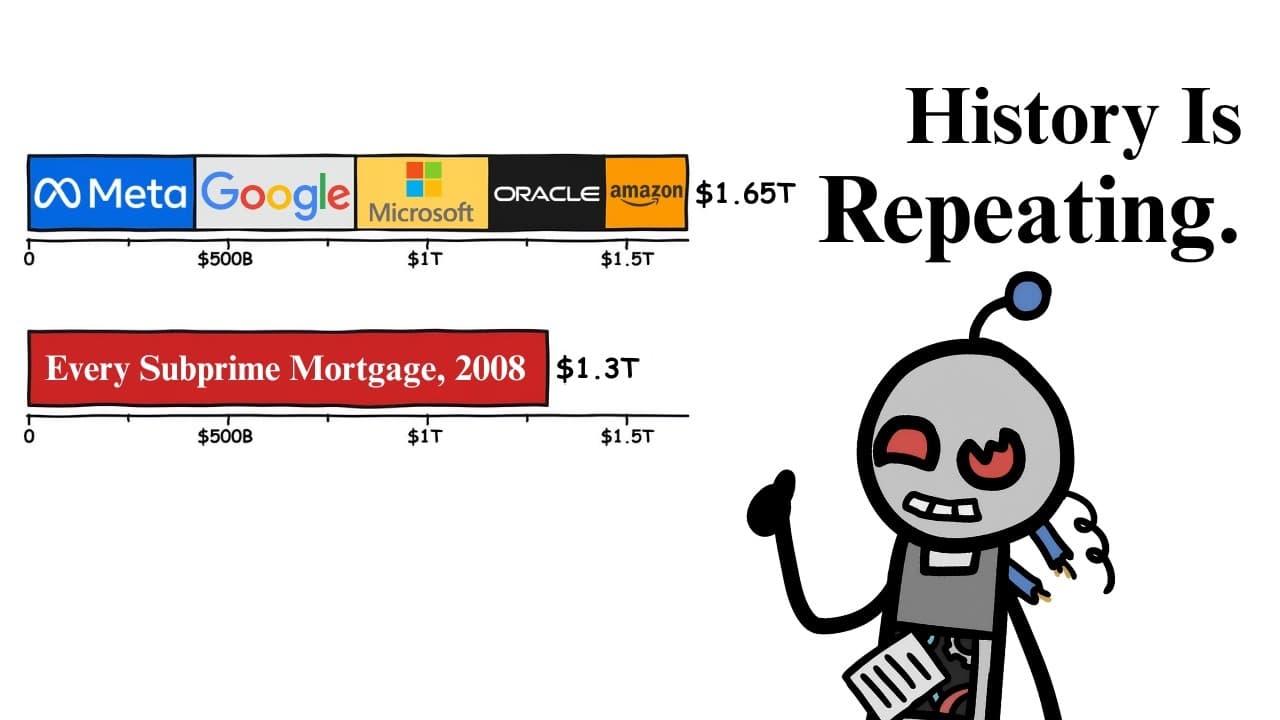
Big Tech is financing the AI buildout with operating cash, rapidly expanding bond issuance, and special purpose vehicles that can keep project debt off corporate balance sheets. The transcript argues that five technology companies have about $1.65 trillion in off-balance-sheet obligations, exceeding roughly $1.35 trillion of reported debt and creating financial risks that ordinary balance-sheet figures may not capture.
Transcript
You've seen the AI headlines. In fact, you've probably seen so many of them that the numbers have stopped meaning anything. Every week it's another hundred billion, another mega campus, another record. The numbers have gotten so big, they've stopped registering at all. They're just something you scroll past on Instagram, think, "Oh, wow." And 3 sec... Read More
Key Insights
- • Five technology companies have approximately $1.65 trillion in obligations that do not appear on their balance sheets, according to a study cited in the transcript. Their reported debt totals about $1.35 trillion, making the off-balance-sheet amount larger than the visible debt.
- • Shadow banking is a system of institutions and financing structures that borrow and lend like banks without being regulated as banks. Paul McCulley warned about this system in 2007, describing leveraged non-bank conduits, vehicles, and structures operating without deposit insurance or a Federal Reserve safety net.
- • A special purpose vehicle is a legally separate company that can borrow money, purchase an asset, and lease that asset to its corporate user. Because the vehicle holds the debt and owns the asset, the obligation may remain outside the user's consolidated balance sheet.
- • Big Tech's capital expenditures are estimated to consume 94 cents of every dollar of cash generated this year. The transcript contrasts that figure with the roughly 40 to 50 cents spent during most of the previous decade, showing how AI infrastructure is draining internal funding capacity.
- • Hyperscaler bond issuance increased from an annual average of $28 billion during 2020–2024 to more than $100 billion in 2025. During the first five months of 2026, the same five companies issued another $159 billion, exceeding their combined issuance during the preceding five years.
- • International debt markets became an additional source of AI funding after the United States market struggled to absorb more technology debt. Alphabet raised about $32 billion across four currencies within 24 hours, including a 100-year bond that attracted demand roughly ten times the offered amount.
- • Beignet Investor is the special purpose vehicle created to own the Hyperion data center campus in Louisiana. Blue Owl Capital provided 80% of its equity, Meta took 20%, and Beignet issued $27.3 billion in investment-grade bonds to finance construction of the Meta-operated campus.
- • Meta's limited ownership does not eliminate every economic obligation connected with Hyperion. Its annual report disclosed residual value guarantees with an aggregate threshold of approximately $28 billion that decreases over time, meaning Meta could owe money if the property's value falls below the guaranteed floor.
Install to Summarize YouTube Videos and Get Transcripts
Explore YouTube Video Summarizer or Get YouTube Transcript Extractor
Questions & Answers
Q: How is Big Tech paying for the AI infrastructure boom?
Big Tech is using three principal funding sources described in the transcript: cash generated by its businesses, corporate bond issuance, and off-balance-sheet financing through special purpose vehicles. Internal cash funded the first stage, but capital expenditures are estimated to consume 94 cents of every dollar of cash produced this year. Companies consequently increased borrowing in United States and international bond markets while arranging separately financed data center projects.
Q: What is off-balance-sheet debt in AI financing?
Off-balance-sheet debt refers to obligations held by legally separate entities rather than reported directly as debt on a technology company's balance sheet. A special purpose vehicle can borrow money, own a data center, and lease it to the technology company that uses it. The transcript cites a study estimating that five technology companies have approximately $1.65 trillion in such obligations, compared with about $1.35 trillion of reported debt.
Q: How does a special purpose vehicle finance a data center?
A special purpose vehicle operates as a separate company with its own accounts, assets, and debts. It borrows from investors, uses the proceeds to construct or purchase a data center, and then leases the facility to a technology company. Rental payments from that tenant support payments to bondholders. Because the vehicle owns the asset and owes the debt, the tenant may avoid reporting that project debt on its balance sheet.
Q: Why is AI financing compared with shadow banking?
The comparison rests on the use of leveraged non-bank entities and financing structures outside conventional bank regulation. Paul McCulley described shadow banking in 2007 as institutions and vehicles that borrow and lend like banks without deposit insurance, a Federal Reserve safety net, or banking regulation. The transcript argues that today's special purpose vehicles apply financing machinery from the same family to data centers rather than the mortgages associated with 2007.
Q: Why are technology companies issuing more bonds for AI?
Technology companies are issuing more bonds because AI capital expenditures are consuming nearly all the cash their businesses generate, according to the transcript's cited estimate. The five largest hyperscalers averaged $28 billion of annual bond issuance from 2020 through 2024, then issued more than $100 billion in 2025. They issued a further $159 billion during the first five months of 2026 as their infrastructure requirements continued expanding.
Q: Why did Big Tech begin borrowing in international markets?
Big Tech moved into international markets because the United States dollar credit market could not absorb all the debt required for the AI buildout, according to a bond manager quoted in the transcript. Alphabet demonstrated the strategy by raising about $32 billion across four currencies in less than 24 hours. The issuance included a 100-year bond with demand roughly ten times greater than the amount offered.
Q: How does the Hyperion data center financing deal work?
Blue Owl Capital created Beignet Investor, a special purpose vehicle formed to own the Hyperion data center campus in Richland Parish, Louisiana. Blue Owl provided 80% of the equity, while Meta took 20% and became the site's only tenant. Beignet issued $27.3 billion of investment-grade bonds, used the proceeds to build Hyperion, and relies on Meta's rent to pay bondholders through 2049.
Q: What financial risk does Meta retain in the Hyperion deal?
Meta retains exposure through residual value guarantees even though Beignet Investor holds the project debt and Meta legally owns only 20% of the venture. Meta's annual report disclosed guarantees with an aggregate threshold of approximately $28 billion that decreases over time. If Meta walks away and the campus is worth less than the applicable guaranteed floor, Meta would be responsible for paying the difference described by that guarantee.
Summary & Key Takeaways
-
Big Tech initially financed AI infrastructure from the cash generated by its businesses, but capital expenditures are consuming a growing share of that money. PIMCO estimates that spending will reach 94 cents of every dollar of cash produced this year, compared with roughly 40 to 50 cents during most of the last decade.
-
The five largest hyperscalers accelerated bond issuance after internal cash became insufficient for their plans. They issued more than $100 billion in 2025 and another $159 billion during the first five months of 2026. When the United States market became saturated, companies raised debt internationally and issued bonds in several currencies.
-
Special purpose vehicles allow outside investors to borrow money, own data centers, and lease those facilities to technology companies. The Hyperion transaction illustrates the structure: Beignet Investor issued $27.3 billion of bonds, Blue Owl supplied 80% of the equity, Meta held 20%, and Meta's rent supports payments to bondholders through 2049.
Read in Other Languages (beta)
Share This Summary 📚
Summarize YouTube Videos and Get Video Transcripts with 1-Click
Try YouTube Summary with ChatGPT & Claude or YouTube Transcript Generator
Explore More Summaries from Casual Finance 📚






Summarize YouTube Videos and Get Video Transcripts with 1-Click
Try YouTube Summary with ChatGPT & Claude or YouTube Transcript Generator