What is prop trading scam and gambler's ruin?

TL;DR
Prop trading profits rely on a flawed math premise, and the industry profits from the failures of others. The key takeaway is that most traders lose because nonpositive expected value and time ensure ruin, while firms profit from charging fees and pooling failed traders, making the system a volume game rather than a path to wealth.
Transcript
Let me ask you a question. If I told you there was a business where 93% of customers lose, the house makes guaranteed money no matter what and people keep coming back convinced this time will be different. You'd immediately assume I'm talking about a casino, right? And honestly, that would be generous because at least in a casino, the rules are hon... Read More
Key Insights
- Prop trading preys on a widely shared dream of fast riches despite negative expected value.
- The industry profits from failed participants, not successful traders, through fee pools and non refundable upfront costs.
- Payouts, if any, come from a pool funded by other traders who fail, not from legitimate market profits.
- Gambler's ruin shows that finite capital and nonpositive expectancy guarantee eventual loss.
- Drawing limits and reset conditions create a volume game where the house wins with high probability.
- Social media amplifies the illusion by showcasing only wins and ignoring the losses and costs.
- The system rewards recruitment of new traders more than profitable, sustainable trading performance.
- The advised takeaway is to avoid prop trading and seek safer, lower-risk alternatives like treasuries.
Install to Summarize YouTube Videos and Get Transcripts
Explore YouTube Video Summarizer or Get YouTube Transcript Extractor
Questions & Answers
Q: How does the video define prop trading and why is it considered predatory?
Prop trading is described as a model where traders pay upfront fees for a simulated account, then trade with profits split with the firm if successful. The system is predatory because it relies on a large majority of participants failing, with fees funding the payouts to a small minority and marketing that disguises losses as progress.
Q: What is gambler's ruin and how does it apply to prop trading?
Gambler's ruin is the concept that in a game with nonpositive expected value and finite capital, a player will inevitably go bankrupt over time. In prop trading, this means that even disciplined traders will eventually face drawdowns and losses, while the firm profits from the continual turnover of failed traders.
Q: What are the typical odds and returns cited for prop trading accounts in the video?
The video states that only 7% of prop trading accounts manage to turn a profit, and the average return of those who succeed is about 4%. This puts the majority at a clear disadvantage, with returns that underperform traditional safe benchmarks over time.
Q: Why do firms favor the winners in prop trading marketing according to the video?
Firms favor winners because they are used as proof of life to attract new traders. The success stories help scale the business model, creating an illusion of accessibility and opportunity while the overall system remains profitable due to the volume of failed participants and the upfront fees collected.
Q: How is the payout structure described in the prop trading model?
Payouts, when they occur, come from a profit split with the trader, but the source of funds is the pool created by fees from other traders who failed. There is no guaranteed market profit backing these payouts, making the entire scheme dependent on continuous new entrants and unsuccessful outcomes.
Q: What is the main critique the video offers regarding the legitimacy of prop trading profits?
The main critique is that prop trading profits are not sourced from real market profitability but from a pool of fees and failed traders. This makes it a volume-based business where the system is designed to lose more traders than it helps, undermining claims of a fair or legitimate path to wealth.
Q: What alternative does the video propose for achieving financial growth with less risk?
The video suggests avoiding prop trading altogether and pursuing safer options with lower risk and better returns, such as buying US treasuries, which offer favorable tax treatment and nearly zero risk compared to the high-risk, fee-laden prop trading model.
Q: How does the video connect social media to the prop trading phenomenon?
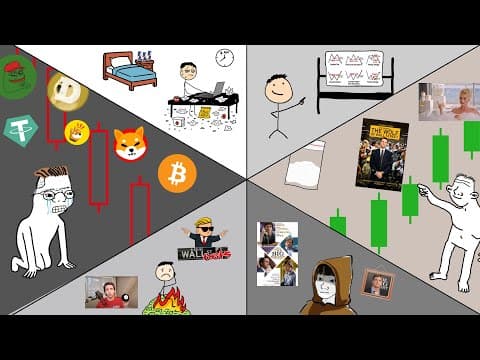
The video argues that social media spreads a pipeline dream by showcasing glamorous assets and winning screenshots while hiding the high failure rate and the real costs. This marketing encourages more people to try prop trading, sustaining the cycle of failures and firm profits.
Summary & Key Takeaways
-
Prop trading is presented as a shortcut to wealth but rests on a model where the house profits from traders failing.
-
The business model uses simulated accounts and profit splits funded by fees from participants who do not succeed.
-
Gambler's ruin explains why, over time, even disciplined traders are statistically likely to fail in this setup.
Read in Other Languages (beta)
Share This Summary 📚
Summarize YouTube Videos and Get Video Transcripts with 1-Click
Try YouTube Summary with ChatGPT & Claude or YouTube Transcript Generator
Explore More Summaries from Casual Finance 📚
Summarize YouTube Videos and Get Video Transcripts with 1-Click
Try YouTube Summary with ChatGPT & Claude or YouTube Transcript Generator