What Are the Main Investor Types on Wall Street?
TL;DR
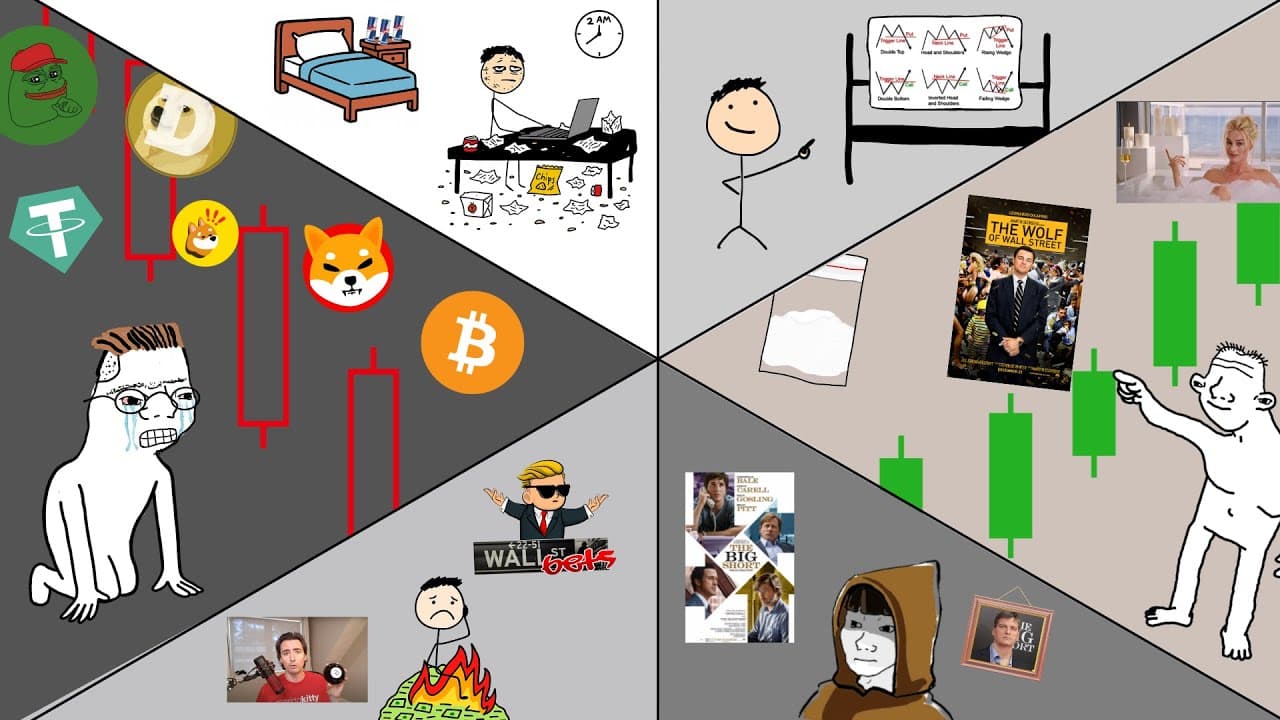
Investor identities often revolve around distinct habits, from studying intrinsic value and company filings to reading chart patterns, chasing meme assets, trading weekly options, or predicting a market collapse. The categories are exaggerated for comedy, but the central conclusion is serious: confidence, specialized language, and strong convictions do not mean anyone can reliably explain or predict the market.
Transcript
Wall Street, a place where the dumbest and brightest minds rejoice. It's a place where a guy with a PhD in quantum physics and a guy who eats crayons can come together and are united by one sacred truth. Nobody knows what the hell is going on. And today we are going to cover the six different types of investors on Wall Street. It's only right t... Read More
Key Insights
- Value investors are portrayed as Warren Buffett disciples who focus on moats, intrinsic value, compound growth, and detailed analysis of company filings. Their long-term orientation can also become a convenient response when someone asks about disappointing year-to-date performance.
- The self-styled entrepreneur is characterized by scattered speculation rather than a coherent investment strategy. His supposed income diversification includes sports betting, crypto meme coins, charging admission to parties, meme stocks, and a forex course, while motivational routines reinforce his Wall Street fantasy.
- Technical traders are depicted as interpreting stock charts through patterns and candlesticks while showing little interest in what the underlying companies do. The satire compares their chart drawings to art and emphasizes their rejection of fundamentals and conventional due diligence.
- Crypto speculators are portrayed as confusing early adoption with compulsive risk-taking. The featured caricature loses money in a Fartcoin rug pull, owns pixelated-animal NFTs, argues about blockchain and Web3, distrusts fiat currency, and still depends on his mother's Venmo.
- Options gamblers are characterized by concentrated weekly SPY calls, loyalty to Roaring Kitty, and nostalgia for GameStop's 2021 peak. They treat a 40% pullback as consolidation, call losses battle scars, ignore retirement accounts, and blame market manipulation when contracts expire worthless.
- Persistent market bears are portrayed as seeing bubbles everywhere and expecting systemic collapse. Inspired by The Big Short, the featured bear studies synthetic CDOs, stores water and canned beans, reviews old earnings reports, and continues predicting disaster after being wrong 137 times.
- Investor confidence is presented as unreliable because every personality uses its own language to defend uncertain decisions. Annual letters, candlestick patterns, blockchain terminology, motivational slogans, and crash forecasts can all create conviction without providing dependable knowledge of future market behavior.
- The video's central claim is that nobody knows exactly what is happening on Wall Street. Its six personalities are deliberately exaggerated, and the closing joke places careful value analysis and reckless pattern-based betting under the same broader condition of market uncertainty.
Install to Summarize YouTube Videos and Get Transcripts
Explore YouTube Video Summarizer or Get YouTube Transcript Extractor
Questions & Answers
Q: What types of investors are portrayed on Wall Street?
The video presents six exaggerated Wall Street personalities through their recognizable habits. These include the Warren Buffett-inspired value investor, a self-styled entrepreneur chasing assorted speculative income, a chart-focused technical trader, a crypto and NFT enthusiast, a weekly-options gambler, and a permanently bearish investor waiting for a major market collapse. The categories function as comedy rather than formal financial classifications.
Q: How are value investors portrayed in the video?
Value investors are portrayed as devoted followers of Warren Buffett who discuss moats, intrinsic value, and compound growth. The caricature spends 400 hours analyzing a company's 10-K and treats The Intelligent Investor with unusual reverence. When asked about year-to-date performance, however, he emphasizes investing for the long term, which the narration jokingly interprets as prolonged underperformance.
Q: Why does the technical trader ignore company fundamentals?
The technical trader believes charts and candlestick patterns contain the information needed to make decisions, so the underlying company's activities are treated as irrelevant. He uses 12 monitors, sees patterns everywhere, and dismisses fundamentals as outdated. The narration says he does not perform conventional due diligence but instead draws art, comparing his approach more closely to Picasso than to Warren Buffett.
Q: What investment habits define the crypto investor?
The crypto investor chases meme coins, owns 12 NFTs depicting pixelated animals, spends eight hours a day in Twitter Spaces, and argues about blockchain, Web3, and the future of finance. He lost his net worth in a Fartcoin rug pull but calls it a learning experience. He rejects fiat currency rhetorically while continuing to use his mother's Venmo.
Q: How is the weekly-options investor characterized?
The weekly-options investor pursues generational wealth by going all in on weekly SPY calls. He admires Roaring Kitty, remembers GameStop's 2021 peak, calls a 40% pullback consolidation, and describes losses as battle scars. He performs neither technical analysis nor earnings research, relying instead on feelings and blaming market manipulation when his options expire worthless.
Q: Why does the bearish investor keep predicting a crash?
The bearish investor treats The Big Short as a spiritual awakening and consequently sees bubbles throughout the market. He studies spreadsheets, synthetic CDOs, old earnings reports, and the possible fall of Western finance. Although the narration says he has been wrong 137 consecutive times, he continues believing that the market will crash and the Federal Reserve will eventually be exposed.
Q: What does the video say about diversified income streams?
The phrase diversified income streams is used sarcastically to describe a self-styled entrepreneur's unrelated and speculative activities. His examples include sports betting, crypto meme coins, and charging people $20 to enter his party. The same personality holds meme stocks and owns a forex trading course. The portrayal suggests that entrepreneurial language can make reckless behavior sound more deliberate than it is.
Q: What is the main conclusion about predicting the stock market?
The main conclusion is that nobody truly knows what is happening in the market, regardless of the identity or strategy they adopt. Reading Warren Buffett's annual letters does not create certainty, and neither does betting rent money on a supposed candlestick pattern. The closing message uses comedy to challenge the confidence displayed by value investors, traders, speculators, options gamblers, and bears alike.
Summary & Key Takeaways
-
Value investors are portrayed as patient Warren Buffett disciples who discuss moats, intrinsic value, and compound growth while spending hundreds of hours analyzing company filings. The comedy contrasts their serious long-term philosophy with possible underperformance and their tendency to answer questions about recent returns by emphasizing an extended investment horizon.
-
Several speculative personalities receive separate caricatures. One pursues meme stocks, forex courses, sports betting, crypto coins, and party income. Another relies on candlestick charts while dismissing fundamentals. Crypto enthusiasts chase meme coins and NFTs, while options gamblers make concentrated weekly bets based more on conviction than documented analysis.
-
The final personality is a persistent market bear who studies spreadsheets, calls nearly every asset a bubble, and repeatedly predicts a crash. After mocking every category, the conclusion rejects certainty itself: whether someone studies annual letters or wagers money on an invented chart pattern, nobody truly knows what is happening in the market.
Read in Other Languages (beta)
Share This Summary 📚
Summarize YouTube Videos and Get Video Transcripts with 1-Click
Try YouTube Summary with ChatGPT & Claude or YouTube Transcript Generator
Explore More Summaries from Casual Finance 📚

Summarize YouTube Videos and Get Video Transcripts with 1-Click
Try YouTube Summary with ChatGPT & Claude or YouTube Transcript Generator