How to build a solo SaaS that makes 40K/month
TL;DR
The product is a single purpose tool that generates 40K monthly recurring revenue with a solo founder and no employees. It started from a simple MVP, validated by user uploads, then grew through product improvements and organic growth after pausing paid ads. The story emphasizes lean startup principles and customer feedback over heavy marketing.
Transcript
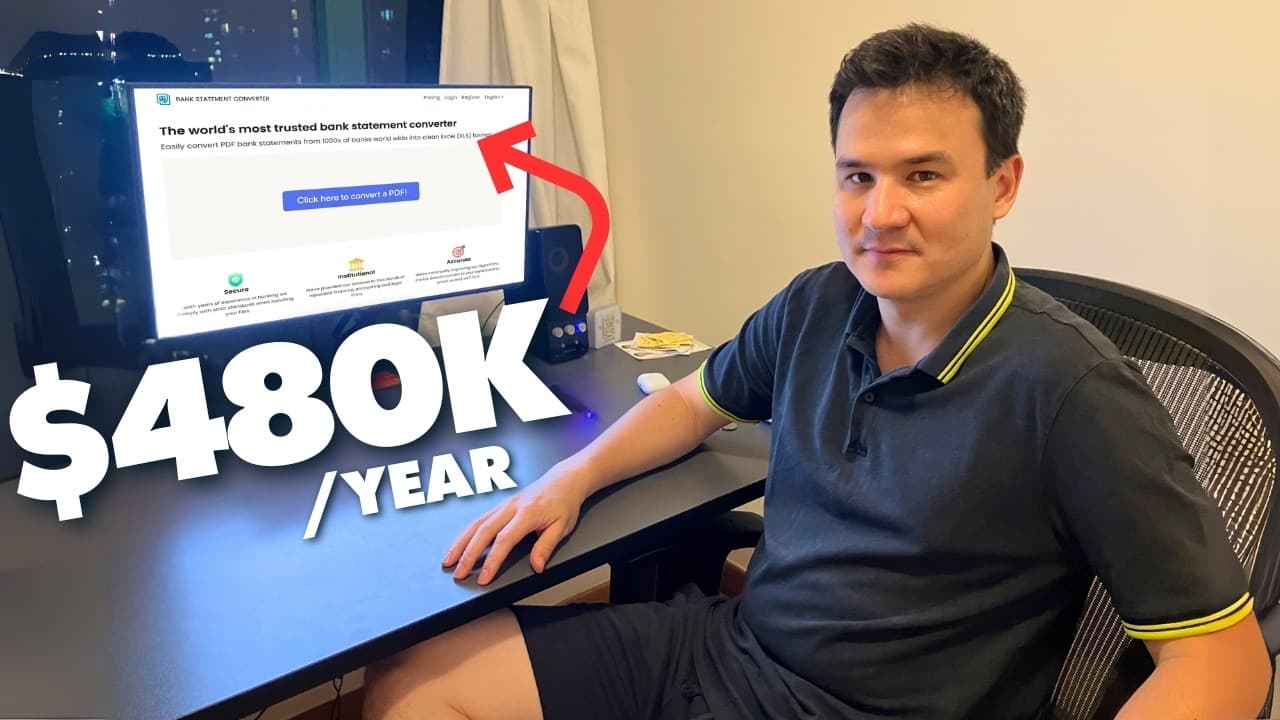
I built a simple website that makes 40K a month. This is Angus Chang. He lives in Hong Kong and he built the simplest website I've ever seen. I built a website that literally does one thing. And what's even crazier is that he operates this business entirely as a solopreneur. Solo founder, zero employees, 100% bootstrapped. I bootstrapped this entir... Read More
Key Insights
- The project does one thing and does it well, which simplifies development and user acquisition.
- A quick MVP with immediate real user feedback accelerates validation and reduces risk.
- Initial paid ads failed to be profitable, teaching the value of organic growth and product improvement.
- The lean startup approach centers on launching fast, learning from users, and iterating features based on real signals.
- Revenue scaled from 6K MRR in 2022 to 40K MRR by 2024, illustrating compounding validation and feature refinement.
- The founder operates as a solopreneur with full control over development, support, and marketing, highlighting a low overhead model.
- Public-facing strategies like blogging and cold emails were tried but had limited impact on acquiring paying users.
- Banking and finance considerations for startups are discussed, emphasizing tools that suit bootstrapped growth and scalability.
- More videos from this channel:
- More from this channel: Starter Story
Install to Summarize YouTube Videos and Get Transcripts
Explore YouTube Video Summarizer or Get YouTube Transcript Extractor
Questions & Answers
Q: How did Angus validate the Bank Statement Converter idea before building it?
Angus validated the idea by launching a minimal viable product quickly and putting it in front of real users. He and a friend produced a basic version in a week, then used Google ads to drive people to the domain where users could upload bank statements. The immediate user responses confirmed the core need and guided further development.
Q: What was the core framework or method Angus used to build the product?
Angus describes his approach as a lean startup method. He emphasizes building an MVP rapidly, releasing it to the target audience, and using real user feedback to decide which features to build next. If analytics show drop-offs or underused features, those areas are deprioritized in favor of customer-driven improvements.
Q: How did Angus grow the business from the MVP to 40K MRR?
After validating the concept, Angus focused on product improvements driven by customer feedback rather than paid advertising. He stopped expensive ad campaigns, observed organic signups rising, and concentrated on fixing issues raised by users. This pivot toward product-led growth and reliability boosted retention and revenue to 40K MRR.
Q: What marketing strategies did Angus try and how did they perform?
Angus experimented with Google search ads, blogging, building in public, and cold emails. Paid ads were not profitable in his case, yielding far fewer sales than spend. Blogging and public building attracted attention but did not translate into many users, while cold emails provoked negative responses and limited success.
Q: Why did Angus decide to stop paying for ads, and what happened next?
Angus stopped paying for ads after realizing the campaigns were unprofitable. He noticed that the users clicking the site became organic users, leading to a steady flow of new signups. This shift to organic growth came from focusing on user needs and improving the product based on feedback rather than chasing paid traffic.
Q: What are the personal pros and cons of a solopreneur lifestyle, according to Angus?
Angus notes that solopreneur life offers flexibility, such as a personal schedule and the ability to hike or set external rhythms. However, it can be lonely, especially when earnings are low, and other people may not understand the venture. The lack of a traditional team also influences social dynamics and day-to-day work priorities.
Q: What is Angus’s tech stack and how did he implement the core engine?
The core engine is written in Kotlin, with the frontend built in Next.js. The background service was deployed on AWS EC2. This stack reflects a practical, scalable solution for a single founder, enabling rapid iteration and a straightforward deployment process that supports a one‑person operation.
Q: What is the broader lesson from Angus’s journey for aspiring solo founders?
The key takeaway is that a single, well-targeted idea can become a sustainable business with disciplined execution. Start with a simple MVP, validate early with real users, and focus on product improvements guided by feedback. Avoid overreliance on ads and embrace a lean approach to growth and customer success.
Summary & Key Takeaways
-
The video explains a one‑purpose web app built by a solo founder that now earns 40K in monthly recurring revenue, showcasing a bootstrap, lean approach.
-
Angus validated the idea by launching a minimal viable product quickly and letting real users reveal needed features through feedback and usage data.
-
The journey covers the shift from ad dependent marketing to organic growth, the solo founder lifestyle, and the practical stack used to implement the product.
Read in Other Languages (beta)
Share This Summary 📚
Summarize YouTube Videos and Get Video Transcripts with 1-Click
Try YouTube Summary with ChatGPT & Claude or YouTube Transcript Generator
Explore More Summaries from Starter Story 📚
Summarize YouTube Videos and Get Video Transcripts with 1-Click
Try YouTube Summary with ChatGPT & Claude or YouTube Transcript Generator