How Julian Built Gravl to $400K/Month as a Fitness App
TL;DR
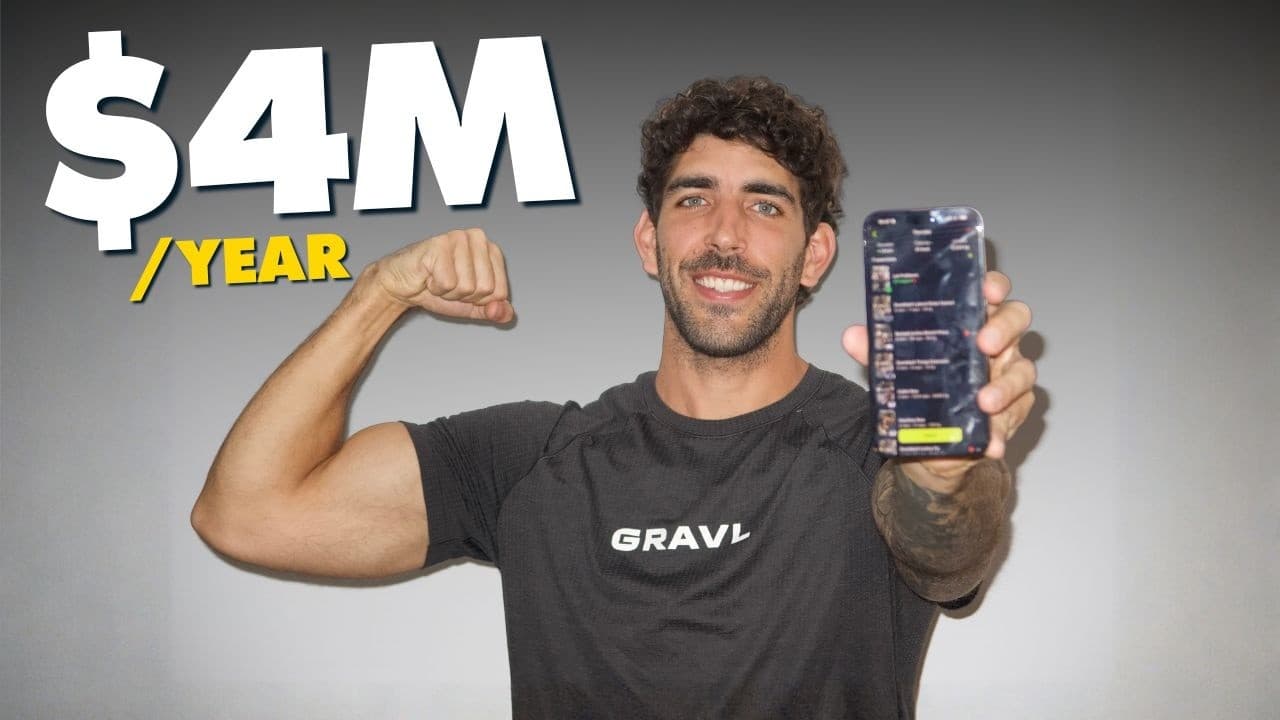
Julian, a developer from Argentina, built Gravl, an AI fitness app for gym strength training, after finding Fitbot's workouts weird and sometimes dangerous. He built the MVP in two to three months, launched via a Reddit thread that hit over 300,000 impressions, and scaled with paid ads to over 70,000 subscribers and more than $440K last month.
Transcript
Last month, we made over $440K. Meet Julian, a developer from Argentina who built an app that makes over $400,000 a month. But it didn't start that way. Before the success, Julian was a dude at the gym who discovered a different app that he thought was pretty cool. However, instead of just using it himself, he thought, "What if I built something be... Read More
Key Insights
- Gravl is an AI fitness app for gym strength training that launched around two years ago, now has over 70,000 subscribers, and made over $440K last month, roughly $4 million a year.
- The founding trigger was a competitor, Fitbot, whose UI Julian loved but whose workouts he found weird and even dangerous, prompting him to build the same UI/UX with a proper workout engine.
- The MVP took about two to three months and split into two parts: first a workout tracker like Hevy or Strong, then the harder Fitbot-style custom workout logic.
- Building custom workouts is the hardest part because of many settings and combinations, including equipment, weekly goal, gym frequency, consistency, gender, weight, and age.
- Reddit was the first distribution channel: a thread on how he built the app, then called Games AI, got a couple hundred likes within hours and over 300,000 impressions, bringing the first couple thousand users.
- Paid ads became the main growth engine, added alongside a subscription model; Julian got a subscription within the first 10 minutes of activating ads, spending less than $50 a day.
- Translating the app to Spanish and running ads in South America worked because Julian and Matias speak Spanish and those markets are cheaper and less competitive than the US.
- The app uses a hard paywall before first sign-in, and Julian says a lot of users actually pay before they see the product, after an AI-driven onboarding that generates a custom workout.
Install to Summarize YouTube Videos and Get Transcripts
Explore YouTube Video Summarizer or Get YouTube Transcript Extractor
Questions & Answers
Q: How much money does the Gravl app make?
Gravl made over $440K last month, which Julian describes as over $400,000 a month and roughly $4 million a year. The AI fitness app launched around two years ago and now has over 70,000 subscribers. Julian is one of the co-founders and the developer, and the app provides smart workouts designed specifically for strength training and gym sessions.
Q: What is the Gravl fitness app?
Gravl is an AI fitness app that provides smart workouts specifically designed for strength training and gym workouts. It adapts to the user by asking a series of onboarding questions covering why they want to use a fitness app, their experience level, one rep max for certain exercises, goals, training frequency, working split, excluded and focus muscles, and where they train, then generates a custom workout plan.
Q: Why did Julian decide to build Gravl?
Julian started with a plain workout tracker like Hevy or Strong but felt he was just copying existing apps and adding no value. A friend then showed him Fitbot, one of the biggest workout apps, whose interface he loved because it provided workouts on the spot. But after using it and researching, he found the workouts were weird and even a bit dangerous, which triggered him to build Fitbot's UI and UX with a proper workout engine.
Q: How long did it take to build the Gravl MVP?
The initial MVP took around two to three months. Julian splits it into two parts: a pre-Fitbot phase that was more of a workout tracker, and a post-Fitbot phase that got trickier. The hardest part was the business logic for building custom workouts, since there are many settings and combinations to consider, including equipment, weekly goal, gym frequency, consistency, gender, weight, and age.
Q: How did Julian get his first users for the app?
Julian used Reddit as a distribution channel, posting a thread on how he built the app, which was then called Games AI, sharing the technical specs. The thread got over a couple hundred likes within the first couple hours and over 300,000 impressions, bringing in the first couple thousand users. Many were developers who liked tech and found the gym intimidating, and they started sending feedback about bugs and feature requests.
Q: What marketing strategy scaled Gravl to $400K a month?
The biggest distribution was paid ads, which Julian started running once he added the subscription model, getting a subscription within the first 10 minutes of activating the ads. He then translated the app to Spanish and ran ads in South America while spending less than $50 a day. This combination of paid ads and cheaper Spanish-speaking markets worked from the start up until now.
Q: What are Julian's top tips for building mobile apps?
Julian gives five tips. First, validate before spending on ads, meaning confirm people are willing to pay, not just that the product works. Second, translate to and target cheaper markets like South America. Third, start small; you can pay creators as low as $50 and use AI tools or CapCut. Fourth, UGC is king since AI videos are cheap and easy to test. Fifth, copy competitors using the public Meta Ads library.
Q: Why did translating the app to Spanish help Gravl grow?
Julian and his partner Matias are both Spanish speaking, so translating the app into Spanish made sense for them. Running ads in South America is cheaper than in the US, where there is a lot of competition and ads are expensive. By translating and targeting South American markets while spending less than $50 a day, they found an approach that worked for them from the start up until this day.
Summary & Key Takeaways
-
Julian, a software engineer from Argentina now in Australia, previously ran an influencer marketing platform for mobile games that became a marketing agency. That work taught him user acquisition, marketing, and app revenue numbers, which led him and his partners to build their own fitness app, Gravl.
-
He first built a plain workout tracker but felt it added no value. After a friend showed him Fitbot, he loved the interface but judged the workouts weird and sometimes dangerous, so he committed to building Fitbot's UI and UX paired with a proper workout engine over a two to three month MVP.
-
Gravl launched via a Reddit thread that earned over 300,000 impressions and the first couple thousand users, then scaled through paid ads, Spanish translation, and cheaper South American markets, reaching over 70,000 subscribers and more than $440K last month behind a hard paywall onboarding flow.
Read in Other Languages (beta)
Share This Summary 📚
Summarize YouTube Videos and Get Video Transcripts with 1-Click
Try YouTube Summary with ChatGPT & Claude or YouTube Transcript Generator
Explore More Summaries from Starter Story 📚

Summarize YouTube Videos and Get Video Transcripts with 1-Click
Try YouTube Summary with ChatGPT & Claude or YouTube Transcript Generator