How to Rebuild a Proven SaaS Idea for Profit
TL;DR
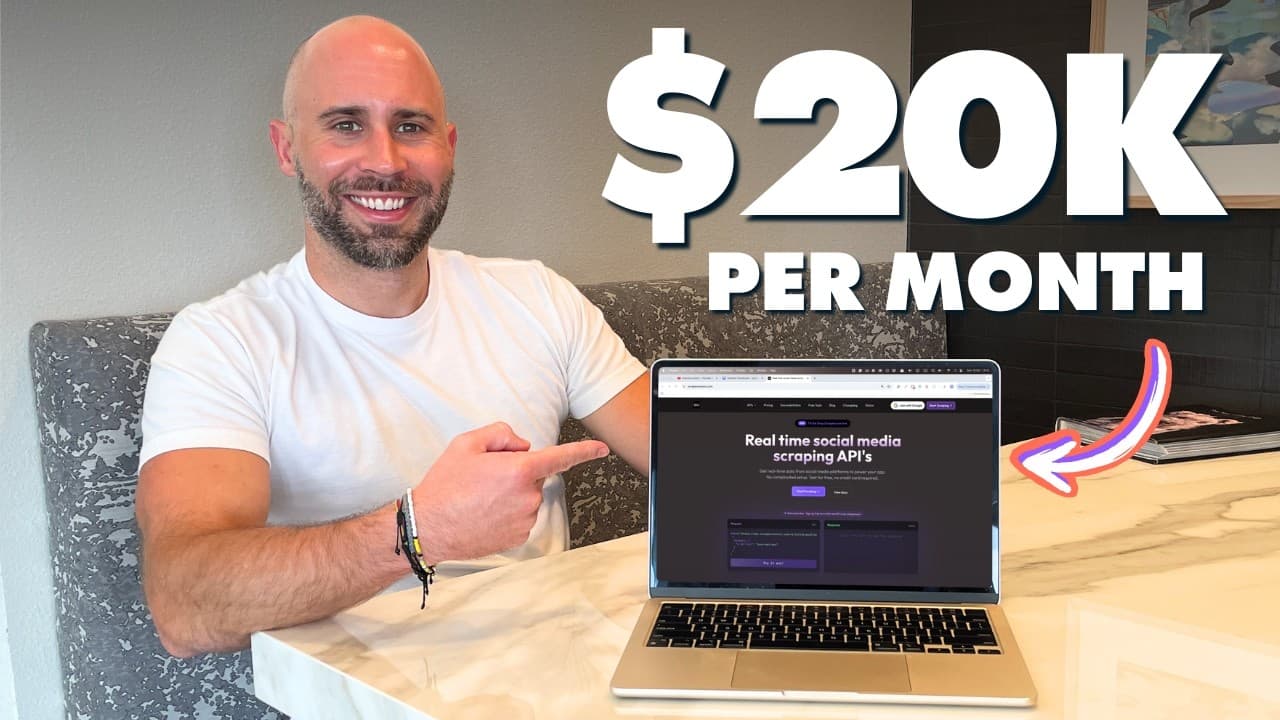
Start with a business that already makes money, confirm that its product and customer-acquisition model match your skills, then rebuild the concept without copying it word for word. Adrian Horning followed this approach with a social-media scraping API, launched a bare-bones version within weeks, and grew it to about $20,000 per month through Twitter visibility, direct outreach, and a small group of high-paying customers.
Transcript
The number one question I get is, "How do I come up with a good business idea?" But the truth is, you don't have to. And this video is proof. Meet Adrian, a solo developer from Austin who had a different approach. I copied a successful app and now it makes me $20,000 a month. A year ago, he saw a successful app for sale, but instead of buying it, h... Read More
Key Insights
- A proven marketplace listing can function as business validation. Adrian used the seller's revenue, operating history, customer count, and acquisition channel to judge demand before committing to development, reducing his reliance on an entirely original and untested idea.
- Founder-market fit was central to Adrian's decision. He had studied web scraping for three years, had already built relevant APIs, and understood social-media products, so he could reproduce the core functionality quickly and evaluate whether the technical demands were realistic.
- The original business showed attractive economics through concentration. It produced $30,000 in monthly recurring revenue with fewer than 100 customers, demonstrating that a scraping API did not need a large customer base to create substantial monthly income.
- Adrian's minimum viable product was intentionally bare-bones. He hosted existing JavaScript scrapers on a Node.js server through Render, placed documentation in a Notion page, built a basic website, and completed the initial version within a couple of weeks.
- Early customer acquisition came through visible, targeted participation on Twitter. Adrian's first customer followed a post in which he scraped a company's site, and he later offered 10,000 free credits to people launching products involving social-media scraping.
- Customer acquisition deserves as much investigation as product functionality. Adrian recommends examining marketplace descriptions, company websites, founders' social profiles, podcasts, and YouTube appearances to determine how an existing business attracts customers before rebuilding its concept.
- Copying a validated concept does not require duplicating its exact execution. Adrian advises builders to avoid copying websites or wording literally, while using the underlying product category, demonstrated demand, pricing logic, and customer-acquisition evidence to guide a distinct implementation.
- Consistent focus is part of the proposed execution strategy. After choosing a validated idea, Adrian recommends avoiding unrelated projects and doing something every day to improve or promote the product, because validation alone cannot replace sustained building and marketing.
Install to Summarize YouTube Videos and Get Transcripts
Explore YouTube Video Summarizer or Get YouTube Transcript Extractor
Questions & Answers
Q: How can you find a validated SaaS idea to rebuild?
Search a marketplace such as MicroAcquire or Acquire.com, filter for SaaS companies, and exclude listings that are not making money. Adrian suggests using an asking price of at least $300,000 or filtering by annual recurring revenue. Then focus on products related to a market or technical skill you already understand, because relevant experience makes both evaluation and implementation more practical.
Q: How did Adrian validate the scraping API opportunity?
Adrian examined evidence from an existing business rather than relying on personal confidence alone. The listed scraping API had operated for three years, generated $30,000 in monthly recurring revenue, acquired customers through SEO, and served fewer than 100 customers. Combined with his three years of scraping experience and his Twitter presence, those facts convinced him that he could build and market a comparable concept.
Q: How did Adrian build the first version of his SaaS?
Adrian used JavaScript and Node.js, drawing on scrapers he had already developed during three years of related work. He placed those scrapers on a Node.js server hosted through Render, wrote the API documentation in a Notion document, and created a basic website. The bare-bones product took only a couple of weeks to assemble, and he gained his first customer a few weeks later.
Q: How did Adrian get customers for his scraping API?
Adrian primarily used his visibility and activity on Twitter. His first customer appeared after he posted about scraping a company's site and its chief technology officer commented. He also watched for launch posts involving social-media scraping and offered their creators 10,000 free API credits. This targeted outreach placed the product directly in front of developers who already had a relevant use case.
Q: What does Scrape Creators do for its customers?
Scrape Creators provides APIs that collect public data from social-media platforms including Instagram, YouTube, and Twitter, as well as sources such as the Facebook and LinkedIn ad libraries. It is designed for developers who do not want to manage scraping infrastructure themselves. The service handles operational work such as proxy rotation and supports products including link-in-bio tools and short-form content analytics systems.
Q: How does the credit-based pricing model work?
The service uses pay-as-you-go credits instead of a recurring subscription. The transcript lists three options: $10 for 5,000 credits, $50 for 25,000 credits, and $500 for 500,000 credits. About 600 people have paid, although they do not necessarily purchase regularly. This means monthly revenue can be discussed operationally even though the customer relationship is not based on subscriptions.
Q: How can you research how an existing SaaS gets customers?
Start by reading everything available on the company's website and marketplace listing, especially references to growth or customer acquisition. Then investigate the founder through Twitter, LinkedIn, podcasts, and YouTube appearances. Adrian considers this one of the most important steps because building the product may be straightforward, while reproducing a workable route to customers can be substantially harder.
Q: What results did Adrian achieve with the rebuilt SaaS concept?
Adrian reports that the API generates about $20,000 per month and handles almost 20 million API requests each month. Roughly 600 people have made a payment, but a much smaller group drives most of the revenue. He estimates that around 12 customers account for the majority of monthly revenue, illustrating how a developer-focused API can work with relatively few high-value users.
Summary & Key Takeaways
-
Adrian found a successful scraping API through a listing on the MicroAcquire marketplace. Its $30,000 in monthly recurring revenue, three-year operating history, SEO-driven growth, and customer base of fewer than 100 convinced him that the demand was real and that a technically similar product could generate meaningful revenue.
-
His initial product was deliberately simple. Existing scrapers were placed on a Node.js server hosted through Render, the API documentation lived in Notion, and a basic website completed the launch. Because he had spent three years studying and building scraping systems, development required only a couple of weeks.
-
Growth came from Adrian's existing Twitter presence, public demonstrations, and direct offers of 10,000 free credits to founders launching social-media scraping products. The business now generates about $20,000 per month, processes almost 20 million API requests monthly, and has roughly 600 customers who have paid at least once.
Read in Other Languages (beta)
Share This Summary 📚
Summarize YouTube Videos and Get Video Transcripts with 1-Click
Try YouTube Summary with ChatGPT & Claude or YouTube Transcript Generator
Explore More Summaries from Starter Story 📚



Summarize YouTube Videos and Get Video Transcripts with 1-Click
Try YouTube Summary with ChatGPT & Claude or YouTube Transcript Generator