How to run a product team like a research lab
TL;DR
Separate a labs team from the product team to explore frontier AI while the product team improves what works. Keep labs tiny, ideally one or two people, pairing pirates with architects. Run many parallel experiments and use a tight feedback loop, preferably by dogfooding, so learnings can flow into the main product.
Transcript
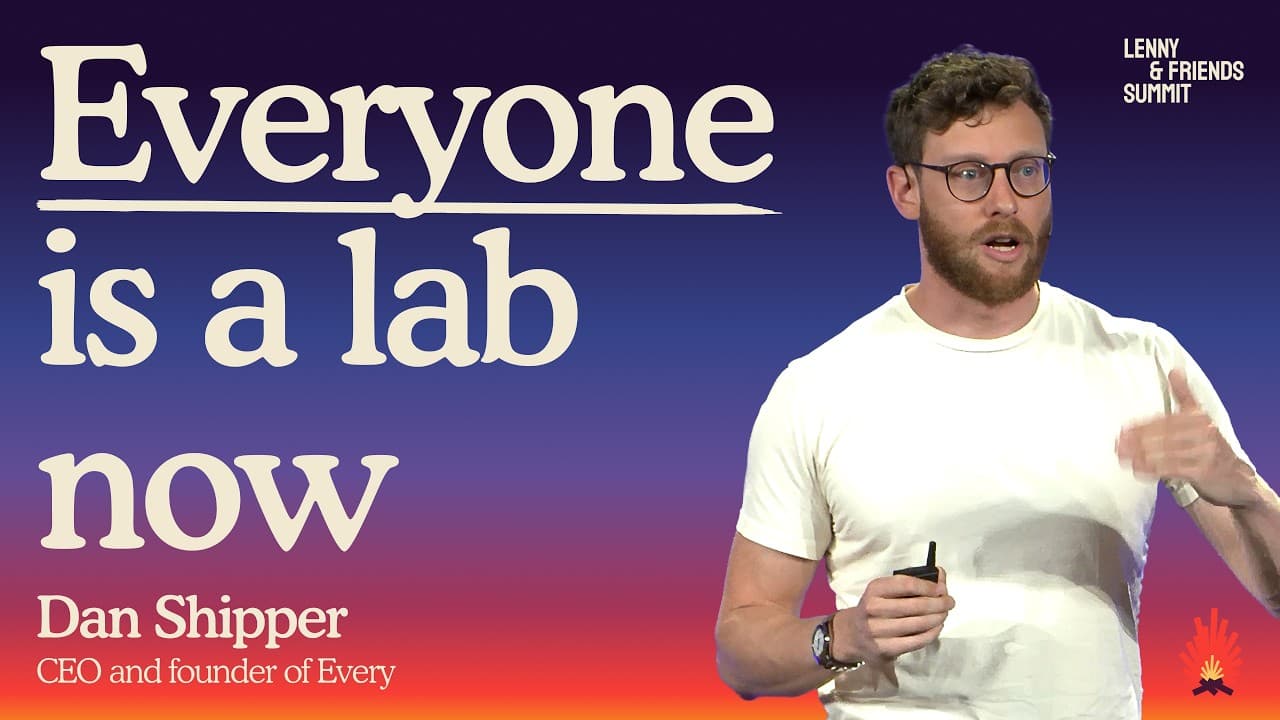
Okay. So, I'm going to talk about how to build products on a moving frontier. Um, or as I like to call it, the unreasonable ineffectiveness of business as usual during technology revolutions and what to do about it. So, the world just changed. The world just changed again. Uh, we had Fable 5.1 launched last week. We had Astra 6 launched last week. ... Read More
Key Insights
- Labs teams separate exploration from execution to prevent distraction in delivery while still advancing frontier capabilities.
- A tiny labs team, ideally one or two people, is enough to explore rapidly and avoid heavy coordination overhead.
- Pirates and architects pairing pairs a value-driven explorer with a system builder to balance speed and robustness.
- Early adopters in the lab role help identify valuable directions without derailing the product team.
- Dogfooding tightens the feedback loop by using the lab output within the company or with early customers.
- Parallel experiments, even competing approaches, map the frontier more effectively than a single path.
- The frontier mindset is enabled by models like Astra and Fable, which expand what can be tested quickly.
- Products should bring the most successful lab learnings into the main product to improve existing offerings.
Install to Summarize YouTube Videos and Get Transcripts
Explore YouTube Video Summarizer or Get YouTube Transcript Extractor
Questions & Answers
Q: How can a company structure its teams to balance exploration and execution?
Create a labs team separate from the product team, with a focus on exploring frontier AI capabilities and running many experiments in parallel. Keep the labs team very small, ideally one or two people, so they can move quickly without creating heavy coordination overhead. The product team then focuses on improving and scaling what already works for existing customers. This split lets you harness early adopters' creativity without distracting the main delivery.
Q: What roles组成 the ideal labs team, and how do they interact?
The ideal labs team uses a pirate who pursues value through rapid, exploratory work and an architect who reshapes messy experiments into scalable, useful solutions. The pirate pushes boundaries and tests many ideas, while the architect ensures the resulting work is coherent and extensible. Together, they move fast, yet maintain a path toward practical applications.
Q: Why is dogfooding important in a labs setup?
Dogfooding creates a tight feedback loop by using lab outputs within the company or with early adopters, allowing the team to quickly see what works in real work. This immediate feedback helps distinguish useful experiments from distractions, accelerating learning and ensuring that investments in frontier capabilities translate into real product improvements.
Q: How should experiments be organized in a labs team?
Organize many experiments in parallel, even if several aim to solve the same problem, to map the frontier effectively. Different approaches can reveal which methods perform best under real-world pressures. This variety helps identify valuable directions and prevents the team from converging on a single, potentially suboptimal solution too early.
Q: What is the recommended team size for a labs setup and why?
Aim for a two slice team, meaning one or two people maximum. Smaller teams reduce coordination overhead, speed up decision making, and enable more rapid iteration. With one or two people, you can test ideas quickly, throw away failures faster, and maintain a clean separation between exploration and product delivery.
Q: How do labs outputs transition into the main product?
Labs outputs should be evaluated for usefulness and scaled into the main product only if they meet customer needs and fit the roadmap. The product team should adopt a small portion of lab learnings, roughly 10 percent, to improve the existing offering, while the majority of experiments remain exploratory and disposable.
Q: What is the role of early adopters in the labs model?
Early adopters on the team help identify promising directions by engaging in frontier experiments, running Astra and similar tools, and testing new capabilities during non-work hours if possible. Their enthusiasm and firsthand experience with emerging tech provide valuable insights that guide the labs toward ideas with real potential for the product.
Q: What examples illustrate successful labs origins in the industry?
Successful labs origins include Enthropic Labs, where projects like Claude Code and other products emerged before being integrated into broader offerings. The idea is to separate the exploratory work from core product development, invest in promising results, and scale the winners, keeping the rest as learning experiments that inform future directions.
Summary & Key Takeaways
-
A labs approach separates exploration from execution so a product can advance without derailing established work. It emphasizes a dedicated tiny team, rapid experiments, and direct feedback to inform the main product roadmap.
-
The talk highlights practical structuring, including one or two person labs, the pirates and architects pairing, and dogfooding as a core feedback mechanism to accelerate learning.
-
The overall message is to adopt a research mindset within product development, leveraging frontier models to push capabilities while maintaining steady delivery for customers.
Read in Other Languages (beta)
Share This Summary 📚
Summarize YouTube Videos and Get Video Transcripts with 1-Click
Try YouTube Summary with ChatGPT & Claude or YouTube Transcript Generator
Explore More Summaries from Lenny's Podcast 📚



Summarize YouTube Videos and Get Video Transcripts with 1-Click
Try YouTube Summary with ChatGPT & Claude or YouTube Transcript Generator