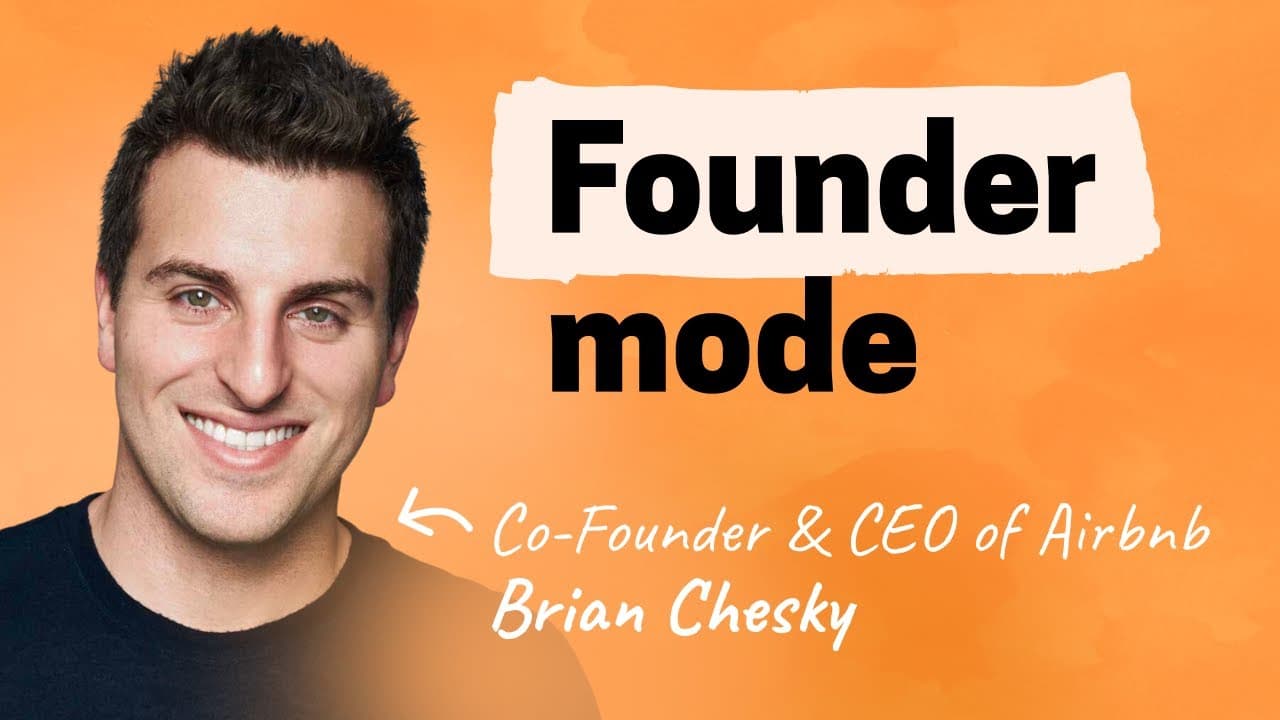
Brian Chesky on Product Management and Founder Mode
TL;DR
Airbnb did not eliminate its product managers. It merged product management with product marketing, moved program management work to real program managers, and made the group smaller and more senior. Brian Chesky argues leaders must be in the details, which differs from micromanagement, and that founders should stop compromising on how they run the company because people want clarity above all.
Transcript
Way too many founders apologize for how they want to run the company. They find some midpoint between how they want to run a company and how the people they lead want to run the company. That's a good way to make everyone miserable. Because what everyone really wants is clarity. And what everyone really wants is to be able to row in the sam... Read More
Key Insights
- Being in the details is different from micromanagement. Micromanagement means telling people exactly what to do, while being in the details means knowing enough about the work to judge whether people are doing a good job, much as a responsible board does with its CEO.
- Founders who compromise between their own vision and the preferences of the people they lead tend to make everyone miserable. Chesky argues that what everyone really wants is clarity and the ability to row in the same direction quickly.
- Airbnb did not get rid of product people. It combined the inbound product development responsibilities of product managers with the outbound marketing responsibilities of product marketing into one smaller, more senior function.
- Many people with a product management title are actually doing program management. Airbnb moved much of that program management work to dedicated program managers so the product function could focus on the product and the market.
- You cannot build a product unless you know how to talk about it. Chesky argues that being an expert in making a product requires also being an expert in its market, because a great product nobody knows about barely counts as built.
- When a launch fails, teams should ask whether it was a bad product, a bad strategy, or bad execution. A well-made product can still fail simply because there was no distribution plan and no way to talk about it.
- Airbnb runs a fairly purely functional model in which product marketers manage by influence rather than control. They do not control or drive design or engineering, and Chesky says the company is designed so that no one has to like you to get work done.
- Chesky believes many Silicon Valley designers are frustrated because design is treated as a service organization that catches problems before launch. He says some well-known heads of design have become design administrators rather than designers, which is bad for everyone building products.
Install to Summarize YouTube Videos and Get Transcripts
Explore YouTube Video Summarizer or Get YouTube Transcript Extractor
Questions & Answers
Q: Did Airbnb eliminate product management?
No. Brian Chesky says Airbnb did not get rid of the people who help drive the product. It no longer has the traditional product management function, but instead combined the inbound product development responsibilities of product managers with the outbound marketing responsibilities of product marketing. It also moved program management work to program managers and made the group smaller and more senior.
Q: What is the difference between micromanagement and being in the details?
According to Brian Chesky, micromanagement means telling people exactly what to do, while being in the details means understanding the work closely enough to know whether people are doing a good job. He compares it to how a responsible board treats a CEO: the board knows the details without dictating decisions. He argues you cannot judge performance if you are not in the details.
Q: Why did designers cheer when they thought Airbnb removed product management?
Chesky believes the cheering at Figma Config, from about 5,000 designers, reflected deep frustration with the product development process in Silicon Valley. Many designers feel they are compromising, and design is often treated as a service organization that catches issues before release rather than being part of development. He says this hurts designers, product managers, and engineers alike.
Q: Why should product builders also know how to market the product?
Chesky argues you cannot build a product unless you know how to talk about it, and you cannot be an expert in making the product unless you understand its market. Many companies ship something, see it fail, and conclude the idea did not work, when the real issue was no distribution plan. If nobody knows about a great product, it is as if it was never built.
Q: How should teams diagnose a failed product launch?
Chesky suggests asking whether the failure came from a bad product, a bad strategy, or bad execution. Teams often say they tried something and it did not work, but a well-made product may have failed only because there was no distribution plan and no way to talk about it. Separating these causes avoids abandoning good ideas for the wrong reason.
Q: How do product marketers at Airbnb work with design and engineering?
At Airbnb, product marketers do not control or drive design or engineering. The company uses a fairly purely functional model, and the product marketers manage by influence rather than authority. Chesky says Airbnb designed the company so that people can manage by influence without anyone having to like them, meaning they do not need to win people over personally to get things done.
Q: Why should founders stop compromising on how they run their company?
Chesky says too many founders apologize for how they want to run the company and settle on a midpoint between their own approach and what the people they lead prefer. He calls this a good way to make everyone miserable. What people really want is clarity and the ability to row in the same direction quickly, which compromise tends to undermine.
Q: What happened to program management work at Airbnb?
Chesky notes that many people holding a product management title are really doing program management. As part of restructuring, Airbnb offboarded much of that program management work from product managers to actual program managers. This let the remaining, smaller and more senior product group concentrate on understanding the product and how to talk about it in the market.
Summary & Key Takeaways
-
Brian Chesky, CEO and co-founder of Airbnb, which grew from his apartment into an $80 billion business across 220 countries, explains what really happened to product management at Airbnb. After a talk at Figma Config, people believed he had eliminated the function, and 5,000 designers in the room cheered at the idea.
-
Chesky clarifies that Airbnb kept the people but changed how they work. Product management merged with product marketing, program management tasks went to actual program managers, and the group became smaller and more senior. These product marketers manage by influence, not control, inside a functional organization where design and engineering are separate.
-
Chesky also describes his leadership approach: leaders must be in the details, which he distinguishes from micromanagement. He warns founders against apologizing for how they want to run the company, since compromise makes everyone miserable, and he argues designers are frustrated because Silicon Valley treats design as a late-stage service function.
-
The conversation also covers Airbnb's single company-wide roadmap, shifting away from paid growth toward building the best product and telling people about it, and Chesky's personal approach to balance, avoiding burnout, and continuing to learn.
Read in Other Languages (beta)
Share This Summary 📚
Summarize YouTube Videos and Get Video Transcripts with 1-Click
Try YouTube Summary with ChatGPT & Claude or YouTube Transcript Generator
Explore More Summaries from Lenny's Podcast 📚


Summarize YouTube Videos and Get Video Transcripts with 1-Click
Try YouTube Summary with ChatGPT & Claude or YouTube Transcript Generator