How to Find Hidden Growth Opportunities in Your Product
TL;DR
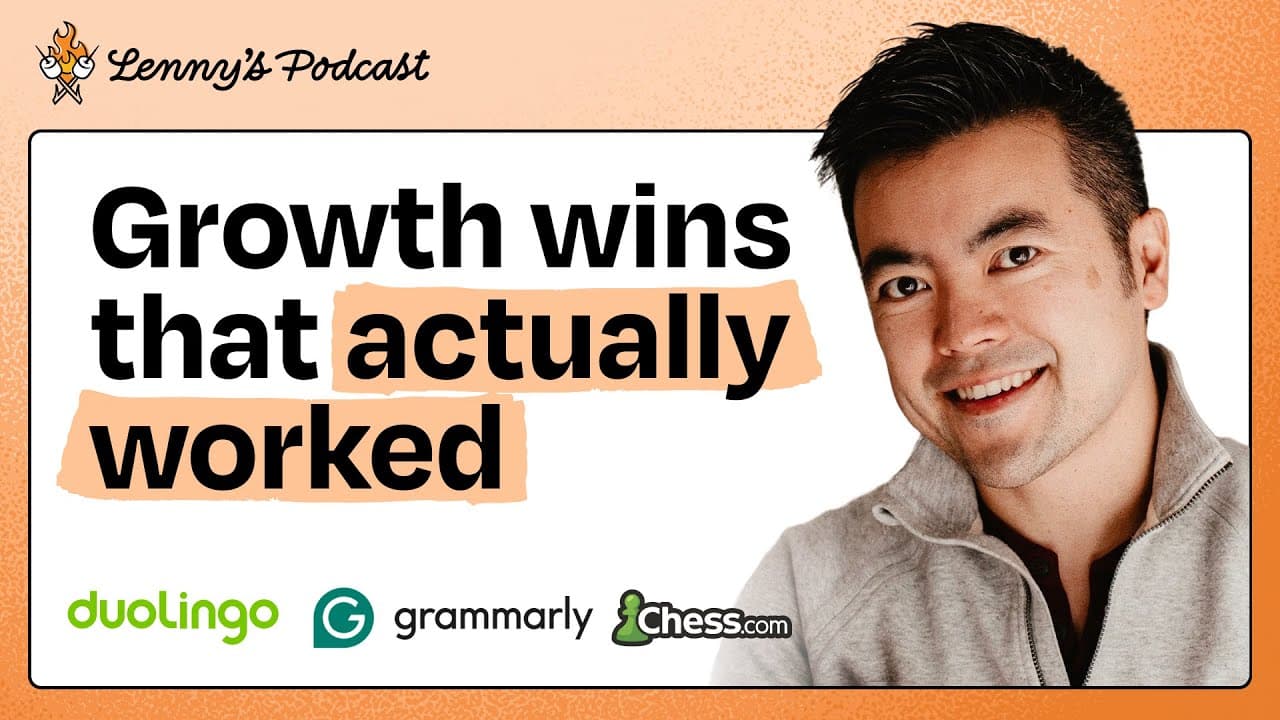
Growth's core job is to connect users to the value of your product, not to hack metrics. At Grammarly, sampling paid suggestions and interspersing them into free users' writing made people see the tool as far more powerful, driving a major monetization win. User retention is the real gold for consumer subscription products.
Transcript
growth as the job is to connect users to the value of your product. Growth sometimes gets this reputation that it's just pure metrics hacking. You've worked at three of the most successful consumer subscription products in the world. What do you think is the biggest missing piece that people don't get about building a successful consumer subscripti... Read More
Key Insights
- Growth as a job is to connect users to the value of your product, countering its reputation as pure metrics hacking; the goal is helping users experience what the product can actually do for them.
- User retention is gold for consumer subscription companies. If you don't retain users, most of the onus falls on getting them to pay on day one, which is a far weaker position.
- Grammarly's biggest monetization win came from realizing free users experienced it only as a spelling and grammar fixer, because those were the only free suggestions they ever saw.
- Sampling a number of different paid suggestions and interspersing them into free users' writing made people suddenly see Grammarly as a much more powerful tool than before, unlocking upgrades.
- The highest performers often had very high agency, fast clock speed, and energy, but did not necessarily have deep experience in the subject matter they were working on.
- Experience can be a crutch, especially in a world where the ground shifts fast with AI, because many learned habits actually need to be intentionally discarded to adapt.
- The explore and exploit framework, learned via a Grammarly engineering partner and traced to Reforge and possibly Brian Balfour, structures how to find and scale growth opportunities.
- Music and growth both rely on consistent repetition, tight feedback loops, and resilience to constant mistakes, while also needing creativity layered on top of a structural underpinning.
Install to Summarize YouTube Videos and Get Transcripts
Explore YouTube Video Summarizer or Get YouTube Transcript Extractor
Questions & Answers
Q: What is the real job of growth according to Albert Cheng?
Albert Cheng defines growth as connecting users to the value of your product. He notes that growth sometimes gets a reputation for being pure metrics hacking, but he pushes back on that view. The real work is helping users actually experience and understand what the product can do for them, so they recognize its value rather than being manipulated through numbers alone. This framing shaped his approach across Duolingo, Grammarly, and Chess.com.
Q: Why is user retention so important for consumer subscription products?
According to Cheng, user retention is gold for consumer subscription companies. If you don't retain your users, then a lot of the onus falls on getting them to pay on day one, which is a much harder and weaker position to operate from. Retaining users gives a company more opportunities over time to demonstrate value and convert people to paid, rather than betting everything on an immediate first-day payment. This makes retention central to a healthy subscription business.
Q: How did Grammarly achieve its biggest monetization win?
Cheng explains that the lived product experience for most free Grammarly users was that it was just a tool to fix spelling and grammar, because those were the only free suggestions they saw. The team asked what would happen if they sampled a number of different paid suggestions and interspersed them into free users' writing. Suddenly, people saw Grammarly as a much more powerful tool than before, which drove a significant monetization win by revealing the product's fuller value.
Q: What is the most counterintuitive lesson Albert Cheng learned about building teams?
Cheng says some of the highest performers were people with very high agency, fast clock speed, and energy, but who did not necessarily have deep experience in the subject matter. He found that experience could sometimes be a crutch, especially in a world where the ground is shifting fast with AI. In that environment, many learned habits actually need to be intentionally discarded, so raw agency and adaptability can outweigh accumulated expertise.
Q: What is the explore and exploit framework and where did it come from?
The explore and exploit framework is Cheng's approach to finding growth opportunities. He says he initially came up with or heard about it through his engineering partner at Grammarly, who had taken some Reforge classes. He suggests the original inventor might be Brian Balfour. The framework informs how he thinks about balancing the search for new growth opportunities against scaling and optimizing existing ones across the companies and products he works on.
Q: Why can experience be a disadvantage in a fast-changing, AI-driven environment?
Cheng argues that experience can be a crutch, especially in a world where the grounds are shifting so fast with AI. A lot of your learned habits actually need to be intentionally discarded because they may no longer apply. That is why he valued high performers with agency, clock speed, and energy who could adapt quickly, rather than only those with deep prior experience. In rapidly changing conditions, the ability to unlearn and adjust becomes more valuable than established expertise.
Q: What does Albert Cheng see as the connection between music and growth?
Cheng, a serious pianist earlier in life, sees two links. First, both music and growth rely on consistent repetition, tight feedback loops, and resilience to making mistakes constantly, since learning happens through those mistakes. Second, both have a structural underpinning: growth has a growth model, metrics, experiments, and channels, while music has theory and scales, yet both also require day-to-day creativity, passion, and flow to produce something interesting and beautiful.
Q: Which companies has Albert Cheng led growth at, and what is his experimentation goal?
Albert Cheng led growth and monetization at Duolingo, Grammarly, and now Chess.com, three of the most successful and beloved consumer subscription products. Earlier in his career at YouTube, he worked on streaming and gaming features used by over 20 million people. His approach blends marketing, data, strategy, and product management. One notable ambition mentioned is that his goal at every company is to run 1,000 experiments a year, reflecting his emphasis on rapid experimentation to find growth.
Summary & Key Takeaways
-
Albert Cheng led growth and monetization at Duolingo, Grammarly, and Chess.com, three of the most successful consumer subscription products. He frames growth's true job as connecting users to a product's value rather than hacking metrics, and treats user retention as the gold standard for consumer subscription businesses.
-
At Grammarly, most free users experienced the product only as a spelling and grammar fixer because those were the free suggestions. By sampling paid suggestions and interspersing them into free users' writing, the team made people see Grammarly as far more powerful, producing a major monetization win.
-
On teams, Cheng found the highest performers had high agency, fast clock speed, and energy rather than deep subject expertise. Experience can become a crutch as AI shifts the ground, so learned habits sometimes must be discarded. His explore and exploit framework guides finding growth opportunities.
Read in Other Languages (beta)
Share This Summary 📚
Summarize YouTube Videos and Get Video Transcripts with 1-Click
Try YouTube Summary with ChatGPT & Claude or YouTube Transcript Generator
Explore More Summaries from Lenny's Podcast 📚






Summarize YouTube Videos and Get Video Transcripts with 1-Click
Try YouTube Summary with ChatGPT & Claude or YouTube Transcript Generator