What is utilitarianism and why does it matter?
TL;DR
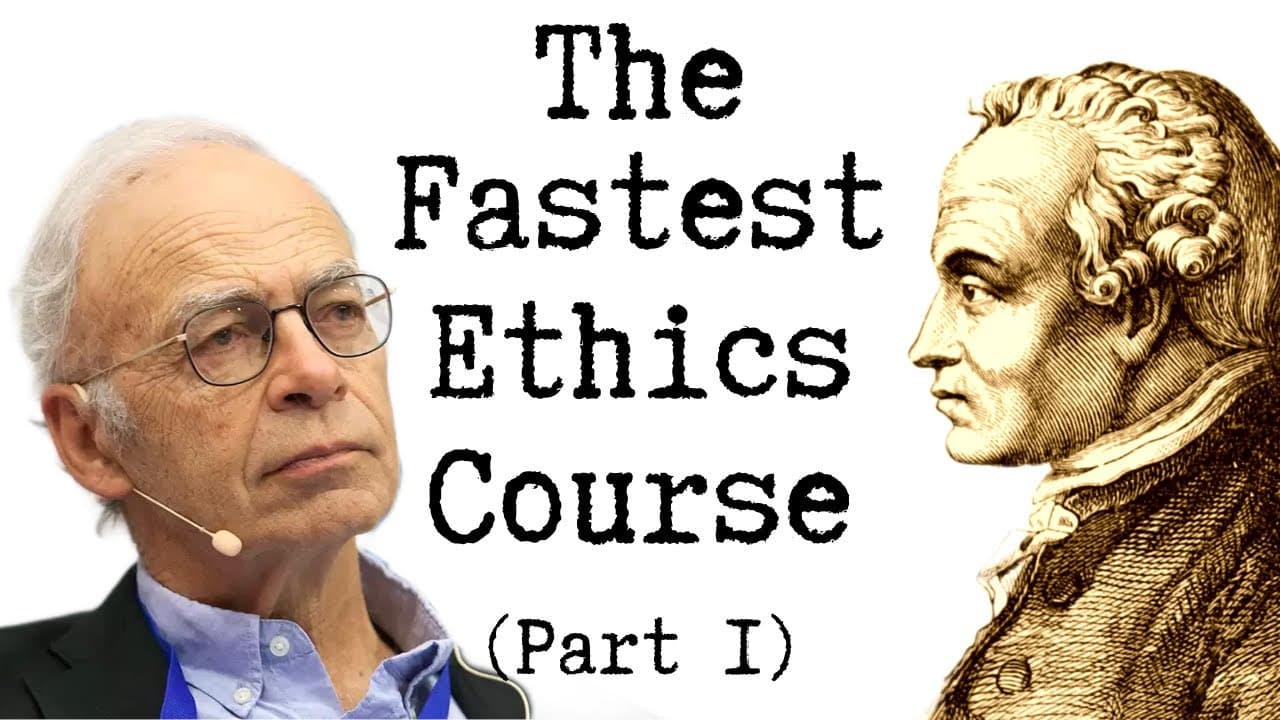
Utilitarianism judges actions by their consequences, valuing overall pleasure over pain and treating all pleasure equally. The theory faces objections like the experience machine and scenarios where framing an innocent person could reduce harm, highlighting limits of simple arithmetic morality. The video also contrasts consequentialism with Kantian ethics and introduces broader moral questions about objective moral facts and human goods.
Transcript
i'm a professor of philosophy at this university i'm going to take my entire introduction to ethics course which usually takes a whole semester and condense it down into one video i'm going to edit this video fast jeremy bentham looked like this he was born in london in 1748 and he introduced a moral theory an ethical theory called utilitarianism u... Read More
Key Insights
- Utilitarianism is a consequentialist theory where the moral value of actions is determined by outcomes, specifically the total pleasure minus pain for all affected.
- Benthams principle of utility treats all pleasures as equal in value, focusing on the amount of satisfaction produced rather than the quality or type of pleasure.
- The arithmetic theory of morality quantifies moral worth by adding up pleasure and pain, but it can yield counterintuitive results in cases like framing an innocent person to prevent a riot.
- The experience machine thought experiment challenges hedonism by suggesting that experiential pleasure alone may not be sufficient for a good life.
- Nozicks critique implies that there are goods beyond pleasure, such as control, authentic relationships, and meaningful action.
- Utilitarianism faces historical critiques including issues of sexual rights and the morality of punishment in cases like the sheriff example.
- The video hints at the difference between utilitarianism and Kantian ethics, emphasizing non-consequentialist critiques of moral law and duties.
- Peter Singer's famine relief argument radicalizes moral obligation by proposing significant giving to alleviate global poverty and famine.
- More videos from this channel:
- More from this channel: Jeffrey Kaplan
Install to Summarize YouTube Videos and Get Transcripts
Explore YouTube Video Summarizer or Get YouTube Transcript Extractor
Questions & Answers
Q: What is utilitarianism and how does it judge actions?
Utilitarianism is a moral theory that evaluates actions by their consequences, specifically aiming to maximize overall pleasure and minimize pain for everyone affected. It treats each person's happiness as equally important, regardless of who experiences it. The theory implies that the right action is the one that produces the greatest net balance of good over bad outcomes, across all affected individuals.
Q: What is the experience machine thought experiment and what does it show?
The experience machine is a thought experiment where one could plug into a device that generates perfect sensory experiences of pleasure without real-world activities. Most people would refuse lifelong immersion in the machine, suggesting that true goods beyond mere pleasure exist, such as autonomy, meaningful relationships, and actual accomplishments, which argue against hedonism as a complete account of well being.
Q: Why does Nozick argue that pleasure alone might not matter for a good life?
Nozick argues that if one would choose authenticity and control over always experiencing pleasure, there are goods beyond pleasure that contribute to a good life. The preference for real actions, genuine friendships, and being in charge of one’s life implies that fulfillment comes from aspects beyond the feel of pleasure, challenging a pure utilitarian framework.
Q: What is Bentham's utilitarian view on equality of pleasure and examples cited?
Bentham’s utilitarian view, often described as the arithmetic theory of morality, holds that all pleasures and pains count equally when assessing actions. It does not distinguish between types of pleasure; what matters is the amount of overall happiness produced for everyone involved, leading to egalitarian considerations in moral calculations.
Q: What counterexample challenges utilitarianism according to the lecture?
A classic counterexample is the sheriff who must decide whether to frame an innocent person to prevent a riot and save many lives. Utilitarianism would justify framing the innocent person to maximize overall happiness, but this outcome conflicts with common moral intuitions about justice, showing that simple calculations may fail to capture moral wrongdoing.
Q: How does the lecture introduce Kant and Aristotle in relation to utilitarianism?
The lecture briefly mentions Kant as a contrasting non consequentialist framework where moral duties are not solely about outcomes, and then introduces Aristotle, Nietzsche, and other thinkers to broaden the discussion of ethics beyond pure consequences, suggesting that morality includes character, virtues, and rational principles that may resist simple outcome calculations.
Q: What is Singer’s famine relief argument about giving to the needy?
Singer argues that people in affluent societies are morally obliged to give resources that would prevent suffering or death from famine, suggesting that money spent on luxuries should be redirected to effective aid organizations. This radical moral claim reframes charity as an obligation rather than a voluntary act of generosity within a global context.
Q: What is the broader aim of the course condensed in the video, and which philosophers are mentioned?
The course aims to introduce foundational debates in ethics by surveying philosophers like Plato, Aristotle, Hobbes, Hume, Bentham, Locke, Kant, Nietzsche, Nozick, Singer, and O Neill. It covers questions about objective moral facts, the value of morality, and how different theories apply to real world situations, while offering a concise survey of major ethical traditions.
Q: What is meant by the term counterexample in philosophy, as referenced in the video?
A counterexample in philosophy is a specific case or scenario that demonstrates a flaw or exception to a theory, challenging its universal applicability. By presenting situations where a theory yields undesirable or contradictory results, counterexamples help philosophers refine or reject problematic moral frameworks and push for more robust principles.
Summary & Key Takeaways
-
Utilitarianism is a consequentialist theory where the moral worth of an action rests on its outcomes, specifically the balance of pleasure and pain for everyone affected. The video situates utilitarianism within a broader debate about moral theory and foreshadows later contrasts with Kantian ethics and rule-based approaches.
-
A key challenge discussed is whether pleasure alone can capture what matters to human life, illustrated by thought experiments like the experience machine, which suggests other goods such as autonomy and genuine relationships matter beyond pleasure.
-
The lecture also traces historical figures like Bentham, Nozick, and Singer to show how utilitarian ideas confront issues like morality of social policies, sexual ethics, and global famine relief, setting up questions about moral duties in real-world contexts.
Read in Other Languages (beta)
Share This Summary 📚
Summarize YouTube Videos and Get Video Transcripts with 1-Click
Try YouTube Summary with ChatGPT & Claude or YouTube Transcript Generator
Explore More Summaries from Jeffrey Kaplan 📚





Summarize YouTube Videos and Get Video Transcripts with 1-Click
Try YouTube Summary with ChatGPT & Claude or YouTube Transcript Generator