Master Memory: Use Mnemonic Cues & Spaced Repetition
TL;DR
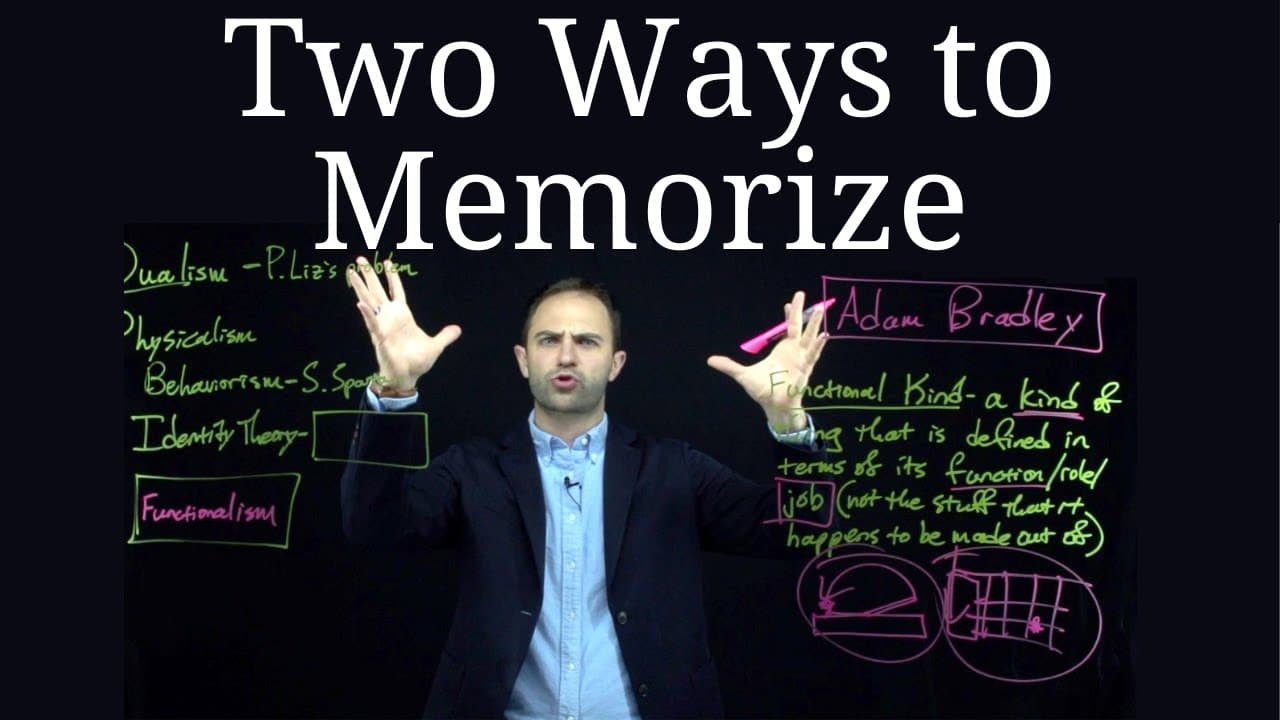
Mnemonic cues and spaced repetition are two powerful techniques for improving memory retention. By creating vivid associations and reviewing material at increasing intervals, you can effectively enhance your ability to recall information for academics or daily life.
Transcript
science has discovered two exactly two ways to memorize things mnemonic cues and spaced repetition when i say mnemonic q i mean an association like a story when you do this properly what happens is that you see the symbol and then that causes you to recall the story that you told yourself or whatever and the story causes you to recall the other pie... Read More
Key Insights
- 👶 Mnemonic cues help with memory retention by creating associations or stories that connect new information with existing knowledge.
- 💁 Spaced repetition involves reviewing information at intervals, emphasizing unfamiliar or difficult material.
- 👾 Mnemonic cues and spaced repetition are highly effective memory techniques that can be used for various types of information.
- 🗂️ Implementing spaced repetition using index cards is a simple and efficient method.
- 👾 Mnemonic cues and spaced repetition can significantly improve memory and retention in academic and everyday life situations.
- 🧠 Understanding the brain's natural inclination to remember stories and connections is crucial for effective memorization.
- 👾 Mnemonic cues and spaced repetition are often underutilized despite their proven effectiveness.
Install to Summarize YouTube Videos and Get Transcripts
Explore YouTube Video Summarizer or Get YouTube Transcript Extractor
Questions & Answers
Q: How do mnemonic cues help with memory retention?
Mnemonic cues work by creating associations or stories that connect new information with existing knowledge, making it easier to recall later on. This method takes advantage of the brain's natural inclination to remember stories and connections.
Q: How does spaced repetition enhance memorization?
Spaced repetition involves reviewing information at intervals, with a focus on unfamiliar or difficult material. By spacing out repetitions, the brain strengthens memory and improves retention. This method capitalizes on the brain's ability to remember information more effectively when it is encountered multiple times.
Q: Can mnemonic cues be used for any type of information?
Yes, mnemonic cues can be used for various types of information, such as vocabulary words, facts, or names. By creating associations or stories, the brain can form stronger connections and make it easier to recall the information when needed.
Q: Are there any recommended tools or methods for implementing spaced repetition?
While there are various methods and tools available, using index cards is a simple and effective way to implement spaced repetition. By testing yourself on the front of the card and placing it at different positions in the pile based on your familiarity with the information, you can optimize your learning and retention process.
Key Insights:
- Mnemonic cues help with memory retention by creating associations or stories that connect new information with existing knowledge.
- Spaced repetition involves reviewing information at intervals, emphasizing unfamiliar or difficult material.
- Mnemonic cues and spaced repetition are highly effective memory techniques that can be used for various types of information.
- Implementing spaced repetition using index cards is a simple and efficient method.
- Mnemonic cues and spaced repetition can significantly improve memory and retention in academic and everyday life situations.
- Understanding the brain's natural inclination to remember stories and connections is crucial for effective memorization.
- Mnemonic cues and spaced repetition are often underutilized despite their proven effectiveness.
- These memory techniques can be applied to various subjects, including languages, factual knowledge, and names.
Summary & Key Takeaways
-
Science has found two effective methods for improving memory: mnemonic cues and spaced repetition.
-
Mnemonic cues involve creating associations or stories to help recall information.
-
Spaced repetition involves reviewing information at intervals, focusing more on unfamiliar or difficult material.
Read in Other Languages (beta)
Share This Summary 📚
Summarize YouTube Videos and Get Video Transcripts with 1-Click
Try YouTube Summary with ChatGPT & Claude or YouTube Transcript Generator
Explore More Summaries from Jeffrey Kaplan 📚





Summarize YouTube Videos and Get Video Transcripts with 1-Click
Try YouTube Summary with ChatGPT & Claude or YouTube Transcript Generator