What Is Russell's Paradox in Set Theory?
TL;DR
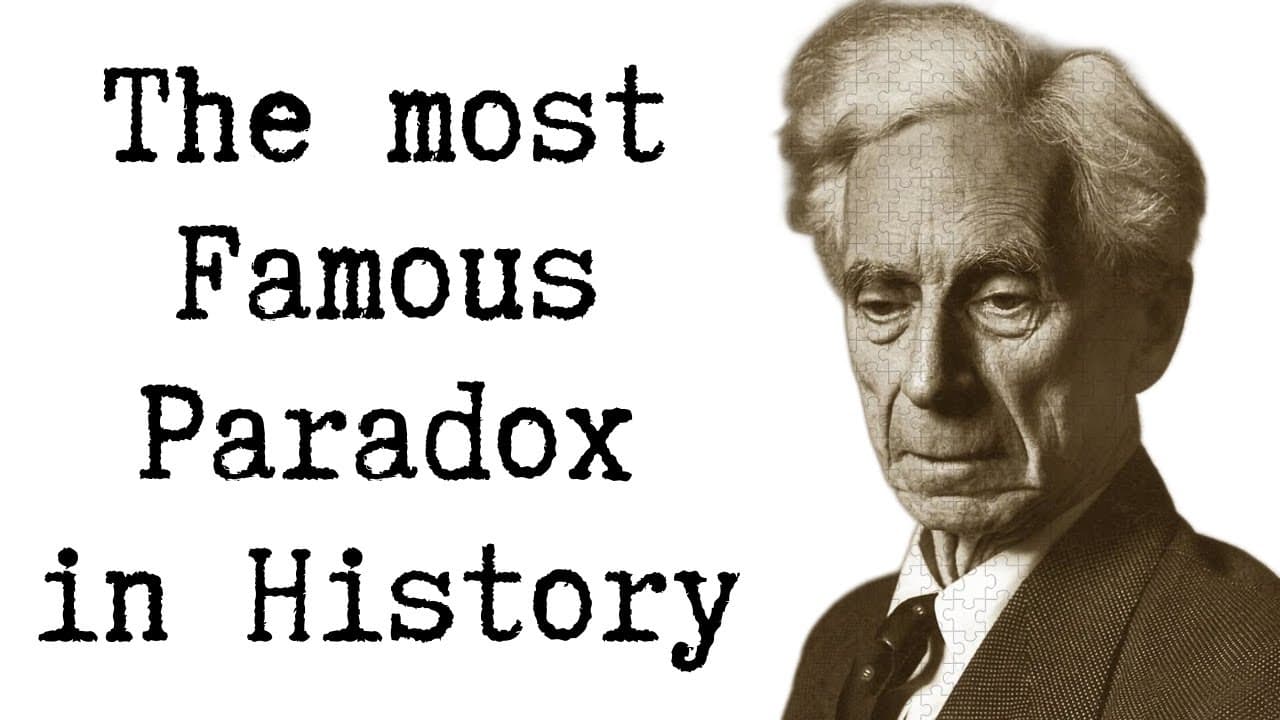
Russell’s Paradox is a logical problem discovered by Bertrand Russell in 1901 that arises from set theory’s own rules. The lecture introduces naive set theory in roughly eight minutes and argues that Russell and other mathematicians did not actually solve the paradox. Because set theory is presented as foundational to mathematics and science, the problem has unusually broad significance. Read on to understand the definitions and rules behind it.
Transcript
in 1901 the english philosopher and mathematician bertrand russell discovered a problem a paradox at the heart of mathematics and all of science the paradox specifically concerns a foundational branch of mathematics called set theory so in this lecture i teach you all of set theory in like eight minutes and then i show how the paradox arises russel... Read More
Key Insights
- Russell's Paradox was discovered in 1901 by Bertrand Russell, the English philosopher and mathematician, and it concerns set theory, a foundational branch of mathematics. Because set theory underlies mathematics, the problem reaches into all of science, not just one specialized corner of math.
- Logicism is the view developed by Gottlob Frege and Bertrand Russell that mathematics is a branch of logic and that arithmetic, the most basic type of math, can be reduced to first order basic logic plus set theory. Its payoff would be answering what a number is: numbers are sets.
- Immanuel Kant, a Prussian philosopher living in the 1700s, thought mathematics was a construction of the human mind, which makes mathematical truths subjective in some sense. Frege and Russell disliked this because they held that mathematics had to be objective, and logicism was their counteraction.
- Set theory was invented in the 1870s by Georg Cantor, the Russian German mathematician, and not as a mathematical game for its own sake. He needed it to prove that some infinities are larger than other infinities, meaning you can have two infinite collections with more in one than the other.
- A set is a collection of objects whose members need not be gathered together in space or time and need not be related to each other in any meaningful way. A set can contain LeBron James and the top half of the Eiffel Tower, or a real person and the fictional Harry Potter.
- Set identity is determined by membership alone, which is the axiom of extensionality. From this follow the rules that order does not matter, that repeated members change nothing, and that how you describe a member does not matter, so the set of LeBron James equals the set of the NBA all-time scoring leader.
- Unrestricted composition, called the axiom of unrestricted comprehension in formal set theory, says any set you can think of is a set. From it follow the rules that the union of two or more sets is itself a set and that any subset of a set is also a set.
- A singleton set contains exactly one member and is not identical to that member. The singleton set containing LeBron James is a zero-time NBA champion even though LeBron James is a four-time NBA champion, showing that a set and its lone member have different properties.
Install to Summarize YouTube Videos and Get Transcripts
Explore YouTube Video Summarizer or Get YouTube Transcript Extractor
Questions & Answers
Q: What is Russell’s Paradox in set theory?
Russell’s Paradox is a logical problem that arises from the rules of set theory, a foundational branch of mathematics. Bertrand Russell discovered it in 1901, and Jeffrey Kaplan argues that Russell and other mathematicians did not actually solve it.
Q: Why is Russell’s Paradox important?
The paradox concerns set theory, which the lecture describes as foundational to mathematics. It is therefore presented as a problem at the heart of mathematics and science rather than an isolated mathematical puzzle.
Q: What is a set in set theory?
A set is a collection of objects, and its members do not need to be together in space or time or meaningfully related. For example, a set can contain LeBron James and the top half of the Eiffel Tower, or LeBron James and the fictional Harry Potter.
Q: Who invented set theory and why?
Georg Cantor, described as a Russian German mathematician, invented set theory in the 1870s. He needed it to prove that some infinities are larger than other infinities.
Q: What is naive set theory?
Naive set theory is ordinary set theory formulated in an ordinary language such as English. It is contrasted with formal or axiomatic set theory, which is formulated in an artificial logical language.
Q: What is logicism?
Logicism is the view developed by Gottlob Frege and Bertrand Russell that mathematics is a branch of logic. They believed arithmetic could be reduced to first-order basic logic and set theory, allowing numbers to be understood as sets.
Q: Why did Frege and Russell develop logicism?
Immanuel Kant held that mathematics was a construction of the human mind, making mathematical truths subjective in some sense. Frege and Russell believed mathematics had to be objective, so they developed logicism to counter that view.
Q: How are sets written and described?
Squiggly brackets identify a set, with the items inside them representing its members. For large collections such as all cats, set-builder notation describes the set as all objects satisfying a condition instead of listing every member.
Summary & Key Takeaways
-
Bertrand Russell discovered a paradox in 1901 at the heart of mathematics and all of science, specifically concerning set theory. The lecture teaches set theory in roughly eight minutes, shows how the paradox arises from the rules, and argues that Russell and other mathematicians did not really solve it despite thinking they had.
-
The motivation is the question of what a number is. Immanuel Kant, a Prussian philosopher of the 1700s, held that mathematics is a construction of the human mind, which makes mathematical truths subjective. Gottlob Frege and Bertrand Russell rejected this and developed logicism, the view that mathematics is a branch of logic.
-
A set is a collection of objects, and its members need not be together in space or time, nor related in any meaningful way. Sets can contain a basketball player and part of a tower, real and fictional things together, and even the set of all objects that cannot be imagined.
-
Naive set theory runs on rules including unrestricted composition (any set you can think of is a set), set identity determined by membership, order not mattering, repeats not mattering, descriptions not mattering, unions being sets, subsets being sets, and singleton sets containing exactly one member.
Read in Other Languages (beta)
Share This Summary 📚
Summarize YouTube Videos and Get Video Transcripts with 1-Click
Try YouTube Summary with ChatGPT & Claude or YouTube Transcript Generator
Explore More Summaries from Jeffrey Kaplan 📚




Summarize YouTube Videos and Get Video Transcripts with 1-Click
Try YouTube Summary with ChatGPT & Claude or YouTube Transcript Generator